Rudrabhishek
What is Rudrabhishek?
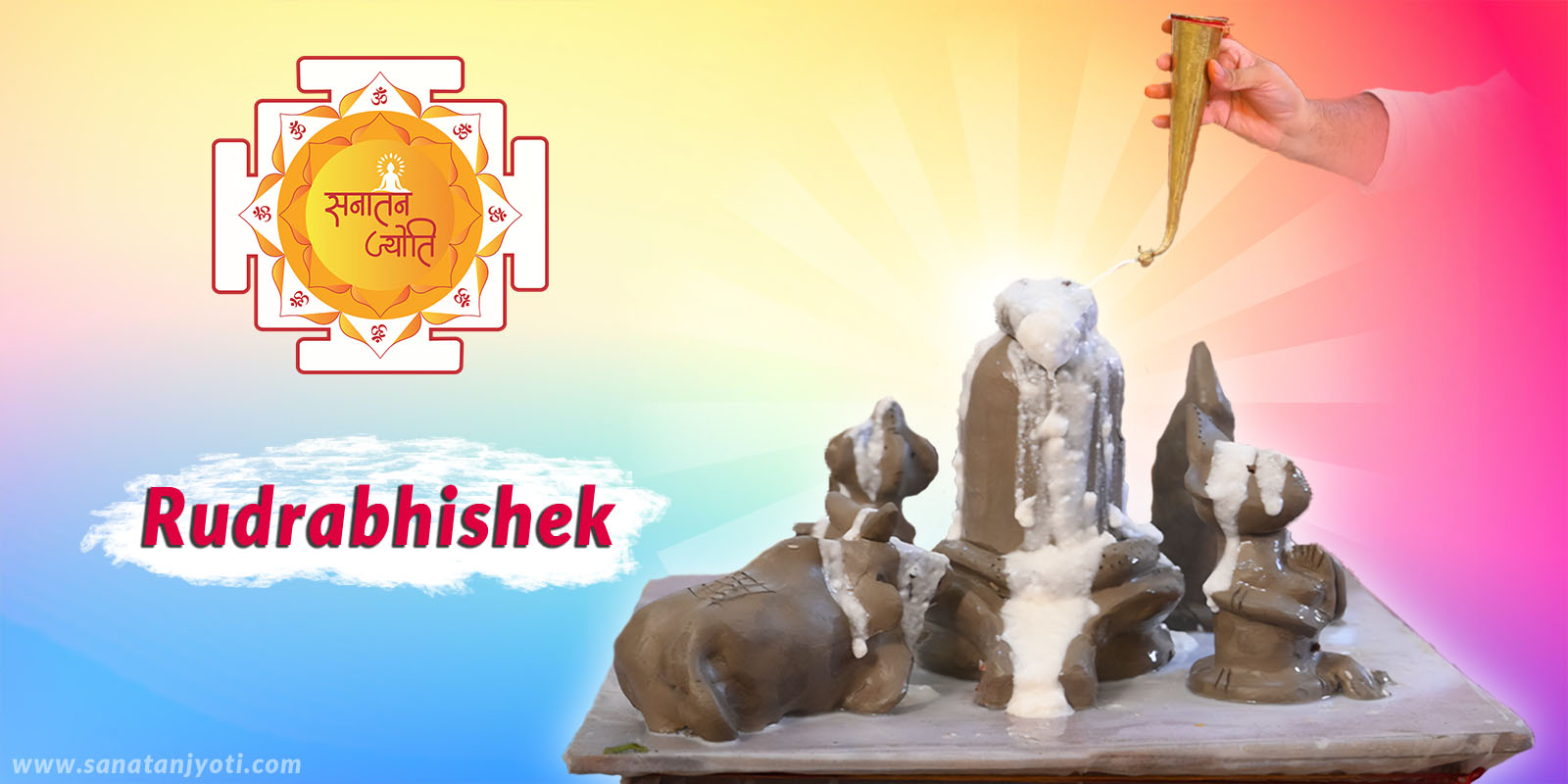
Rudrabhishek means the coronation of Lord Rudra, i.e., Shiva. The word Abhishek means to bathe. On Earth, Lord Shiva's form is in the Shivalinga; thus, bathing the Shivalinga with various herbs and substances (water, milk, Panchamrit, sugarcane juice, coconut water, Ganga water, etc.) is called Rudrabhishek. It holds a significant place among the various beneficial Anushthan (Ritual) traditions of Sanatan Dharma. The word 'Rudra' is used because He destroys 'Rutam' (sorrow) completely.
Why is Rudrabhishek considered a special worship?
By performing Rudrabhishek, a person attains their desired results. That is, whatever goal or wish a person has in mind while performing the Rudrabhishek—even if it is rare or difficult to attain—can be fulfilled with ease.
In the Vayu Purana, the greatness of Rudrabhishek is described to such an extent that it states: the merit obtained from a single recitation of Rudrabhishek far exceeds the merit of donating an entire, prosperous Earth filled with wealth and grains.
Through the chanting (japa), recitation (patha), and ceremonial bathing (abhishek) involved in Rudrabhishek, a person is blessed in this very life with devotion to God, peace, the blessing of children, abundance of wealth and grains, and excellent health. Furthermore, after death, they attain a noble afterlife and ultimate liberation (Param Moksha). To enhance the effectiveness of this ritual, seekers can also recite the Shiva Sahasranama. Furthermore, fo r attaining a complete protective shield, performing the Amogh Shiva Kavach ritual is considered extremely beneficial.
Which idols are created during Rudrabhishek?
In Rudrabhishek, idols of the Shiva family are created. First, an idol of Lord Ganesha is made. After that, idols of Goddess Parvati, Lord Kartikeya, Nandi, and the serpent, along with the Shivlinga, are prepared.
The three types of Rudrabhishek are as follows:
Laghu Rudrabhishek, Ati Rudrabhishek, and Maha Rudrabhishek differ in the number of recitations and the scale of the ritual.
Laghu Rudrabhishek: When a priest performs 11 recitations of the Ekadashini Rudri, it is known as the Laghu Rudra Anushthan.
Maha Rudrabhishek: When a priest performs 121 recitations of the Ekadashini Rudri (i.e., 11 Laghu Rudras), it is called the Maha Rudra Anushthan.
Ati Rudrabhishek: When a priest performs 1,331 recitations of the Ekadashini Rudri (i.e., 11 Maha Rudras), it is known as the Ati Rudra Anushthan .
Benefits of Rudrabhishek
Rudrabhishek puja eliminates negativity from the home and life, creating positive effects everywhere.
1. All sins are destroyed, and the blessings of Lord Shiva are attained.
2. Since all deities reside in Lord Rudra, Rudrabhishek pleases all gods, and the person receives their blessings.
3. Performing Rudrabhishek provides relief from various astrological obstacles such as Kalsarp Yoga, Planetary Peace Related Problem, and any complex Family Related Problem (such as domestic dis cord).
4. This ritual is extremely effective for physical ailments and provides a spiritual solution to any chronic Health Related Problem, infusing the seeker with new energy.
5. It provides relief from business losses and fulfills all wishes in a short time.
What benefits does the Abhishek of Shiva with various substances bring?
To make one’s life happy and to please Lord Shiva, one should perform Yajna (sacred rituals) with a selfless attitude (nishkam bhav). This leads to the attainment of infinite blessings. According to the scriptures, to fulfill various desires and to receive the grace of Lord Sadashiva, his Abhishek (ritual bathing) is performed with different sacred substances. Let us now understand—which substance should be used for Lord Shiva’s Abhishek to attain specific results or fulfill particular desires?
The instructions are as follows:-
• If a person desires rainfall, they should perform Rudrabhishek with water.
• To gain relief from diseases, one should perform Abhishek with water containing Kusha grass leaves (Kushodaka).
• A person who wishes to acquire livestock should perform Abhishek with curd (yogurt).
• For the blessings of Goddess Lakshmi (wealth and prosperity), one should perform Abhishek with sugarcane juice.
• To attain wealth, Abhishek should be done with honey and ghee, and for liberation (moksha), it should be done with holy water from sacred pilgrimages.
• Those who wish for a son should perform Abhishek with milk.
• A woman who has no children, has only one child, or whose children die shortly after birth should perform Rudrabhishek of Lord Shiva with cow's milk. Abhishek with cow’s milk is believed to lead to the early birth of a son—this is beyond doubt.
• To gain sharp and noble intellect, one should perform Abhishek with milk mixed with sugar.
• Performing Abhishek with mustard oil leads to the destruction of enemies.
Procedure for performing Rudrabhishek
Rudrabhishek is highly rewarding, but when performed correctly, its effects become even more powerful. Before starting the Rudrabhishek Puja, one must first worship Lord Ganesha to remove any obstacles or hindrances. After that, a Sankalp (resolve) is taken, where you declare to Lord Shiva the intention or desire for which you are performing the Rudrabhishek—such as for health, peace, or the fulfillment of a specific wish. As part of the Rudrabhishek Puja, a Shivlinga and the Shiva family are made using pure, smooth clay. The Shivlinga, along with the idols of the divine family, should be placed facing north. Then, sit facing east and begin by bathing the Shivlinga with Ganga water. Next comes the Abhishek (ritual bathing). One by one, offer milk, curd, honey, ghee, sugarcane juice, sandalwood paste, and Panchamrit on the Shivlinga. During the entire Abhishek, you should continuously chant "Om Namah Shivaya". Once all the offerings are made, decorate the Shivlinga with Bilva leaves, flowers, Datura, and sacred ash (Bhasma). If possible, immerse yourself in devotion and chant the Rudrashtadhyayi or the Mahamrityunjaya Mantra. After this, light a lamp and perform the Aarti of Lord Shiva, offering sweets or fruits as Prasad. Any leftover Abhishek water or Panchamrit may be lightly sprinkled on the devotees present or offered in small amounts as sacred Prasad. It is especially beneficial to have the Rudrabhishek performed by a skilled and qualified Acharya (priest).
Worship materials
Essential worship materials for Rudrabhishek
1. Pure Water (Ganga Jal)
2. Milk
3. Curd (Yogurt)
4. Honey
5. Ghee (Clarified Butter)
6. Sugarcane Juice
7. Bilva Leaves (with three leaflets)
8. Aak, Datura (fruit and flower), Bhang (hemp leaves)
9. Sandalwood Paste
10. Black Sesame Seeds
11. Sacred Thread (Janeu)
12. Incense and Lamp (Dhoop, Deep)
13. Fruits and Sweets
14. Flowers
15. Naivedya (Food Offering)
16. Sacred Ash (Bhasma/Vibhuti)
17. Amir (scented powder) and Gulal (coloured powder)
18. Powdered Sugar
19. Lotus Seeds (Kamal Gatta)
20. Shami Leaves
21. Rice Grains (Akshat)
22. Panchamrit (a mixture of milk, curd, ghee, honey, and sugar)
Frequently Asked Questions
1. What is Rudrabhishek and why is this worship considered so special?
Rudrabhishek is an extremely powerful Vedic ritual in which Lord Shiva is bathed with various sacred substances. During the Abhishek performed on the Shivling with water, milk, Panchamrit, honey, Ganga water, etc., the chanting of “Om Namah Shivaya” not only purifies the mind but also resolves all spiritual, material, and karmic problems. The Vayu Purana considers it even superior to donating the Earth itself.
2. What are the benefits of Rudrabhishek?
• Removal of domestic conflicts, obstacles, and business losses
• Destruction of sins and attainment of Lord Shiva’s blessings
• Fulfilment of desires related to health, wealth, progeny
• Remedies for astrological issues like Kaal Sarp Dosh and planetary defects
• Spiritual upliftment and attainment of salvation
Properly performed Rudrabhishek with true devotion makes life completely auspicious.
3. What is the significance of different substances used in Rudrabhishek?
According to scriptures, different substances are used based on the devotee’s desires:
• Water – For rain or peace
• Milk – For progeny
• Honey/Ghee – For wealth and prosperity
• Sugarcane juice – For opulence
• Mustard oil – For destruction of enemies
• Panchamrit – For complete purification and well-being
This selection is made as per the specific wish of the devotee.
4. How many types of Rudrabhishek are there and what are the differences between them?
There are three main types of Rudrabhishek:
• Laghu Rudra: 11 recitations of Rudri
• Maha Rudra: 121 recitations (11 times Laghu Rudra)
• Ati Rudra: 1331 recitations (11 times Maha Rudra)
The greater the number and intensity of recitations, the more powerful and fruitful the ritual is considered.
5. Can Rudrabhishek be performed from home as well?
Yes, in today’s time, if someone lacks time or space, Rudrabhishek can be performed from home by experienced priests. Through online booking, arrangements for pooja materials, auspicious timing, and qualified Brahmins are made so that this divine ritual can be performed methodically allowing the devotee to receive full blessings and merit.





 +91 9219765437