
Nagula Chavithi 2026 will be observed on Friday, November 13, 2026. It is an important religious festival in South India, during which Nag Devatas are worshipped. The festival holds particular significance in Telugu tradition.
Nagula Chavithi is considered similar to Nag Panchami, which is observed in North India. On this day, married women observe a Vrat and worship the Nag Devatas, praying for the happiness and prosperity of their families and for the long life and good health of their children.
For more information about Nag Panchami, read our article: -When is Nag Panchami 2026?
Nagula Chavithi is also considered significant for farmers. Given the important role of snakes in agriculture, this day is observed as an occasion to express gratitude and offer prayers to the Nag Devatas.
When is Nagula Chavithi 2026?
Nagula Chavithi 2026 will be observed on Friday, November 13, 2026.
The festival is celebrated across South India with faith and devotion. There is a tradition of worshipping the Nag Devatas on this day and praying for the happiness, prosperity, and well-being of the family.
Religious Significance of Nagula Chavithi
Nagula Chavithi is an important religious festival in South India. On this day, married women observe a Vrat and worship the Nag Devatas. According to traditional beliefs, women perform this Puja to pray for the long life and good health of their family members, especially their children.
The festival is also considered important for farmers. Snakes help control rats and other rodents that can damage crops. During winter, when snakes emerge from their burrows and hunt rodents, they help protect agricultural fields and crops.
Snakes are also traditionally believed to contribute to maintaining soil fertility. For this reason, farmers worship the Nag Devatas with faith and devotion and pray for the protection and prosperity of their crops.
Nagula Chavithi Puja Vidhi
No specific elaborate Puja Vidhi has been prescribed for Nagula Chavithi, but the festival is traditionally observed in a simple and devotional manner.
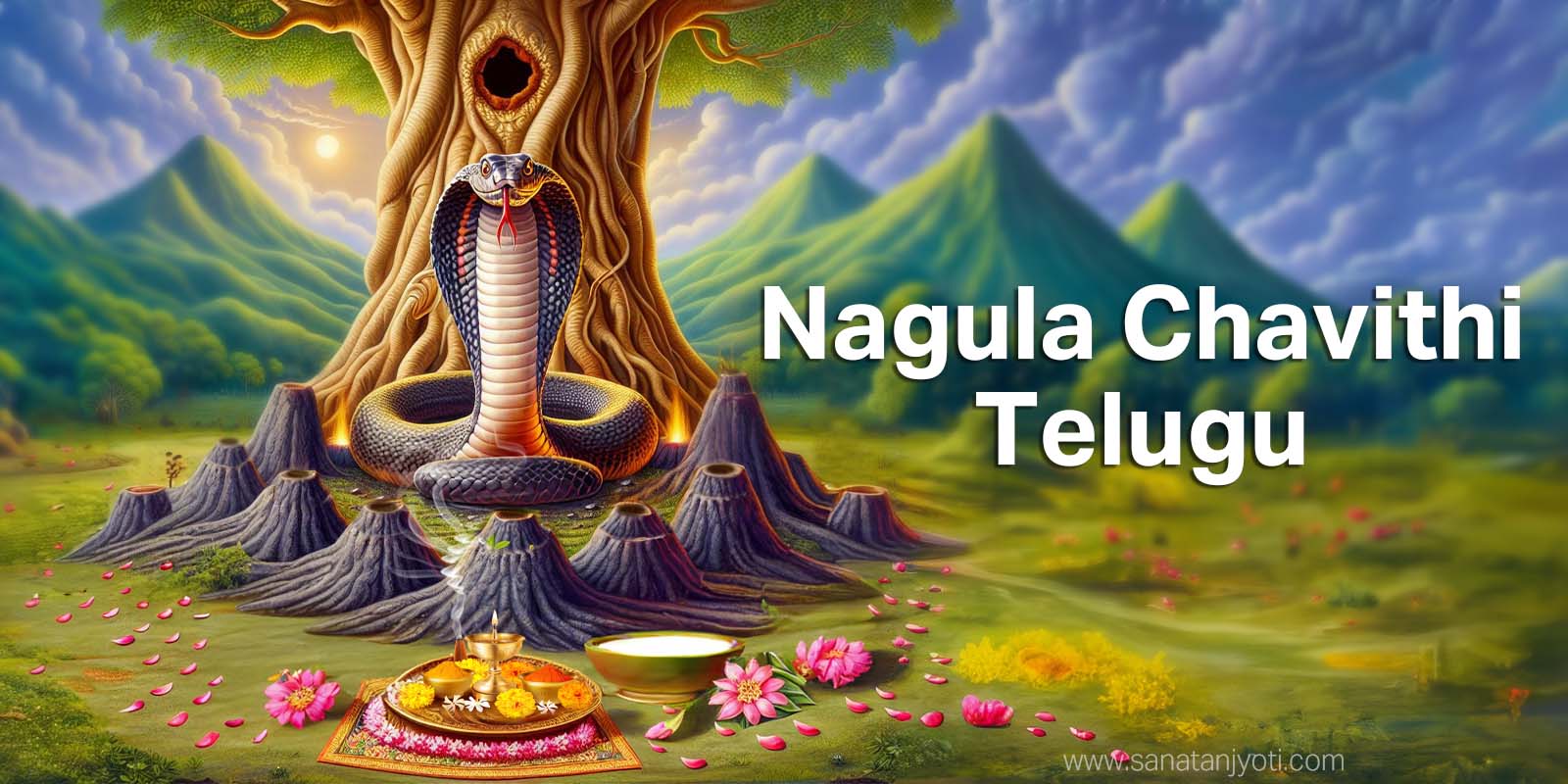
Take a bath in the morning and wear clean clothes. Then place an idol or image of a Nag Devata at the Puja place. Worship the Nag Devata with devotion by offering cow's milk, flowers, turmeric, Kumkum, sesame laddoos, and other Prasad.
During the Puja, take a Sankalp and pray for the happiness and prosperity of the family and the long life of the children. There is also a tradition of offering Prasad near snake burrows after the Puja.
After completing the Puja, observe the Vrat and distribute the Prasad. Devotees also pray to the Nag Devata to continue showering blessings upon their families.
Nagula Chavithi Vrat Katha
Kadru, the daughter of Daksha, was married to Sage Kashyapa. Pleased with her devotion and service, Sage Kashyapa asked Kadru to seek a boon. Kadru asked for the blessing of having one hundred sons. As a result, she was blessed with one hundred serpent sons.
Once, during the churning of the ocean, a beautiful white horse emerged from the Samudra Manthan. Seeing the horse, Kadru told her co-wife Vinata that the horse was very beautiful but was not completely white because its hair was black. Vinata replied that the horse was completely white, including its hair.
The two began arguing over this matter. Kadru then said that if she could prove that the horse's hair was black, Vinata would have to become her servant. If the hair was white, Kadru would become Vinata's servant.
Vinata agreed to the challenge. However, Kadru had a deceptive plan in mind. She instructed her serpent sons to make themselves very small and hide among the horse's hair so that the hair would appear black. When the sons heard their mother's plan, they told her that she was abandoning Dharma and choosing the path of Adharma. They refused to carry out her command.
Angered by her sons' refusal to obey her, Kadru cursed them, saying that when a king named Janamejaya from the Pandava lineage performed a Sarpa Yajna in the future, all of them would be destroyed in that sacrifice.
Frightened by their mother's curse, the Nagas went to Lord Brahma. He reassured them and said that in the future, a king named Jaratkaru would be born. He advised them to marry their sister to him. From their union, a son named Astika would be born, and he would stop the Sarpa Yajna performed by Janamejaya.
In time, this prophecy came true. When King Janamejaya learned that snakes were responsible for the death of his ancestors, he resolved to destroy the entire serpent race. He began performing a Sarpa Yajna for the destruction of all snakes.
When Astika learned that his maternal uncles were in danger, he went to the sacrificial ceremony and stopped the Yajna. In this way, Astika brought the sacrifice to an end, freed the serpents from fear, and protected their lives. Since then, this day has traditionally been observed as Nagula Chavithi, a festival associated with the protection and worship of snakes.
On this day, devotees traditionally draw images of Sheshnag, Takshak Nag, Vasuki Nag, and other Nag Devatas on a wall and worship them by offering turmeric, Akshat, Roli, and flowers. Raw milk mixed with Ghee is also offered while remembering the Nag Devatas.
According to traditional beliefs, women who worship the Nag Devatas with complete devotion on this day receive protection from the fear of snakes for their families. It is also believed that the blessings of Lord Shiva, Lord Vishnu, and the Nag Devatas remain upon their homes.
According to these religious beliefs, when a family receives the blessings of all three divine powers, sorrow does not reside in the household, and the family is blessed with happiness and prosperity.
Worship of Nag Devatas on Nagula Chavithi
On Nagula Chavithi, there is a tradition of drawing images of Sheshnag, Takshak Nag, Vasuki Nag, and other Nag Devatas on a wall and worshipping them.
The Nag Devatas are offered turmeric, Akshat, Roli, and flowers. Raw milk mixed with Ghee is also offered while remembering and invoking the blessings of the Nag Devatas.
According to traditional beliefs, women who worship the Nagas with devotion on this day receive protection from the fear of snakes for their families. It is also believed that their homes continue to receive the blessings of Lord Shiva, Lord Vishnu, and the Nag Devatas.
In religious tradition, the blessings of these three divine powers are associated with happiness, prosperity, and the well-being of the family.