
Namkaran Muhurat
The arrival of a newborn fills a family with immense joy, new hopes, and positive energy. Among the sixteen sacraments of Sanatan Hindu Dharma, 'Namkaran' is that significant milestone where a child receives his distinct identity and a dignified place in society. It is not just a process of choosing a name; it is the first spiritual step toward shaping the child's personality and future destiny. At Sanatan Jyoti, we provide the most accurate timing to connect this special day of your child with astrological purity and divine blessings. The auspicious time determined by our experienced acharyas connects your child's sacraments with the divine power of the planets, paving the way for good fortune, fame, and health in his life. Consult our experts today for a blessed start to your child's first sacrament.
Namkaran Muhurat
Namkaran Muhurat
Auspicious Dates and Time for Naming Ceremony
Book Your Muhurat to Unlock Up to 90% OFF on Talk to Astrologer
Namkaran Muhurat
In Sanatan culture and Vedic tradition, the Namkaran Sanskar is considered the fifth and most essential sacrament. According to the scriptures, a 'name' is not just a means of calling someone, but functions like a sound mantra that influences the person's subconscious mind and entire life. It is necessary to perform this through Vedic Namkaran Muhurat Consultation because the vibrations of the planets and constellations at the time of birth have a deep impact on the child's mental and physical health. A name kept at the right time opens the doors to success, fame, and prosperity in the child's life.
At Sanatan Jyoti, our senior astrologers conduct a microscopic analysis of the ancient panchang and the child's birth chart. Our goal is to provide you with that Accurate Namkaran Muhurat Consultation which ensures happiness, health, and longevity for your child. Along with Namkaran, plans for upcoming sacraments such as Mundan Muhurat, Annaprashan Muhurat, and future Upanayan Muhurat can also be made on an astrological basis. You can get information about the movement of your child's stars through the daily Rashifal and detailed planetary descriptions here.
According to astrology, Namkaran Muhurat Consultation is that specific and auspicious time period determined after the purification of the five limbs of the Panchang—Tithi, Vara, Nakshatra, Yoga, and Karana. According to Hindu scriptures, performing this ritual on the 10th or 12th day of the child's birth is considered best. The main reason behind this is 'Sutika Shuddhi' (purification after childbirth). For 10 days after birth, both the mother and the child are physically sensitive, and only after the completion of the purification process on the 10th day are they allowed to participate in divine tasks.
- Divine Alignment of Fortune and Identity: Personalized Namkaran Muhurat Consultation ensures that the child's name aligns perfectly with his birth sign and Nakshatra quarters. When the first letter of the name is favorable to the Nakshatra, it provides strength to the child's destiny.
- Psychological Building of Personality: A meaningful and melodious sounding name boosts the child's self-confidence. An astrologically correct name brings gentleness to the child's nature and intelligence in behavior.
- Impenetrable Protection from Negative Energy: Invoking deities and the Navagrahas during an auspicious muhurat creates a protective shield around the infant. This shield protects him from external negative influences, diseases, and Bhadra defects.
- Social Prestige and Fame: A name kept according to Namkaran Ceremony Muhurat Consultation not only gives the child a unique identity in society but also connects him with the spiritual energy of his lineage and clan.
Our Namkaran Muhurat Expert team does not just look at superficial dates while determining the muhurat; they follow deep and subtle standards of astrological calculation certified by our sages for centuries. While deriving the Kundli Based Namkaran Muhurat, we conduct a microscopic analysis of the following main pillars:
The choice of auspicious days is extremely important for Namkaran. Monday (for mental peace), Wednesday (for intellect), Thursday (for knowledge), and Friday (for luxury) are considered most auspicious. During calculation, we completely avoid 'Rikta' dates through the Panchang Calendar.
The 'Name Letter' is selected based on the constellation the Moon is in at the time of birth. For Namkaran Muhurat by Astrologer, top priority is given to constellations like Mrigashira, Hasta, Chitra, Swati, Anuradha, and Revati. We specifically ensure that the transit of the Moon at the time of the ritual is not in the 4th, 8th, or 12th house from the child's sign.
We pay special attention to cosmic obstacles. In muhurat selection, we discard inauspicious times like Rahu Kaal, Yamaghant, and Kharmas. Additionally, we subtly consider the status of Choghadiya Muhurat and Hora Muhurat so that every moment of the main Anushthan is filled with divine energy.
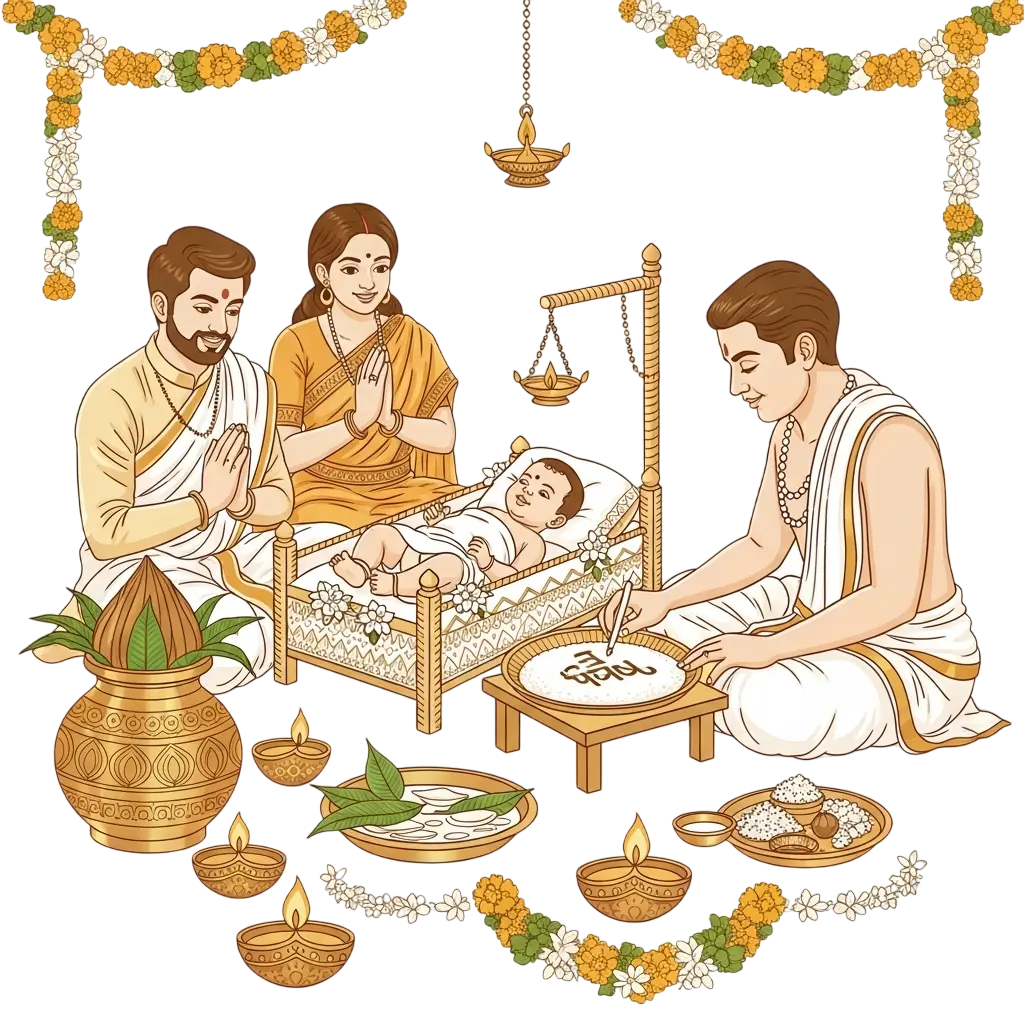
The spiritual benefit of a successful Namkaran is attained only when it is performed with classical Puja Vidhi and full devotion. Here are the main steps of the ritual:
- Purification: The mother and child are given a holy bath and the house is purified with mantras.
- Divine Invocation: First, Lord Ganesha, the family deity, and the Navagrahas are worshipped.
- Naming the Infant: This is the main part of the ritual. The father whispers the name slowly into the child's right ear three times with the help of a gold ring or Kusha grass.
- Blessings and Donation: Elders shower flowers on the infant and donations are made according to capacity.
We consider your child's first sacrament not just a tradition, but a divine experience. Our Online Namkaran Muhurat Service is a unique confluence of modern technology and ancient Vedic knowledge.
- Horoscope Based Accurate Analysis: We ensure Kundli Based Namkaran Muhurat Booking by studying every house of the child's Kundli.
- Online Namkaran Muhurat Consultation: You can Get Namkaran Muhurat Online from any corner of the world through our website and get solutions to your doubts.
- Convenient Booking: Easily Book Namkaran Muhurat Consultation or Book Namkaran Muhurat Expert on our website in a very short time.
- Personalized Discussion: You can directly use the Talk to Astrologer for Namkaran Muhurat option.
- Complete Solution: We are with you at every step, from Namkaran Muhurat Consultation Booking to the method. You can secure your child's future through our Online Namkaran Muhurat Service Booking. You can also avail of the Book Astrologer for Namkaran Muhurat service for this.
Namkaran Muhurat is the best time when cosmic energies are most favorable for the infant's development. A name given at this time provides a positive direction to the child's personality and fortune.
A personalized muhurat is determined based on the child's birth Kundli, Nakshatra, and Rashi. Our acharyas provide Personalized Namkaran Muhurat Consultation by analyzing the date and exact time of birth.
Maintain complete purity in the house on this day. Dress the infant in new clothes. This ritual is prohibited during eclipse or Sutak periods. Family members should remain happy.
Its primary objective is to bring divine blessings to the newborn and connect him with his spiritual roots. Performing Namkaran in an auspicious muhurat brings stability and confidence to the child's life.
Yes, at Sanatan Jyoti, we use traditional Panchang and modern astronomical calculations. Our service is as accurate and effective as an in-person consultation.