
Upanayana Muhurat
In the sixteen sacraments of Sanatan Dharma, the Upanayana Sanskar is that significant turning point in a child's life where his spiritual and intellectual journey truly begins. Also known as the Yagyopavit or Janeu Sanskar, it prepares the child to walk the path of discipline, knowledge, and righteousness (Dharma). At Sanatan Jyoti, we provide an accurate muhurat to complete this sacred sacrament of your child with astrological purity and the auspicious influence of the planets. The muhurat selected by our experienced acharyas provides a positive astrological foundation for the child's academic journey and intellectual advancement, helping to secure his future. Consult our experts today to ensure the auspiciousness of your child's sacrament.
Upanayana Muhurat
Upanayana Muhurat
Auspicious Dates and Time for Upanayana Ceremony
Book Your Muhurat to Unlock Up to 90% OFF on Talk to Astrologer
Upanayana Sanskar Muhurat
In Indian culture, the Upanayana Sanskar is considered the 'second birth' (Dvija) of a child. The word 'Upanayana' means 'to bring close'—that is, taking the child from the darkness of ignorance toward the light of the Guru and knowledge. It is mandatory to perform this through Vedic Upanayana Muhurat Consultation so that the child can receive the rules of the Brahmacharya Ashram and the energy of a spiritual life. This sacrament is not just a ritual of wearing a thread, but it is the cornerstone of the child's character building.
At Sanatan Jyoti, our senior astrologers conduct a profound analysis of the ancient Panchang and the child's personalized birth chart. Our goal is to provide you with that Accurate Upanayana Muhurat Consultation which provides success in education, excellent health, and mental fortitude to the child. Along with the Upanayana Sanskar, plans for other auspicious events such as Mundan Muhuratand Naming Muhuratare also made on an astrological basis. You can also get information about planetary positions through the daily Horoscope and detailed Planet Details.
According to astrology, Upanayana Muhurat Consultation is the time when cosmic energies are most favourable for the child's intellectual development. This sacrament, performed at an auspicious time, awakens the child's subtle body and makes him capable of receiving the power of the Gayatri Mantra.
- Intellectual Development: Wearing the Janeu at the right time leads to a wonderful increase in the child's memory and concentration.
- Protection from Negative Energy: The power of the sacred Yagyopavit and mantras creates a protective shield around the child, protecting him from bad company and negative thoughts.
- Mitigation of Planetary Doshas: Personalized Upanayana Muhurat Consultation ensures that the influence of inauspicious planets in the child's chart does not fall on his education and health.
- Discipline and Dharma: This sacrament makes the child aware of his duties and makes him realize his responsibilities toward society.
Our Upanayana Muhurat Expert team conducts a microscopic analysis of the child's age and planetary positions. While determining the muhurat, the following main pillars are kept in mind:
According to the scriptures, the Upanayana Sanskar is performed in odd years (5th, 7th, 9th, or 11th year). During the calculation, we select auspicious days (Sunday, Monday, Wednesday, Thursday, Friday) and auspicious dates (2nd, 3rd, 5th, 10th, 11th, 12th) through the Panchang Calendar.
For Janeu Sanskar Muhurat, priority is given to stable and gentle constellations like Hasta, Chitra, Swati, Anuradha, Shravan, Dhanishta, and Revati. The compatibility of Chandra Bala and Tara Bal is checked from the child's sign so that the full benefit of the sacrament can be obtained.
For Yagyopavit, it is considered mandatory for the Sun to be in 'Uttarayana' (Northern Transit), as the Sun's energy is superior for knowledge-seeking during this time. We ensure that Jupiter (Brihaspati) and Venus are not combust (Asta) at the time of the sacrament, as they are the main significators of education and knowledge.
In muhurat selection, Bhadra, Rahukaal, and decaying dates (Kshaya Tithis) are completely avoided. Additionally, we also consider Choghadiya Muhurat and Hora Muhurat so that the moment of the main ritual is faultless.
The full benefit of an Auspicious Upanayana Muhurat Consultation is attained only when the Ritual is performed according to the classical method:
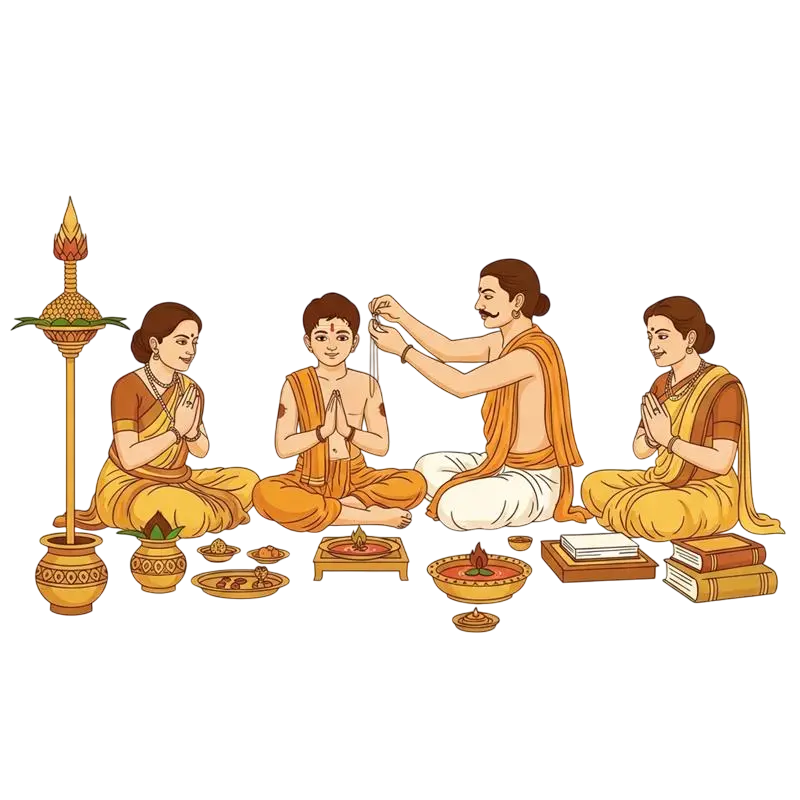
- Mundan and Bath: As a symbol of purification, the child's head is shaved (Mundan) and he is bathed with holy water.
- Yagyopavit Dharan: Before the sacrificial fire (Havan), the Guru makes the child wear the triple-threaded Yagyopavit, which symbolizes Dev-rin (debt to deities), Rishi-rin (debt to seers), and Pitra-rin (debt to ancestors).
- Gayatri Upadesh: The Guru whispers the supreme holy Gayatri Mantra into the child's ear, which gives him the power to walk the path of knowledge.
- Mekhla and Danda Dharan: A Mekhla (waistband) is tied around the child's waist and he is given a staff (Danda), which is a symbol of his vow of celibacy (Brahmacharya) and protection.
- Bhikshatan: The child seeks alms (Bhiksha) from his mother and other elders, which develops qualities of humility and self-reliance in him. For a detailed Puja Vidhi, you can contact us.
- Spiritual Benefits: Wearing the Yagyopavit gives the child the right to study the Vedas and perform Sandhya Vandan. It increases his spiritual strength.
- Scientific Benefits: By wrapping the Janeu on the ear and placing pressure on specific points of the body, blood pressure remains controlled and memory becomes sharp.
- Mental Stability: Constant chanting of the Gayatri Mantra keeps the nerves of the child's brain calm and removes stress.
We secure your child's sacraments with astrological science. Through our Online Upanayana Muhurat Service, you can get superior consultation from any corner of the world.
- Personalized Consultation: Accurate determination of Horoscope-based Janeu Muhurat Booking for the child.
- Experienced Acharyas: Our astrologers microscopically analyze Bhadra, Jupiter-Venus combustion, and other complex defects.
- Online Upanayana Muhurat Consultation: You can Get Online Upanayana Muhurat from the comfort of your home and resolve your doubts.
- Convenient Booking: Easily Book Upanayana Muhurat Consultation or Book Yagyopavit Muhurat Expert on our website.
- Simple Process: You can directly Talk to Astrologer for Upanayana Muhurat and ensure your Janeu Sanskar Muhurat Booking.
According to the scriptures, the Upanayana Sanskar is generally performed in an odd year (5, 7, 9, 11). The best muhurat is finalized only after a Birth Chart examination by a qualified Acharya so that the ritual can be performed at an auspicious time.
Before the Upanayana Sanskar, the purification of the home, arrangement of the worship place, availability of the Yagyopavit, and preparation of the necessary worship materials are done. Proper preparation makes the entire process organized and fruitful.
The Yagyopavit is a symbol of the beginning of knowledge, discipline, and celibacy (Brahmacharya). Wearing it inspires the child to walk the path of Vedic study, self-study, and righteous conduct. This sacrament is the basis for mental purity and spiritual progress.
While determining the best muhurat, the Nakshatra, Tithi, Day, Yoga, Lagna, and Chandra Bala are analyzed. Rahukaal, Bhadra, and inauspicious yogas are avoided. Experienced Acharyas determine the best muhurat based on all these standards.
After the sacrament, the child must regularly chant the Gayatri Mantra, perform Sandhya Vandan, respect the Guru's orders, and follow a disciplined routine. These rules are necessary for his personality building and spiritual development.