
Vivah Muhurat
Vivah Muhurat is the auspicious time when the energy of planets, constellations, and time is considered most favorable for a sacred ritual like marriage. According to astrology, a marriage performed at the right muhurat increases the possibilities of happiness, harmony, and prosperity in married life. Generally, people decide the wedding date just by looking at the Panchang, whereas the Acharyas of Sanatan Jyoti determine the Vivah Muhurat based on a deep analysis of the birth charts of the bride and groom, planetary positions, tithi, nakshatra, and lagna. It is this personalized and detailed calculation that sets it apart from a general muhurat, ensuring the marriage begins with more auspicious and balanced energy.
Vivah Muhurat
Vivah Muhurat
Vivah Muhurat: Auspicious Dates and Time To Get Married
Book Your Muhurat to Unlock Up to 90% OFF on Talk to Astrologer
Vivah Muhurat
In Hindu culture, marriage is not just a social contract, but a sacred and unbreakable union. According to the scriptures, the energy of planets and constellations deeply affects our lives. Therefore, it is extremely necessary to select a Horoscope-based Marriage Muhurat for the wedding. A correct muhurat is that time when cosmic powers are in your favor, maintaining harmony and love in the relationship.
Finding the right astrologer in today's busy lifestyle can be difficult. To solve this problem, Online Marriage Muhurat Service has emerged as an excellent option. Sitting at home, you can obtain a Marriage Muhurat by Expert Astrologer, who also takes care of your traditions and regional customs. Just like the auspicious muhurat for marriage, the importance of Bhumi Pujan Muhurat for laying the foundation is also very high.
According to Vedic astrology, it is mandatory for the positions of the Moon and Jupiter to be favorable at the time of marriage. If a marriage takes place during an inauspicious time or Bhadra Kaal, the possibility of discord and unrest in married life increases. Therefore, through Vedic Marriage Muhurat Consultation, it is ensured that:
- Mental and spiritual harmony is maintained between the groom and the bride.
- There is happiness, prosperity, and growth of lineage in the family.
- The impact of any defects arising after marriage can be reduced.
Our Marriage Muhurat Expert team considers not only the Panchang but also Kundali matching and the purification of the tenth house while determining the wedding date. While providing Personalized Marriage Muhurat Consultation, we analyze the following factors:
- Auspicious Nakshatra: Calculation of Nakshatras like Rohini, Mrigashira, Hasta, Swati, etc.
- Tithi and Day: Selection of auspicious dates.
- Moon of Groom-Bride: Strength of the Moon according to the zodiac signs of both.
- Tribal Shuddhi: Checking the compatibility of the Sun, Jupiter, and the Moon.
Due to these subtle calculations, our Online Marriage Muhurat Consultation service is considered the most reliable. The selection of the engagement muhuratbefore marriage should also be done with equal care.
The significance of muhurat for marriage is unique from both astrological and spiritual perspectives. The very foundation of a marriage rests upon an Auspicious Marriage Muhurat.
The Importance of Marriage Muhurat is determined by the fact that this time represents the balance of energy and planets. An auspicious muhurat ensures that:
- Alignment of Planets: Favorable planetary positions are ensured for the groom and bride, preventing negative energies from entering their lives.
- Removal of Obstacles: All hindrances, obstacles, and unpleasant incidents associated with the wedding ceremony are averted.
- Long-term Happiness: A marriage performed in an astrologically favorable muhurat increases love, respect, and mutual understanding between both parties, making married life successful and long-lasting. The selection of Marriage Muhurat is done with such intensity for this reason.
To determine the Auspicious Marriage Muhurat of the wedding, a deep study of the five limbs of the 'Panchang' (Tithi, Vaar, Nakshatra, Yoga, and Karana) is conducted. Additionally, some other primary factors are considered:
- Month and Prohibited Period: It is necessary for 'Guru' (Jupiter) and 'Shukra' (Venus) to be risen for marriage. When these planets are Guru Asta or Shukra Asta, no auspicious work is performed. Apart from this, it is considered inauspicious to marry during Malmas/Kharmas, Chaturmas (from Devshayani Ekadashi to Devuthani Ekadashi), and Pitru Paksha (Shraddha period).
- Tithi: Rikta Tithis (4, 9, 14), Amavasya, and Purnima should be avoided. Dwitiya, Tritiya, Panchami, Saptami, Ekadashi, and Trayodashi dates are considered auspicious.
- Nakshatra: Rohini, Mrigashira, Magha, Hasta, Swati, Anuradha, Moola, Uttara Phalguni, Uttarashada, Uttara Bhadrapada, and Revati Nakshatras are extremely auspicious for marriage.
- Bala Shuddhi: It is most necessary for Tara Bala (strength of constellations) and Chandra Bala (position of the Moon) to be favorable. Both these strengths are directly linked to the birth charts of the groom and bride and ensure the energy necessary for a happy married life.
- Lagna Shuddhi: According to the horoscopes of the groom and bride, 'Lagna Shuddhi' is most necessary in an Auspicious Wedding Muhurat.
- Guna Milan: Before extracting the marriage muhurat, Guna Milan or Kundali Milan of the groom and bride is mandatory. In this, a minimum of 18 out of 36 qualities matching is considered auspicious.
In the calculation of Hindu Marriage Muhurat, the rising and setting of Jupiter and Venus along with the movement of the Moon and Sun play a major role. The auspicious months for marriage are classified according to the seasons, making it easy to understand the availability of Marriage Muhurat:
At the beginning of the year, the status of Hindu Marriage Muhurat remains mixed. In January (Pausha/Magha month), there are fewer Marriage Muhurat due to Kharmas, and Pausha month is considered prohibited. However, medium auspicious muhurats start appearing in February (Magha/Phalguna) and March (Phalguna/Chaitra). There is auspiciousness in Phalguna month, provided Jupiter and Venus planets are not set. In Chaitra month, Marriage Muhurat again decrease.
The summer season is considered the best time for Marriage Muhurat. In April (Chaitra/Vaishakha), the number of Marriage Muhurat increases with the beginning of Vaishakha month and it has been considered very excellent for marriage. Similarly, in May (Vaishakha/Jyeshtha) also, good and auspicious dates are found for Marriage Muhurat. In June (Jyeshtha/Ashadha), medium auspicious muhurats can be obtained until the beginning of Ashadha month, after which auspiciousness decreases.
The months of July (Ashadha/Shravana), August (Shravana/Bhadrapada), and September (Bhadrapada/Ashwin) come under Chaturmas. Due to Chaturmas (starting from Devshayani Ekadashi), marriage and other auspicious works are completely prohibited. This time is also ignorable for Marriage Muhurat because during this time Lord Vishnu is in Yoganidra and the full blessing of divine powers is not received. Additionally, Pitru Paksha coming in September is also prohibited for marriage.
Marriage Muhurat start again from the end of Chaturmas (Devothani Ekadashi). In November (Kartika/Margashirsha), the month of Margashirsha (Agahan) provides excellent Marriage Muhurat. Good Marriage Muhurat are also found in December (Margashirsha/Pausha), but marriage should be completed before the arrival of Pausha month (which starts in January).
When you Book an Astrologer for Marriage Muhurat and complete the marriage under their guidance, it has several spiritual benefits:
- Protection from Obstacles: There is protection from untoward incidents or interruptions coming during the wedding ceremony.
- Longevity and Health: The desire for better health and long life of the couple is fulfilled.
- Mental Peace: The host remains satisfied that they have followed all the scriptures.
If you also want to know the best time for your or your loved ones' marriage, then Book Marriage Muhurat Consultation now. Along with this, do not forget to consider the Griha Pravesh Muhuratfor a new beginning of domestic life.
Starting a marriage without an Auspicious Marriage Muhurat is not considered favorable. According to astrology, some months and dates are considered especially auspicious.
- Auspicious Days (Vaar): Monday, Wednesday, Thursday, and Friday are considered auspicious for marriage, and Tuesday and Saturday are usually avoided.
- Auspicious Dates (Tithis): Dwitiya, Tritiya, Panchami, Saptami, Ekadashi, Trayodashi.
- Auspicious Nakshatras: Rohini, Mrigashira, Magha, Hasta, Swati, Anuradha, Moola, Uttara Phalguni, Uttara Bhadrapada, Uttarashada, Revati.
A: The major prohibited periods for marriage are as follows:
- Guru Asta and Shukra Asta: When Jupiter (Guru) and Venus planets are set, their auspicious effect ends.
- Chaturmas: When Lord Vishnu is in Yoganidra (from Devshayani Ekadashi to Devuthani Ekadashi).
- Pitru Paksha (Shraddha): The period of expressing respect towards ancestors, which is prohibited for auspicious works.
- Malmas or Kharmas: When the Sun enters Sagittarius or Pisces.
A reliable and experienced guide is needed for an extremely important auspicious task like marriage. In Sanatan Jyoti, we consider Marriage Muhurat Consultation not just as the selection of a date, but as the foundation of your happy married future. Through our Online Marriage Muhurat Service, you can directly Talk to an Astrologer for Marriage Muhurat and ensure the best guidance according to your specific needs and family traditions.
Our Main Features:
- Experienced Acharyas: We have a team of scholars who are masters of Vedas and astrology, who have special fame as Marriage Muhurat Expert.
- Personalized Analysis: We do not just tell the dates of the Panchang, but we conduct a subtle study of the planets of the groom and bride under the Horoscope-based Marriage Muhurat Booking service.
- Digital Convenience: You can Get Online Marriage Muhurat and Book Marriage Muhurat Expert sitting at home as per your convenience.
- Transparency: Our Marriage Muhurat Booking and Marriage Muhurat Consultation Booking process is fully transparent, simple, and based on classical calculations.
Ultimately, through Online Marriage Muhurat Service Booking, you can ensure that the shehnai echoing in your house becomes a symbol of happiness, peace, and good fortune. You can also take the help of our digital Panchang for detailed calculations and purity of time.
Monday, Wednesday, Thursday, and Friday are considered the most auspicious days for marriage. Saturday, Tuesday, and Sunday should usually be avoided. A combination of auspicious Nakshatras and dates with these days is necessary for the selection of an Auspicious Wedding Muhurat.
The main list of Wedding Materials includes Havan materials for Yajna, Ganesh-Gauri pujan materials, Navagraha pujan materials, Kalash, Panchamrit, Akshat, Turmeric, Kumkum, Sindoor, Mangalsutra, and traditional clothes for the groom and bride.
Its objective is to ensure that the marriage takes place at the most favorable time of cosmic energy so that the married life of the groom and bride is joyful, healthy, and prosperous. It establishes harmony between their destiny, horoscope, and planets.
Marriage Muhurat itself is not a person, but a unit of calculation of time. It is known as Marriage Muhurat, which represents the 'time' optimized by planets for marriage.
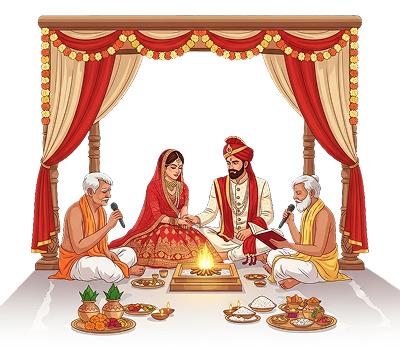
The ritual of marriage and Auspicious Wedding Worship is performed in the 'Mandap' of the wedding venue. The mandap is often established in the North-East (Ishan corner) or East direction, from where the energy of the Sun and deities is received.
Marriage Muhurat Consultation is an expert astrological service where Acharyas conduct a deep analysis of the birth charts of both the groom and bride. They match the zodiac signs, Nakshatras, and positions of planets of both, in which the calculation of Tara Bala and Chandra Bala is prominent. Based on this match (Guna Milan) only, that Hindu Marriage Muhurat is determined which ensures maximum happiness and prosperity for both.
- Name, date of birth, place of birth, and exact time of birth of both the groom and bride.
- Probable time limit of marriage (e.g., in which year or month the marriage is planned).
- Information of Gotra/clan so that the same Gotra can be avoided.
It can usually take a few hours for an expert astrologer to perform Kundali matching and detailed Panchang calculation (which includes analysis of the position of Jupiter and Venus, Malmas, Tara Bala, etc.), so that an error-free Auspicious Marriage Muhurat can be provided.