
Jayaparvati Vrat 2027 will begin on Friday, July 16, and conclude on Wednesday, July 21. This five-day Vrat is mainly observed in Gujarat and is dedicated to Lord Shiva and Goddess Parvati. Married women observe this Vrat with prayers for marital happiness, their husband's longevity and family prosperity, while unmarried girls observe it with the wish to find a suitable life partner. Jayaparvati Vrat begins on Trayodashi Tithi of Shukla Paksha in the month of Ashadha and continues until Tritiya Tithi of Krishna Paksha in the month of Shravan.
When is Jayaparvati Vrat 2027?
Jayaparvati Vrat 2027 will begin on Friday, July 16, and end on Wednesday, July 21. In 2027, the Vrat will begin on Ashadha Shukla Trayodashi and conclude after five days on Shravan Krishna Tritiya.
According to the Panchang, Trayodashi Tithi will begin at approximately 2:42 PM on July 15 and end at around 4:37 PM on July 16. Therefore, the beginning of the Vrat will be observed on July 16. The exact Tithi timings may vary slightly depending on the location.
To know the Jayaparvati Vrat date, Puja timings and other Shubh Muhurat according to your city: - Check the SanatanJyoti Panchang.
What is Jayaparvati Vrat?
Jayaparvati Vrat is a five-day Vrat dedicated to Lord Shiva and Goddess Parvati. It is mainly observed in Gujarat. Both married women and unmarried girls observe this Vrat.
According to religious tradition, married women observe this Vrat for marital happiness, peace and their husband's longevity, while unmarried girls observe Jayaparvati Vrat with the wish to find a suitable life partner.
Why is Jayaparvati Vrat Observed?
Jayaparvati Vrat is associated with the worship of Goddess Parvati and Lord Shiva. According to religious beliefs, observing this Vrat with devotion, discipline and self-restraint is believed to bring blessings for marital happiness, Akhand Saubhagya and family prosperity.
Unmarried girls worship Goddess Parvati and pray for a suitable life partner.
There is also a religious belief that this Vrat may be observed with wishes related to children. However, such outcomes are part of religious beliefs and should not be understood as guaranteed results.
Jayaparvati Vrat Puja Vidhi
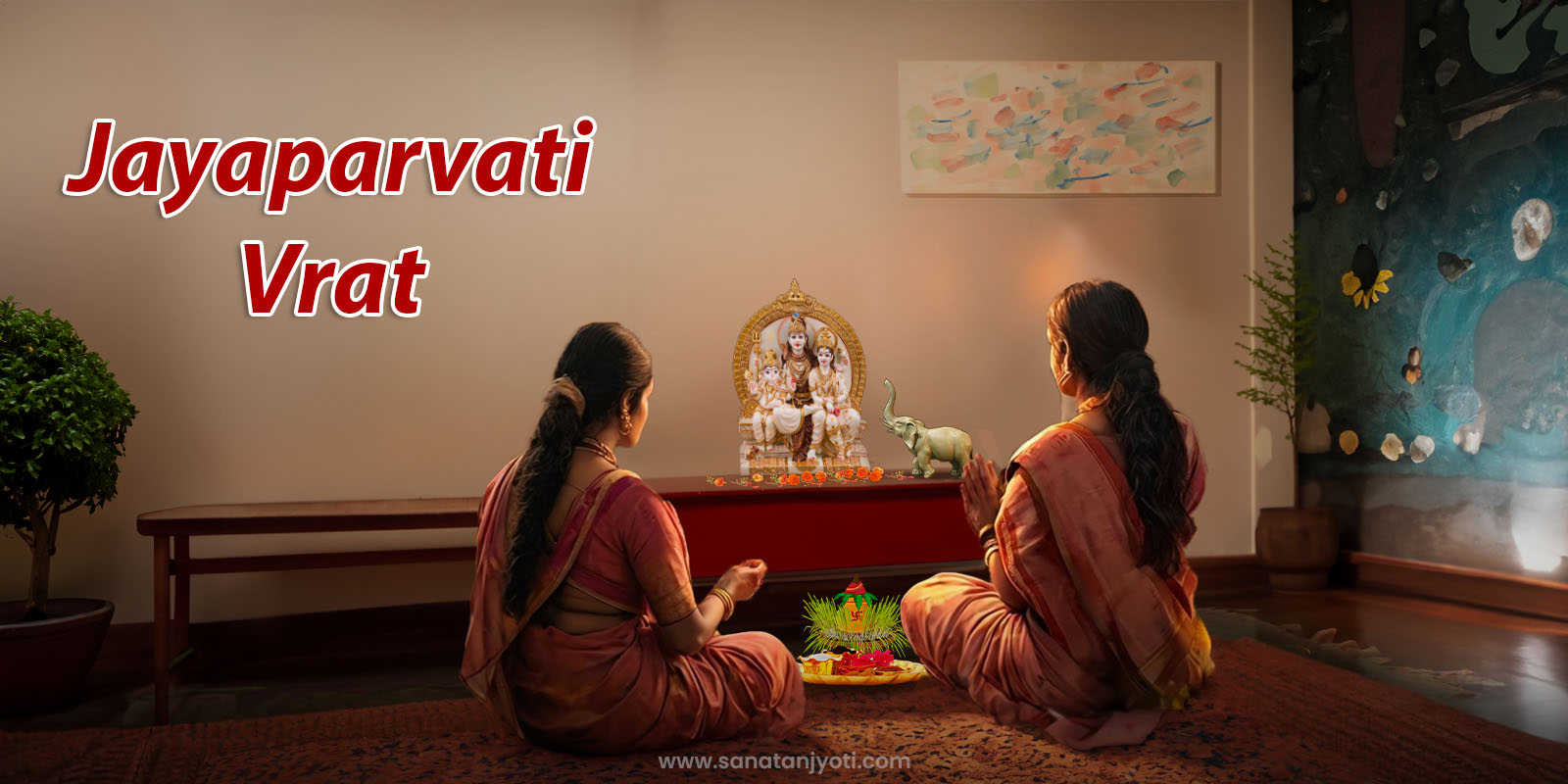
On the first day of Jayaparvati Vrat, wake up early in the morning, take a bath and wear clean clothes. Then take a Sankalp to worship Lord Shiva and Goddess Parvati.
Install an idol or picture of Lord Shiva and Goddess Parvati on a Chawki.
Near the Puja area, make an elephant figure using sand. Along with this, sow a few wheat seeds in a clay Kalash or vessel and place it at the Puja site. Water is offered to this vessel every day during the Puja.
In the vessel where the wheat seeds have been sown, offer water, Akshat, flowers, Roli and Nagla. Nagla is a type of garland made from cotton, which is traditionally decorated with Kumkum.
After this, offer flowers, fruits, Akshat, Dhatura, Kumkum, milk, curd, Panchamrit and other Puja Samagri according to your tradition to Lord Shiva and Goddess Parvati.
Offer flowers and fruits to the sand elephant as well.
Offer Bhog to the deities, light incense and a lamp, and perform Aarti. After this, pray to Lord Shiva and Goddess Parvati for family prosperity and the fulfillment of your wishes.
The tradition is to perform the Puja with devotion in this manner for all five days.
Why Are Wheat Seeds Sown During Jayaparvati Vrat?
On the first day of Jayaparvati Vrat, wheat seeds are traditionally sown in a small vessel and placed at the Puja site. These seeds are worshipped for five days and regularly watered.
At the end of the Vrat, the plants that have grown from these seeds are traditionally removed and immersed in water according to the prescribed ritual. This is considered part of the traditional Puja Vidhi of Jayaparvati Vrat.
Significance of the Sand Elephant in Jayaparvati Vrat
The tradition of making an elephant from sand or fine soil during Jayaparvati Vrat is followed in many places.
The elephant is placed at the Puja site and worshipped along with Lord Shiva and Goddess Parvati for five days. It is considered one of the distinctive regional traditions associated with Jayaparvati Vrat.
Jayaparvati Vrat Rules
Rules and self-discipline are considered especially important during Jayaparvati Vrat. Women observing the Vrat should follow the Puja Vidhi according to their faith and family traditions.
During the Vrat:
• Worship Lord Shiva and Goddess Parvati with devotion.
• Sow wheat seeds at the Puja site and worship them every day.
• Worship the elephant made from sand.
• Follow the dietary rules of the Vrat according to your tradition.
• In many places, there is a tradition of avoiding salt during the Vrat.
• Chant Lord Shiva's “Om Namah Shivaya” Mantra.
• Try to stay away from negative company and inappropriate activities.
• Keep the mind peaceful and meditate on Lord Shiva and Goddess Parvati.
The dietary rules of Jayaparvati Vrat may vary according to regional and family traditions. In some traditions, women avoid not only salt but also grains and certain other foods for all five days. Therefore, it is appropriate to follow the practices traditionally observed in your family.
What Should You Eat During Jayaparvati Vrat?
The dietary rules during Jayaparvati Vrat may vary according to tradition. In particular, avoiding salt is a common practice.
Some traditions prohibit grains and certain other foods during the Vrat. Women observing the Vrat may instead have fruits or a prescribed Satvik diet according to their family tradition.
Therefore, before beginning the Vrat, it is advisable to determine the dietary rules according to your family or local tradition.
Jayaparvati Vrat Jagran
The traditional observance of Jayaparvati Vrat also includes night-long Jagran on the final day.
After performing the Puja on the last day, women stay awake at night while singing Bhajans and Kirtans, performing Aarti and remembering the names of Lord Shiva and Goddess Parvati. Religious songs and Bhajans are traditionally sung during this time. This is known as Jayaparvati Jagran.
How Does Jayaparvati Vrat Conclude?
After observing the Vrat and performing Puja for five days, the Vrat is concluded.
After the Puja and Jagran on the final day, the wheat plants kept for worship are traditionally removed from the vessel the following morning. They are then immersed in a sacred river or water body.
After this, feeding people in need or children and donating useful items according to one's capacity is considered auspicious.
Jayaparvati Vrat Parana
Jayaparvati Vrat continues for five days and is concluded after the fifth day. The method and timing of Parana may vary according to local traditions.
Traditionally, the Vrat is concluded after the final Puja, followed by Satvik food. Some traditions mention breaking the Vrat with salt, vegetables and food prepared from wheat.
To know the correct Jayaparvati Vrat conclusion and Parana timing according to your city and tradition: -Check the SanatanJyoti Panchang.
Significance of Jayaparvati Vrat
Jayaparvati Vrat is considered an important religious Vrat for women. It is associated with the worship of Lord Shiva and Goddess Parvati in their divine marital form.
According to religious beliefs, married women observe this Vrat with prayers for marital happiness and peace, their husband's longevity and Akhand Saubhagya.
Unmarried girls worship Goddess Parvati and pray for a suitable life partner.
There is also a religious belief that this Vrat may be observed for wishes related to children and family prosperity.
What Are the Benefits of Jayaparvati Vrat?
According to religious beliefs, Jayaparvati Vrat is observed with prayers for:
• Happiness and peace in married life.
• The husband's longevity and Akhand Saubhagya.
• A suitable life partner for unmarried girls.
• The blessing of children.
• Family happiness and prosperity through prayers to Lord Shiva and Goddess Parvati.
• Fulfillment of wishes through the worship of Goddess Parvati.
All these should be understood as religious beliefs, not as guaranteed or scientifically established results.
Importance of the “Om Namah Shivaya” Mantra During Jayaparvati Vrat
Jayaparvati Vrat is dedicated to Lord Shiva and Goddess Parvati. Therefore, there is a tradition of chanting the “Om Namah Shivaya” Mantra during this Vrat.
During the Vrat, focusing the mind on devotion to Lord Shiva and chanting the Mantra during Puja may help maintain concentration during spiritual practice.
Jayaparvati Vrat 2027: Important Dates
In 2027, Gauri Vrat will begin on July 14, while Jayaparvati Vrat will begin on July 16. Jayaparvati Vrat will conclude on July 21, 2027.
The main day of Jayaparvati Vrat is July 16. On this day, Ashadha Shukla Trayodashi Tithi will prevail. The five-day Vrat will conclude on July 21 with Shravan Krishna Tritiya.
Jayaparvati Vrat 2027 Puja Muhurat
On the main day of Jayaparvati Vrat, Friday, July 16, 2027, the timing for Jayaparvati Pradosh Puja will vary according to the location.
What Is the Difference Between Jayaparvati Vrat and Gauri Vrat?
Both Jayaparvati Vrat and Gauri Vrat are important Vrat traditions associated with Gujarat, and both are connected with the worship of Goddess Parvati.
In 2027, Gauri Vrat will begin on July 14 and conclude on July 18, while Jayaparvati Vrat will begin on July 16 and conclude on July 21. Therefore, they should not be considered the same Vrat.
For more information about Gauri Vrat, read our article: - Complete Gauri Vrat Puja Vidhi
Personal Guidance for Jayaparvati Vrat
The rules, dietary practices, Puja Vidhi and concluding rituals of Jayaparvati Vrat may vary according to family and regional traditions. If you want personal guidance regarding the Sankalp, Puja Vidhi, Vrat rules or any specific religious ritual: -You can consult our expert through a free consultation.
Jayaparvati Vrat 2027 will be observed from July 16 to July 21. It is a five-day Vrat dedicated to Lord Shiva and Goddess Parvati and is mainly observed in Gujarat by married women and unmarried girls. Married women observe this Vrat with prayers for marital happiness and Akhand Saubhagya, while unmarried girls observe it with the wish to find a suitable life partner. The Vrat includes the worship of Lord Shiva and Goddess Parvati, sowing wheat seeds, worshipping a sand elephant, observing rules and self-discipline, and staying awake on the final night.
Important Questions About Jayaparvati Vrat 2027
1. When will Jayaparvati Vrat begin in 2027?
Jayaparvati Vrat 2027 will begin on Friday, July 16.
2. When will Jayaparvati Vrat end in 2027?
Jayaparvati Vrat 2027 will conclude on Wednesday, July 21.
3. How many days does Jayaparvati Vrat last?
Jayaparvati Vrat lasts for five days. It begins on Ashadha Shukla Trayodashi and concludes on Shravan Krishna Tritiya.
4. Who observes Jayaparvati Vrat?
Both married women and unmarried girls observe Jayaparvati Vrat. Married women pray for marital happiness and their husband's longevity, while unmarried girls observe the Vrat with the wish to find a suitable life partner.
5. What should you eat during Jayaparvati Vrat?
There is a special tradition of avoiding salt during this Vrat. Some traditions also prohibit grains and certain other foods for five days. Dietary rules may vary according to family and regional traditions.
6. Why is salt avoided during Jayaparvati Vrat?
The traditional observance of Jayaparvati Vrat includes avoiding salt for five days. Some communities also abstain from certain other foods during the Vrat.
7. Why is wheat sown during Jayaparvati Vrat?
On the first day of the Vrat, wheat seeds are sown in a small vessel and placed at the Puja site. They are worshipped and cared for over five days and are traditionally immersed in water at the conclusion of the Vrat.
8. Why is an elephant made during Jayaparvati Vrat?
Making and worshipping an elephant from sand or fine soil is a regional tradition associated with Jayaparvati Vrat. It is performed along with the worship of Lord Shiva and Goddess Parvati.
9. What is the significance of Jayaparvati Vrat?
According to religious beliefs, this Vrat is observed with prayers for marital happiness, the husband's longevity, Akhand Saubhagya, family prosperity and a suitable life partner.
10. Is Jayaparvati Vrat observed only in Gujarat?
Jayaparvati Vrat is primarily associated with Gujarat, although related traditions may also be observed in other regions.
11. Are Jayaparvati Vrat and Gauri Vrat the same?
No. Both are traditional Vrat practices associated with Gujarat, but their dates and duration are different. In 2027, Gauri Vrat will be observed from July 14 to July 18, while Jayaparvati Vrat will be observed from July 16 to July 21.