
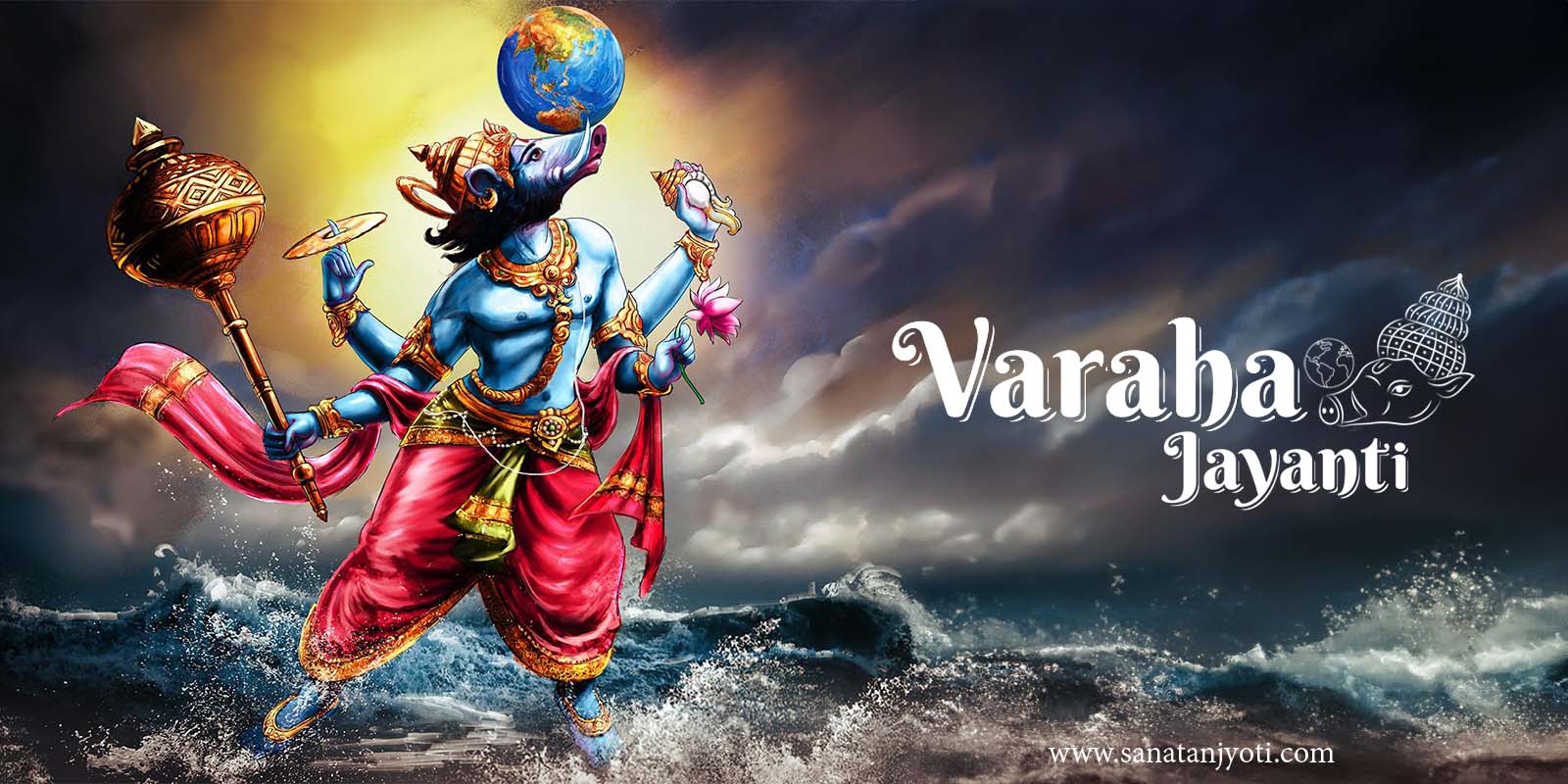
Varaha Jayanti commemorates the divine appearance of Lord Varaha, the third incarnation of Lord Vishnu. In Sanatan Dharma, this sacred festival holds great religious significance. According to Hindu tradition, Lord Varaha rescued Mother Earth (Bhudevi) from the demon Hiranyaksha, who had submerged her beneath the cosmic ocean. By lifting the Earth out of the waters, Lord Varaha restored balance to creation. Therefore, this festival symbolizes the triumph of Dharma, the protection of the Earth, and the divine grace of Lord Vishnu.
If you want to know when Varaha Jayanti 2026 falls, its date, auspicious Puja Muhurat, Puja Vidhi, fasting rules, the story of Lord Varaha, sacred mantras, Bhog, religious significance, and what to do or avoid on this day, this guide provides complete information.
When is Varaha Jayanti 2026?
In 2026, Varaha Jayanti will be observed on Sunday, 13 September 2026. The festival falls on the Dwadashi Tithi of Shukla Paksha in the month of Bhadrapada.
On this sacred day, worshipping Lord Varaha, observing a fast, chanting His holy mantras, and performing acts of charity are considered highly auspicious. According to Hindu beliefs, devotees who worship Lord Varaha with sincere faith and proper rituals are blessed with the grace of Lord Vishnu, bringing happiness, prosperity, and positive energy into their lives.
Varaha Jayanti 2026 Date
• Dwadashi Tithi Begins: Saturday, 12 September 2026, at 7:48 AM
• Dwadashi Tithi Ends: Sunday, 13 September 2026, at 7:09 AM
If you wish to know the auspicious Muhurat, the correct Puja timings, and the detailed Panchang for Varaha Jayanti 2026: -Be sure to check our comprehensive Panchang.
Who is Lord Varaha?
Lord Varaha is revered as the third incarnation (third avatar) of Lord Vishnu among the Dashavatara. In this divine incarnation, Lord Vishnu assumed the form of a boar (Varaha) to rescue the Earth and destroy the demon, Hiranyaksha.
According to the sacred scriptures, Hiranyaksha hid the Earth deep within the cosmic ocean. To restore creation, Lord Vishnu descended as Varaha, entered the waters, lifted Mother Earth on His mighty tusks, and returned her to her rightful place.
This divine incarnation represents much more than the destruction of a demon. It conveys the timeless message that whenever Adharma (unrighteousness) increases and creation is threatened; the Supreme Lord incarnates to protect Dharma and restore cosmic order.
Religious Significance of Varaha Jayanti
In Sanatan Dharma, Varaha Jayanti is observed with deep devotion to the appearance day of Lord Varaha, the divine incarnation of Lord Vishnu.
According to Hindu tradition, Lord Varaha rescued Mother Earth from the tyranny of the demon Hiranyaksha and restored balance to creation. Therefore, this festival symbolizes the victory of righteousness, the protection of nature, and the divine grace of Lord Vishnu.
Worshipping Lord Varaha on this sacred day inspires devotees to uphold Dharma, fulfill their responsibilities, and develop greater respect for nature. Many devotees observe a fast, worship Lord Vishnu, chant sacred mantras, and perform acts of charity.
It is believed that those who worship Lord Varaha with sincere devotion on Varaha Jayanti receive the blessings of Lord Vishnu, filling their lives with positivity, peace, prosperity, and the well-being of their families.
What Should You Do on Varaha Jayanti?
According to Hindu traditions, performing the following acts with devotion on Varaha Jayanti is considered highly auspicious:
• Wake up early in the morning, take a holy bath, and wear clean clothes.
• Meditate on Lord Vishnu and Lord Varaha.
• Take a sincere vow (Sankalp) to observe the fast.
• Offer yellow flowers, Tulsi leaves (Tulsi Dal), and Naivedya to the Lord.
• Chant the Vishnu Sahasranama, Varaha Stuti, or the sacred mantra "Om Namo Bhagavate Varahaya" with devotion.
• Donate food, clothes, or other essential items to those in need according to your ability and faith.
• Maintain a Sattvic lifestyle throughout the day and keep remembering Lord Vishnu.
• In the evening, perform Aarti and accept the Prasad with devotion.
What Should You Avoid Varaha Jayanti?
According to religious traditions, devotees should avoid the following on Varaha Jayanti:
• Do not become angry or use harsh and hurtful words.
• Avoid insulting others or getting involved in unnecessary arguments.
• Do not consume meat, alcohol, or any Tamasic food.
• Do not treat Puja or the fast as a mere formality. Perform both with sincere faith and complete concentration.
• Avoid harming trees, plants, animals, birds, or nature in any way.
• Stay away from falsehood, deceit, and all unrighteous actions.
Varaha Jayanti Puja Vidhi
According to Hindu beliefs, Lord Varaha, the divine incarnation of Lord Vishnu, should be worshipped with proper rituals, devotion, and a pure heart on Varaha Jayanti. If you are observing this festival for the first time, you can follow the simple Puja Vidhi below.
Morning Preparation
• Wake up during Brahma Muhurta or before sunrise.
• Take a holy bath and wear clean or yellow-colored clothes.
• Clean the worship area thoroughly and purify it by sprinkling Gangajal.
• While remembering Lord Vishnu and Lord Varaha, take a vow to observe the fast.
• Place an idol or picture of Lord Vishnu or Lord Varaha at the worship altar.
Puja Samagri Required
The following items are commonly used for Varaha Jayanti Puja:
• Gangajal
• Pure water
• Yellow flowers
• Tulsi leaves (Tulsi Dal)
• Sandalwood paste
• Akshat (unbroken rice)
• Incense sticks
• Oil or ghee lamp (Deepak)
• Ghee
• Seasonal fruits
• Panchamrit
• Naivedya
• Camphor
You may also include other Puja materials according to your family's customs and traditions.
How to Worship Lord Varaha
Follow these steps to perform the Puja:
1. Meditate on Lord Vishnu and Lord Varaha.
2. Offer Gangajal and pure water.
3. Offer sandalwood paste, Akshat, yellow flowers, and Tulsi leaves.
4. Light the incense sticks and the lamp.
5. Offer seasonal fruits and Naivedya.
6. Chant the sacred mantra "Om Namo Bhagavate Varahaya Namah" with devotion.
7. Recite the Vishnu Sahasranama or Varaha Stuti.
8. Perform the Aarti and pray for the happiness, prosperity, and well-being of your family.
Varaha Jayanti Fasting Rules
If you are observing the Varaha Jayanti Vrat, Hindu traditions recommend following these guidelines:
• Eat only Sattvic food throughout the day or observe a complete fast according to your faith.
• Keep remembering Lord Vishnu and chant His holy names.
• Stay away from anger, lies, and negative thoughts.
• Help those who are in need whenever possible.
• Participate in acts of charity (Daan) and selfless service (Seva).
• Maintain self-discipline, good conduct, and purity of mind throughout the day.
• Conclude the fast in the evening after performing the Aarti of Lord Vishnu.
The Mythological Story of Lord Varaha
According to the sacred scriptures, when Lord Brahma began the work of creation, He decided to populate the Earth with human beings. For this purpose, He instructed His son Svayambhuva Manu and Manu's wife Shatarupa to begin the expansion of human life on Earth. Manu, who always obeyed Lord Brahma with complete devotion, accepted this divine responsibility with reverence and sought His blessings.
However, Manu had an important question. He humbly asked Lord Brahma, "O revered Lord, you have entrusted us with the task of creating human life, but where will our future generations live? The entire Earth is submerged under the waters of the great deluge."
Manu's concern was valid. Seeing that the Earth was completely covered by water, Lord Brahma Himself became worried. He wondered how human life could flourish if the Earth remained submerged. As He searched for a solution, He realized that only Lord Vishnu possessed the power to rescue the Earth from this crisis.
Remembering Lord Vishnu, Lord Brahma prayed with deep devotion. At that very moment, Lord Vishnu manifested from one of Brahma's nostrils in the form of a tiny boar (Varaha), no larger than a thumb.
Before anyone could understand this miraculous event, the tiny boar began to grow rapidly. Within moments, He became as large as an elephant. Seeing this extraordinary sight, the sages, celestial beings, and Lord Brahma Himself were filled with wonder. They began to wonder who this divine being in the form of a boar could be.
Seeing the concern of the gods and sages, the all-powerful Lord Vishnu expanded into a colossal form, as vast as a mountain. He let out a mighty roar that echoed across all directions of the universe. Hearing this divine roar, the gods and sages rejoiced, recognizing the Lord's arrival.
The body of Lord Varaha was enormous like a mountain, with a powerful frame, coarse hair, brilliant white tusks, and radiant eyes that shone with divine splendor.
Overwhelmed by His magnificent appearance, the gods, sages, and Lord Brahma praised Lord Varaha and prayed for the rescue of the Earth. Pleased with their prayers, Lord Varaha roared once again in acceptance. Then, with tremendous speed, He leaped into the sky, shook His mighty mane, and struck the clouds with His powerful hooves. Since He had assumed the form of a boar, He searched for the Earth by sniffing in every direction.
Finally, following the Earth's scent, Lord Varaha plunged into the cosmic waters. His gigantic body, which was as massive as a mountain, entered the ocean with such tremendous force that it created a deafening roar like thunder. The impact of His descent formed enormous whirlpools and deep chasms in the waters.
At last, Lord Varaha found the submerged Earth and gently lifted Mother Earth (Bhudevi) upon His divine tusks. As He raised the Earth from the depths of the ocean, the water level receded, allowing the Earth to emerge once again.
At that very moment, the demon Hiranyaksha, who had hidden the Earth beneath the waters, attacked Lord Varaha with his mace. Angered by the demon's arrogance, Lord Varaha swiftly destroyed Hiranyaksha through His divine power.
Having defeated the demon and restored the Earth to its rightful place, Lord Vishnu, in His Varaha form, completed His divine mission and disappeared.
After the Earth had been restored, Svayambhuva Manu and Shatarupa fulfilled Lord Brahma's command by giving rise to future generations and expanding human civilization. They also performed sacred Yajnas and continued to worship Lord Vishnu with unwavering devotion.
Which Mantra Should Be Chanted on Varaha Jayanti?
Chanting the sacred mantras of Lord Vishnu and Lord Varaha on Varaha Jayanti is considered highly auspicious. According to Hindu tradition, reciting these mantras with faith and a focused mind strengthens devotion and helps devotees connect with the divine.
Main Mantra
Om Namo Bhagavate Varahaya Namah॥
If time permits, devotees may also recite other sacred hymns dedicated to Lord Vishnu, such as the Vishnu Sahasranama, Vishnu Chalisa, or Varaha Stuti with sincere devotion.
What Bhog Should Be Offered to Lord Varaha?
According to Hindu traditions, Sattvic Bhog is offered to Lord Vishnu and Lord Varaha on Varaha Jayanti. Depending on your family customs and devotion, you may offer the following:
• Panchamrit
• Kheer (Rice Pudding)
• Yellow-colored sweets
• Seasonal fruits
• Tulsi leaves (Tulsi Dal)
• Makhan Mishri (Butter and Rock Sugar)
• Dry fruits
After offering the Bhog, perform the Aarti and distribute the Prasad among your family members and other devotees.
Frequently Asked Questions About Varaha Jayanti 2026
1. When is Varaha Jayanti in 2026?
In 2026, Varaha Jayanti will be observed on Sunday, 13 September 2026.
2. Whose incarnation is Lord Varaha?
Lord Varaha is revered as the third incarnation (third avatar) of Lord Vishnu among the Dashavatara.
3. Why is Varaha Jayanti celebrated?
According to Hindu beliefs, Lord Varaha rescued Mother Earth by defeating the demon, Hiranyaksha. Varaha Jayanti is celebrated to commemorate this divine event.
4. Which deity is worshipped on Varaha Jayanti?
On this sacred day, devotees worship Lord Varaha, the divine boar incarnation of Lord Vishnu.
5. Which mantra should be chanted on Varaha Jayanti?
The principal mantra for Varaha Jayanti is: "Om Namo Bhagavate Varahaya Namah”
Chanting this mantra with devotion is considered highly auspicious.
6. What Bhog is offered on Varaha Jayanti?
Devotees traditionally offer Panchamrit, Kheer, Tulsi leaves, seasonal fruits, Makhan Mishri, and other Sattvic Prasad to Lord Varaha.
7. Is it necessary to observe a fast on Varaha Jayanti?
No. Observing the Varaha Jayanti Vrat depends on one's personal faith and family traditions. Many devotees choose to fast and worship Lord Vishnu on this sacred day.
8. What is the religious significance of Varaha Jayanti?
Varaha Jayanti commemorates the divine incarnation of Lord Vishnu as Lord Varaha. The festival symbolizes the protection of Dharma, the preservation of Mother Earth, and the blessings of Lord Vishnu.
Varaha Jayanti is an important Vaishnava festival celebrated in honor of Lord Vishnu's Varaha Avatar. In 2026, this sacred festival will be observed on Sunday, 13 September.
According to Hindu beliefs, worshipping Lord Varaha with devotion, observing a fast, chanting sacred mantras, and performing acts of charity on this day are believed to invoke the blessings of Lord Vishnu. The festival also reminds us of the timeless values of protecting Dharma, respecting nature, and fulfilling our responsibility toward all creation.
If you would like to know the auspicious Muhurat for Varaha Jayanti 2026, the correct Puja timings, details about the Vrat, or receive personalized astrological guidance: -You can consult our experienced Acharyas.