
When Will Shakambhari Utsav 2027 Begin?
Shakambhari Utsav 2027 will begin on Saturday, January 16, and conclude on Friday, January 22, 2027, with Shakambhari Purnima. This festival is observed from Ashtami Tithi of Shukla Paksha in the month of Pausha until Pausha Purnima. Shakambhari Navratri is considered an eight-day festival beginning with Banada Ashtami.
Shakambhari Purnima 2027: Friday, January 22
Beginning of Shakambhari Utsav: Saturday, January 16
End of Shakambhari Utsav: Friday, January 22
According to the Panchang, Purnima Tithi will prevail from approximately 9:35 PM on January 21 to 5:50 PM on January 22. The exact timing may vary slightly depending on the location.
To know the exact Shakambhari Utsav, Purnima Tithi, Puja and other auspicious timings according to your city: -Check the Our Panchang.
Main Dates of Shakambhari Navratri 2027
In 2027, Shakambhari Navratri will begin on Pausha Shukla Ashtami, also known as Banada Ashtami, and conclude on Pausha Purnima.
Shakambhari Navratri will begin on January 16, 2027, and conclude with Shakambhari Purnima on January 22, 2027. According to the Panchang tradition, it is considered an eight-day festival.
What is Shakambhari Utsav?
Shakambhari Utsav is an important festival in Sanatan Dharma associated with the worship of Goddess Shakambhari. According to religious beliefs, Goddess Shakambhari is a form of Devi Bhagwati who manifested to protect the Earth from famine and severe food shortages. Goddess Shakambhari is also worshipped as the deity associated with fruits, vegetables and green vegetation.
According to the original content, the 11th chapter of Shri Durga Saptashati and the Murti Rahasya describe various forms of the Goddess. These include Nanda, Raktadantika, Shakambhari, Durga, Bhima and Bhramari, among others.
Goddess Shakambhari is also remembered as Devi Shatakshi, and because of the story associated with the destruction of Durgamasura, her Durga form is also described.
Appearance of Goddess Shakambhari
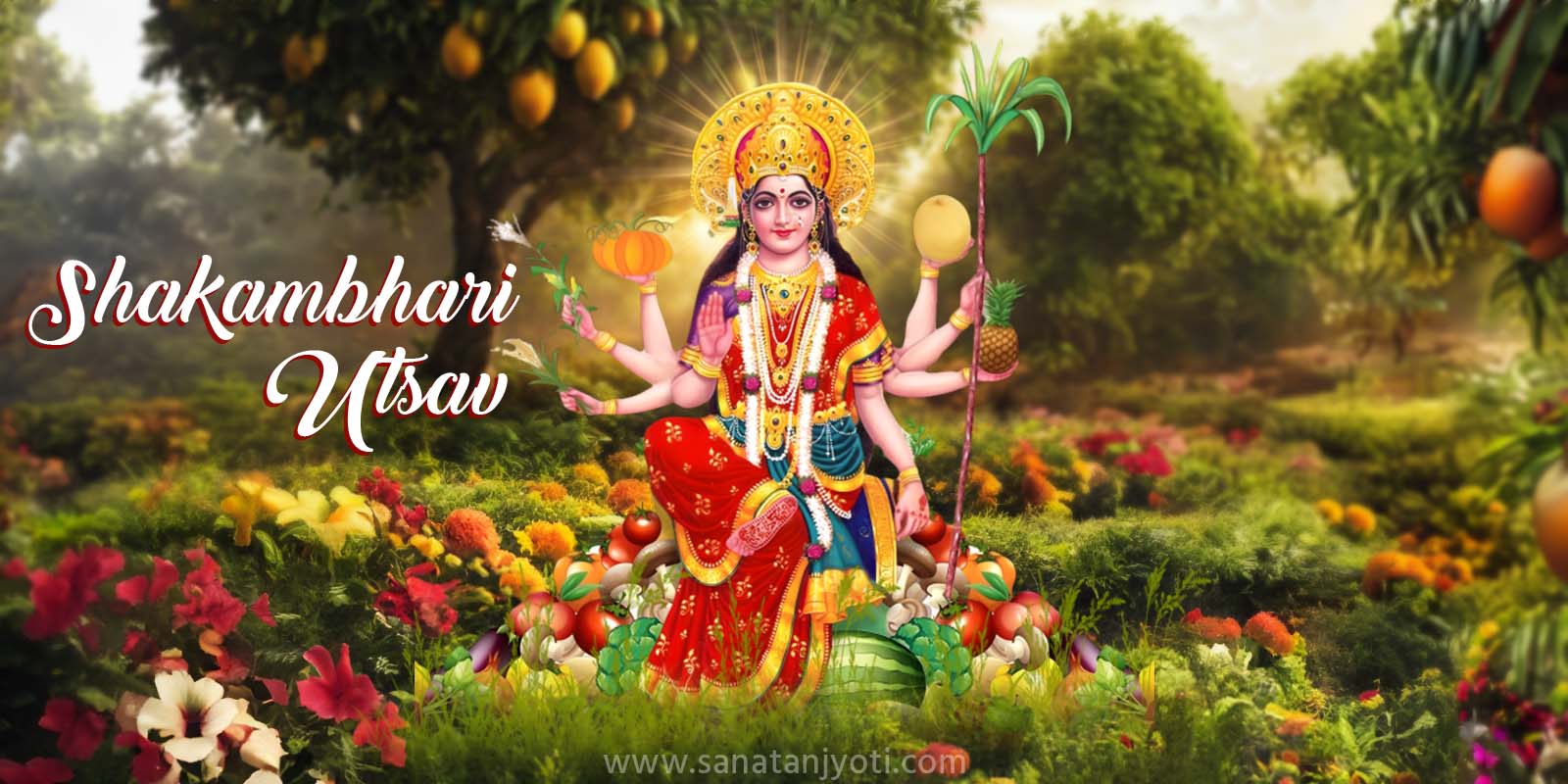
Goddess Shakambhari is described as extremely beautiful and divine. Religious descriptions portray Her body as having a blue radiance.
Her eyes are described as beautiful and captivating like blue lotuses. Her navel is described as slightly low, with three graceful folds, while Her abdomen is described as delicate.
Goddess Shakambhari is believed to reside on a lotus. Her hands hold arrows, various greens and a radiant bow.
She is described as a divine form adorned with fruits, flowers, vegetables and various leaves. According to religious belief, Her form represents the compassionate divine power that removes hunger, thirst and the fear of death.
Story of the Manifestation of Goddess Shakambhari
The demon Durgamasura was the immensely powerful son of the Daitya Ruru. He pleased Lord Brahma and obtained a boon, through the power of which he brought all four Vedas under his control.
As the Vedas came under his control, Vedic rituals gradually began to disappear. Religious activities such as Yajnas, Tapasya, Homa, charity and other meritorious acts also began to decline.
Due to the absence of Vedic rituals on Earth, rainfall stopped. As there was no rain for a long period, a terrible crisis spread across all three worlds.
Wells, stepwells, ponds, rivers and even the oceans began to dry up. Trees and creepers withered, while living beings wandered in distress because of hunger and thirst.
Seeing this terrible situation, all the Devas sought refuge in Maheshwari Yogamaya.
The Devas prayed to the Goddess:
“O Mahamaya! All Your creation is suffering from hunger and thirst and crying out for help. Please protect Your creation, otherwise the entire population will perish.”
The Devas also prayed to the Goddess to destroy Durgamasura in the same way that She had slain demons such as Shumbha, Nishumbha, Chanda, Munda, Raktabija, Madhu-Kaitabha and Mahishasura.
Hearing the compassionate prayers of the Devas, the merciful Goddess appeared before them in Her form with numerous eyes.
Her face was radiant and joyful, and Her four hands held a bow, arrow, lotus and various fruits and roots.
When the Goddess saw the suffering of all living beings, Her heart was filled with compassion. Tears began to flow from Her eyes.
The Mother continued to weep for nine days and nine nights. The streams of water flowing from Her eyes quenched the thirst of all living beings and provided water to the vegetation.
The rivers and oceans became filled with water. Sprouts of greens, fruits and roots began to grow on Earth.
The compassionate Goddess distributed the fruits held in Her hands among the sages and also arranged suitable food for cows and other living beings.
When all the Devas and all moving and non-moving beings became satisfied, the Goddess asked the Devas:
“What other task should I accomplish for you?”
The Devas replied:
“O Goddess! You have ended our suffering. Now, for the protection of the Devas and all living beings, please kill the demon Durgamasura and return to us the Vedas that he has taken away.”
The Goddess said “Tathastu” and assured them that She would soon help them recover the Vedas.
The Devas were pleased by the Goddess's assurance. They bowed before Her and returned to their respective realms.
After this, Goddess Jagadamba resolved to fight Durgamasura.
The demon Durgama surrounded the city of the Devas from all sides. To protect the Devas, the Goddess created a protective circle and came outside it to fight the demon Herself.
The Mother roared fiercely and challenged Durgamasura to battle.
A terrible war then began between the Goddess and Durgamasura. Arrows began raining down from both sides.
During the battle, numerous divine Shaktis emerged from the body of the Goddess. These included Mahavidyas such as Kali, Tara, Chhinnamasta, Shri Vidya, Bhuvaneshwari, Bhairavi, Bagalamukhi, Dhumavati, Tripura Sundari and Matangi.
After this, numerous Matrika Shaktis also manifested. They confronted the vast armies of the demons and destroyed them.
Finally, the Goddess killed Durgamasura with the edge of Her Trishul. He fell to the Earth like a gigantic tree.
Thus, the Mother killed the tyrannical Durgamasura and returned the four Vedas that he had taken from the Devas.
Because of this story, Goddess Shakambhari is worshipped as the Goddess who protects living beings from famine, hunger, thirst and suffering.
Shakambhari Mata Puja Vidhi
On the first day of Shakambhari Utsav, which is Pausha Shukla Ashtami, wake up early in the morning, complete your daily routine, take a bath and wear clean clothes.
First, worship Lord Ganesha. After this, meditate upon Goddess Shakambhari.
Place a red cloth, or an auspicious cloth according to your tradition, on a wooden Chawki and install an idol or image of Goddess Shakambhari.
After this, worship the Goddess with devotion according to your faith and family tradition.
What Should Be Offered to Goddess Shakambhari?
According to one's faith, the following may be placed around the Goddess:
• Fruits
• Green vegetables
• Shak
• Various leaves
• Flowers
• Naivedya
After the Puja, perform the Goddess's Aarti.
For Naivedya, Halwa-Puri, fruits, Shak, vegetables, Mishri and dry fruits may be offered according to one's tradition.
What to Do During Shakambhari Navratri?
During Shakambhari Utsav, devotees may perform the following according to their faith and traditions:
• Worship Goddess Shakambhari.
• Chant the Mantras of the Goddess.
• Recite Durga Saptashati.
• Listen to the story of the Goddess.
• Observe a Vrat or follow a Satvik diet.
• Offer fruits and vegetables as Bhog.
• Feed people in need.
• Donate food grains and food items.
• Visit a temple dedicated to the Goddess.
When is Shakambhari Purnima 2027?
Shakambhari Purnima 2027 will fall on Friday, January 22. It is also known as Shakambhari Jayanti and marks the final day of Shakambhari Navratri.
In 2027, Purnima Tithi will prevail from approximately 9:35 PM on January 21 to 5:50 PM on January 22.
Pausha Purnima also falls on the same day. Therefore, the religious significance of Shakambhari Purnima and Pausha Purnima comes together on this date.
To explore all Purnima fasts and festivals, their dates, Puja Vidhi and religious significance, read our complete guide to: -All Purnima Vrat & Festivals.
Charity on Shakambhari Purnima
On Shakambhari Purnima, the following may be donated to people in need according to one's capacity:
• Sesame seeds
• Jaggery
• Food grains
• Fruits
• Vegetables
• Clothes
• Blankets
The story of Goddess Shakambhari emphasizes protecting living beings through food, fruits, vegetables and water. Therefore, providing food or essential food items to people in need on this occasion may be considered in keeping with the spirit of the festival.
If you need guidance on worshipping Shakambhari Mata, observing the vrat, or performing a specific religious ritual according to your tradition: -You can consult our experts through Free Consultation.
Frequently Asked Questions About Shakambhari Utsav 2027
1. When will Shakambhari Utsav 2027 begin?
Shakambhari Utsav 2027 will begin on Saturday, January 16. It begins on Pausha Shukla Ashtami, also known as Banada Ashtami.
2. When will Shakambhari Navratri 2027 end?
Shakambhari Navratri will conclude on Friday, January 22, 2027, with Shakambhari Purnima.
3. When is Shakambhari Purnima 2027?
Shakambhari Purnima will fall on Friday, January 22, 2027.
4. Who is Goddess Shakambhari?
According to religious beliefs, Goddess Shakambhari is a form of Devi Bhagwati. She is worshipped as the Goddess associated with fruits, vegetables, Shak and vegetation and as the divine power that protects living beings from famine and food shortages.
5. How many days does Shakambhari Navratri last?
According to the general Panchang calculation, Shakambhari Navratri lasts for eight days, from Pausha Shukla Ashtami to Purnima. In some years, due to Tithi Kshaya or Vriddhi, its duration may be seven or nine days.
6. What Bhog should be offered to Goddess Shakambhari?
Fruits, green vegetables, Shak, various forms of vegetation and, according to one's tradition, Halwa-Puri, Mishri, dry fruits and other offerings may be offered to the Goddess.
7. What should be donated on Shakambhari Purnima?
According to one's capacity, sesame seeds, Jaggery, food grains, fruits, vegetables, clothes and blankets may be donated to people in need.