
When is Rath Saptami 2027?
Rath Saptami 2027 will be observed on Saturday, February 13, 2027. It falls on the Saptami Tithi of Shukla Paksha in the month of Magha. According to religious tradition, this day is considered especially significant for the worship of Lord Surya (Sun God). Rath Saptami is also known as Magha Saptami, Surya Jayanti, Achala Saptami and Arogya Saptami.
On Rath Saptami, there is a tradition of taking a bath during Arunodaya, offering Arghya to Lord Surya at sunrise, chanting Surya Mantras, performing Puja and making donations. According to religious beliefs, worshipping Lord Surya on this day is associated with prayers for good health, happiness, prosperity and positivity in life.
Rath Saptami 2027 Date and Time
Rath Saptami will be observed on Saturday, February 13, 2027. According to the Panchang, Magha Shukla Saptami Tithi will begin at approximately 3:01 AM on February 13 and end at around 2:08 AM on February 14.
The main religious observance of Rath Saptami is considered to be bathing during Arunodaya and offering Arghya to Lord Surya at sunrise. Therefore, local sunrise should be taken into account while determining the Puja timing.
To know the exact Snan, sunrise and Puja timings for Rath Saptami according to your city: -Check the SanatanJyoti Panchang.
What is Rath Saptami?
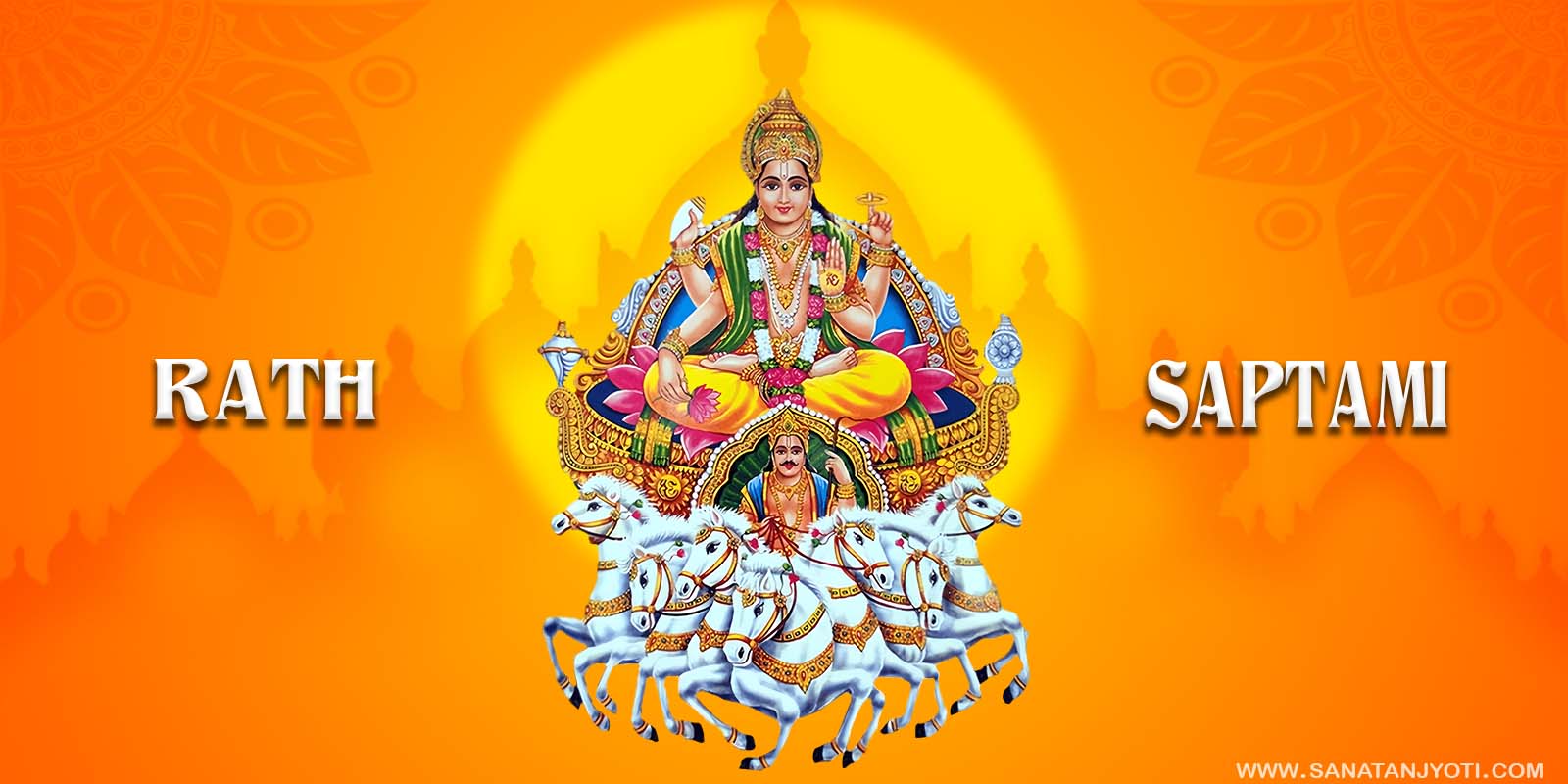
Rath Saptami is observed on the Saptami Tithi of Shukla Paksha in the month of Magha. This day is considered dedicated to Lord Surya. According to religious belief, Lord Surya is worshipped as the deity who rides a chariot drawn by seven horses and provides light and energy to the world.
Rath Saptami is also known as Surya Jayanti. There is a religious tradition associating this day with the divine radiance and light of Lord Surya. For this reason, Surya worship, bathing, offering Arghya and charitable acts are given special importance on this day.
Other Names of Rath Saptami
Rath Saptami is known by several names in different religious traditions. Its major names include:
• Rath Saptami
• Magha Saptami
• Surya Jayanti
• Achala Saptami
• Arogya Saptami
• Bhaskar Saptami
All these names are traditionally associated with Magha Shukla Saptami and the worship of Lord Surya.
Religious Significance of Rath Saptami
Saptami Tithi of Shukla Paksha in the month of Magha has been given special significance in religious texts and traditions. It is described as a Tithi associated with the removal of sins and the attainment of spiritual merit.
According to religious beliefs, worshipping Lord Surya and observing a Vrat on this day is associated with prayers for freedom from sins, happiness, prosperity and good fortune.
It is believed that a person may knowingly or unknowingly commit various types of sins through thoughts, words and actions. On Rath Saptami, performing Surya worship, Snan, offering Arghya and engaging in charity according to prescribed traditions is believed to help seek freedom from the effects of such sins.
For this reason, Rath Saptami is considered an important day for Surya worship and spiritual purification.
Significance of Snan on Rath Saptami
There is a special tradition of taking a bath during Arunodaya on Rath Saptami. Arunodaya refers to the period before sunrise, which is considered spiritually significant for Snan and religious practices.
In several traditions, it is prescribed to place seven leaves of the Aak plant and seven leaves of the Ber plant on the head while bathing. According to religious belief, this is associated with the removal of sins accumulated over seven births.
However, this practice may vary according to regional and family traditions.
Rath Saptami Puja Vidhi
On Rath Saptami, wake up before sunrise and take a bath. If possible, Snan should be performed during Arunodaya.
After bathing, wear clean clothes and worship Lord Surya.
How to Worship Lord Surya?
1. Take a bath in the morning and wear clean clothes.
2. Clean the Puja area.
3. Meditate on Lord Surya.
4. Offer Arghya to Lord Surya with water.
5. While offering Arghya, you may chant a Surya Mantra or Om Suryaya Namah.
6. Offer red flowers to Lord Surya.
7. Light incense and a lamp.
8. Perform Aarti of Lord Surya.
9. Donate food grains, clothes or other items according to your faith and capacity.
10. Maintain self-discipline and Satvik conduct throughout the day.
Offering Arghya to Lord Surya at sunrise is considered one of the major religious traditions of Rath Saptami.
How to Offer Arghya to Lord Surya on Rath Saptami?
After taking a bath, face the east direction at sunrise and offer Arghya to Lord Surya using water in a copper or clean vessel.
While offering Arghya, slowly pour the water with both hands and meditate on Lord Surya. You may also chant a Surya Mantra along with it.
Om Suryaya Namah.
After this, offer red flowers to Lord Surya and worship with incense and a lamp.
Rath Saptami Vrat
There is also a tradition of observing a Vrat on Rath Saptami. A person observing the Vrat should practice self-control and maintain Satvik conduct.
In religious traditions, this Saptami is also described as a Putradayak Vrat, associated with the blessing of children.
According to the traditional account, Lord Surya said:
“One who worships Me properly on Saptami Tithi of Shukla Paksha in the month of Magha will please Me, and I will manifest as his son through a part of Myself.”
According to this belief, devotees observe fasting and worship Lord Surya on this day. After completing the Vrat, traditions also mention performing a Havan the following day and serving Brahmins food such as curd, rice, milk and Kheer.
Rath Saptami Story
Prajapati Daksha had 60 daughters, who were noble and beautiful. Their names included Aditi, Diti, Danu and Vinata, among others. Daksha married 13 of his daughters to Rishi Kashyapa.
Aditi gave birth to the Devas, who became the lords of the three worlds. Diti gave birth to the Daityas, while Danu gave birth to powerful and fierce Danavas. Vinata and the other women also gave birth to various forms of living beings, both immovable and movable.
Through the sons, grandsons and descendants of these daughters of Daksha, the entire world became populated. Among Kashyapa's sons, the Devas were prominent. Some possessed Satvik qualities, while others were Rajasic or Tamasic in nature.
The Devas were entitled to their share of Yajna offerings, but the Daityas and Danavas were hostile towards them. They therefore joined together and began troubling the Devas.
Mother Aditi saw that the Daityas and Danavas had driven her sons away from their position and placed the three worlds in danger. She then made great efforts to worship Lord Surya.
Following a regulated diet and observing strict spiritual disciplines, she became deeply focused and began praising Lord Bhaskar, the radiant deity who resides in the sky.
After worshipping Him for a long time, Lord Surya appeared before Daksha's daughter Aditi in His radiant divine form.
Lord Surya said: - “Devi! Ask Me for any one boon according to your wish.”
Aditi replied:
“O Lord, may You be pleased. The powerful Daityas and Danavas have taken the sovereignty of the three worlds and the share of Yajna offerings away from my sons. O Lord, please show compassion towards them. Become their brother through a part of Yourself and destroy their enemies.”
Lord Surya said:
“Devi! I will manifest as a child in your womb through one-thousandth part of Myself.”
Having said this, Lord Bhaskar disappeared.
When Lord Bhaskar entered Aditi's womb, Aditi resolved to carry the divine child with purity and devotion. She began observing strict Vrats such as Krichchhra and Chandrayana with complete concentration.
Seeing her severe discipline, Rishi Kashyapa became somewhat concerned and said:
“Why are you fasting continuously and causing harm to the child in your womb?”
Aditi, also becoming upset, replied:
“Look, here is the child in my womb. I have not harmed him. He will be the one who destroys our enemies.”
Having said this, the mother of the Devas gave birth to the child at that very moment.
A radiant child appeared, shining like the rising Sun. At the same time, a divine voice declared that this child would destroy the Asuras who had taken away the share of Yajna offerings.
When the Devas heard this, they became extremely happy. Indra then challenged the Daityas to battle along with the other Devas. The Daityas also came forward to fight.
A fierce battle began. At that moment, Bhaskar destroyed all the enemies with His divine radiance.
The joy of the Devas knew no bounds. They regained their share of the Yajna offerings and the sovereignty of the three worlds was restored.
This story of the manifestation of Lord Surya from the womb of Goddess Aditi is associated with Shukla Paksha Saptami of the month of Magha. Lord Surya illuminates the entire world with His immense radiance, and life on Earth is considered possible because of the Sun's light and energy.
For this reason, this Tithi is given special significance for the worship of Lord Surya and is observed as Rath Saptami and Surya Jayanti.
What Should You Do on Rath Saptami?
On Rath Saptami, devotees may perform various religious activities according to their capacity and traditions.
• Take a bath in the morning.
• Offer Arghya to Lord Surya.
• Chant Surya Mantras.
• Worship Lord Surya.
• Offer red flowers.
• Light a lamp with Ghee.
• Donate food grains and clothes to people in need.
• Follow a Satvik diet and maintain self-discipline.
• Recite Surya Stuti, Aditya Hridaya Stotra or Surya Mantras.
• Observe a Vrat according to your faith.
Importance of Charity on Rath Saptami
Rath Saptami is also considered significant for charity and religious acts. According to one's capacity, one may donate food grains, clothes, Jaggery, sesame seeds and other items on this day.
While making donations, greater importance should be given to devotion and the spirit of service rather than display.
Why is Rath Saptami Significant?
Rath Saptami is a festival dedicated to the worship of Lord Surya. According to religious beliefs, worshipping Lord Surya on this day is associated with prayers for good health, happiness, prosperity and good fortune.
The Sun is regarded as the source of life, light and energy. Therefore, Rath Saptami is also associated with the tradition of expressing gratitude to Lord Surya.
Snan, Arghya, Mantra chanting, Vrat and charity performed on this day are considered especially meritorious according to religious traditions.
Rath Saptami and Surya Jayanti
Rath Saptami is called Surya Jayanti because of the religious beliefs associated with the manifestation of Lord Surya. There is a tradition of considering Magha Shukla Saptami as the birth or manifestation day of Lord Surya.
For this reason, special worship of Lord Surya is performed on this day, and offering Arghya at sunrise is considered important.
Rath Saptami and Achala Saptami
Another name for Rath Saptami is Achala Saptami. Therefore, in many places, people also know this festival by the name Achala Saptami.
Magha Shukla Saptami is referred to by names such as Rath Saptami, Magha Saptami and Surya Jayanti in different religious traditions.
What is Special About Rath Saptami in 2027?
In 2027, Rath Saptami will fall on Saturday, February 13. Magha Shukla Saptami Tithi will prevail on this day. According to the Panchang, Kumbha Sankranti will also occur on the same date, as the Sun will enter the zodiac sign of Aquarius on this Tithi.
Therefore, February 13, 2027, may be considered a significant day in relation to several religious traditions associated with Surya worship.
Frequently Asked Questions About Rath Saptami
1. When is Rath Saptami 2027?
Rath Saptami 2027 will be observed on Saturday, February 13. It falls on Saptami Tithi of Shukla Paksha in the month of Magha.
2. Which deity is worshipped on Rath Saptami?
Lord Surya is primarily worshipped on Rath Saptami.
3. Why is Rath Saptami called Surya Jayanti?
According to religious belief, Magha Shukla Saptami is associated with the manifestation or birth of Lord Surya. Therefore, the day is also known as Surya Jayanti.
4. When should one take a bath on Rath Saptami?
There is a tradition of taking a bath during Arunodaya on Rath Saptami. The exact timing varies according to the location.
5. How should Arghya be offered to Lord Surya on Rath Saptami?
After taking a bath, face the east direction at sunrise and offer water to Lord Surya as Arghya. A Surya Mantra may also be chanted while offering Arghya.
6. Is a Vrat observed on Rath Saptami?
Yes. Religious traditions prescribe observing a Vrat on Rath Saptami. The method of fasting and dietary rules may vary according to family and regional traditions.
7. Why is Rath Saptami called Achala Saptami?
Achala Saptami is a commonly used name for Rath Saptami. Both names are traditionally used for Magha Shukla Saptami.
8. What should be donated on Rath Saptami?
According to one's capacity, one may donate food grains, clothes, sesame seeds, Jaggery and other items. Devotion and the spirit of service are considered important while making donations.
Rath Saptami is an important festival dedicated to the worship of Lord Surya. Rath Saptami 2027 will be observed on Saturday, February 13. On this day, there is a tradition of taking a bath during Arunodaya, offering Arghya to Lord Surya at sunrise, chanting Surya Mantras, performing Puja, observing a Vrat and engaging in charity. According to religious beliefs, Rath Saptami is an important Tithi associated with prayers for the blessings of Lord Surya, good health, happiness, prosperity and spiritual purification.
If you want personal guidance on performing the Rath Saptami Puja Vidhi, Vrat, Sankalp or any religious ritual according to your tradition: -You can consult our expert through a free consultation.