
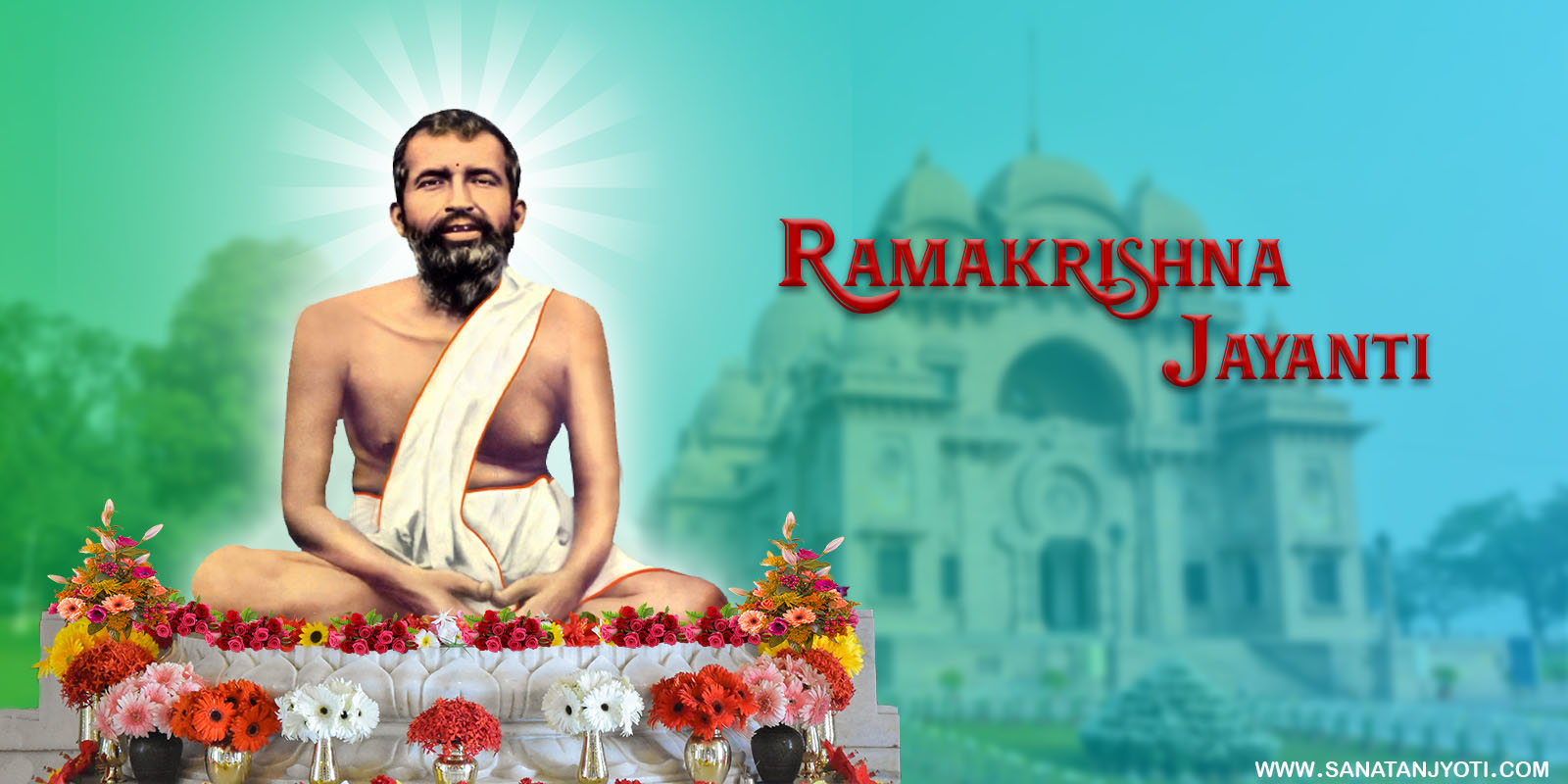
Ramakrishna Paramahamsa was one of India's great thinkers and saints. Swami Vivekananda was deeply influenced by Ramakrishna's teachings and later worked to spread his ideas across the world.
According to the Panchang, Ramakrishna Jayanti is observed on the Dwitiya Tithi of the Shukla Paksha in the month of Phalguna, commemorating the birth anniversary of Swami Ramakrishna Paramahamsa. In 2027, Ramakrishna Jayanti will be celebrated on Wednesday, March 10. The Phalguna Shukla Paksha Dwitiya Tithi will prevail on this day.
Ramakrishna Paramahamsa influenced Indian culture through his devotion, knowledge, and spiritual practices. His Jayanti is celebrated with great enthusiasm by devotees and followers across India. He was also the spiritual guru of Swami Vivekananda. Ramakrishna Paramahamsa was a devoted worshipper of Goddess Kali and regarded all women as manifestations of the Divine Mother.
Ramakrishna Paramahamsa was a renowned 19th-century religious teacher and saint who inspired people in Bengal, in present-day India, to lead better lives through his spiritual experiences and teachings. The inspiring stories and spiritual ideas associated with him are believed to help purify the mind and encourage spiritual growth.
When Is Ramakrishna Jayanti 2027?
Ramakrishna Jayanti 2027 will be celebrated on Wednesday, March 10. The festival is observed on the Dwitiya Tithi of the Shukla Paksha in the month of Phalguna.
On the occasion of Ramakrishna Jayanti, devotees and followers remember Ramakrishna Paramahamsa's life, spiritual practices, experiences, and teachings. Prayer, Satsang, Bhajan-Kirtan, and acts of Seva are among the religious and social activities performed on this day.
Ramakrishna Paramahamsa's Birth and Parents
It is traditionally said that before the birth of Saint Ramakrishna Paramahamsa, his parents had divine visions of Lord Vishwanath (Shiva) and Maa Jagadamba. Ramakrishna's father, Mohan Chattopadhyay, once dreamed that Lord Vishwanath asked him to build a home for him on Earth.
He shared this dream with his wife, Chandrakala Devi. After this, they were blessed with a child, and Saint Ramakrishna was born.
Saint Ramakrishna Paramahamsa was born on February 18, 1836. His childhood name was Gadadhar. Historically, Ramakrishna was also born on February 18, 1836, in Kamarpukur, and he later became associated with the Dakshineswar Kali Temple.
Ramakrishna Paramahamsa's Childhood and Spiritual Experiences
As a child, Ramakrishna was cheerful and playful, while also being exceptionally charming and mischievous. He also had a deep sense of reverence toward women, which remained an integral part of his life until the end.
The extraordinary spiritual potential within the child was unknown even to him, and no one could have imagined what he would eventually become. He had his first profound spiritual experience when he was about six years old.
In 1842, during the months of June and July, an incident occurred while Ramakrishna was walking through the fields with some flattened rice (Chivda) tucked into the edge of his garment. One morning, young Gadadhar was walking through the fields while eating Chivda, and the sky was completely covered with clouds.
The child gazed at the dark clouds while continuing to eat his Chivda. Suddenly, a line of brilliant white cranes, resembling a streak of milk against the clouds, flew overhead. The sight was so captivating that the child lost all awareness of his surroundings and fell unconscious to the ground. The Chivda scattered around him.
A stranger found young Gadadhar, lifted him, and carried him home. At that moment, Gadadhar became overwhelmed with joy and spiritual emotion. This was the first occasion when he experienced such an intense spiritual state.
It was after this experience, through an innate appreciation of beauty and artistic perception, that Shri Ramakrishna is said to have experienced his first profound connection with the Divine.
Ramakrishna understood the various paths believed to lead to God, including devotion, knowledge, self-control, selfless action, compassion, meditation, and Samadhi. He experienced joy by seeing the Divine in all things.
Ramakrishna Paramahamsa's Shivratri Leela
From childhood, Ramakrishna enjoyed playing the role of Lord Shiva. Once, during Shivratri, he was performing the sacred role of Shiva. At that moment, according to the account, Lord Shiva entered his body, and tears of joy began flowing from both his eyes.
Overwhelmed by the divine experience, Ramakrishna lost awareness of his surroundings and entered a profound spiritual state. Such extraordinary experiences continued, and he increasingly became absorbed in spiritual emotions.
Witnessing these events, his parents began to worry greatly. However, apart from these spiritual experiences, the child was completely healthy.
He was skilled at making idols of deities with his own hands. Mythological stories increasingly came alive in his imagination, and at times he would rely on his mature understanding to engage in discussions about scriptures with learned scholars.
Ramakrishna had a fair complexion, a gentle smile, a melodious voice, and a pure and expansive mind. He would sometimes secretly leave school and was strongly independent by nature.
The incidents from Ramakrishna's childhood convey the message that when a person has the ability and genuine love for a particular form of art or work, the Divine itself is believed to guide and complete that work.
Difficulties in the Life of Ramakrishna Paramahamsa
Ramakrishna lost his father when he was only seven years old. Due to financial difficulties, his family faced hardships for several years.
His elder brother, Ramakumar Chattopadhyay, moved to Calcutta and established a school there. He invited Ramakrishna to study with him, but Ramakrishna refused because of his restless nature and strong inner spiritual inclination.
Ramakrishna Paramahamsa and Devotion to Maa Kali
A woman named Rani Rashmoni built a Kali temple at Dakshineswar, about four miles from Calcutta on the eastern bank of the Ganga. A Brahmin was needed there to serve as a priest.
Ramakumar began serving as a priest at the temple. The following year, after the death of his elder brother, Ramakrishna took over his responsibilities. He began performing the temple's religious duties, including offering Bhog to the Goddess, conducting Puja, and performing Aarti.
Pleased with his devotion and rituals, Maa Kali appeared before him in a divine vision. After experiencing this Darshan, his spiritual emotions became even more intense. He repeatedly tried to experience the vision again, but was unable to do so.
After this, he began wandering almost blindly with his eyes closed. Because he could not see his path, he sometimes walked along thorny paths and fell into ditches when they appeared in his way.
His days became increasingly difficult. Then, suddenly, he felt that the Divine Mother had entered his body and saw Maa Kali standing on the roof of the temple. Her hair was loose and her face carried a gentle smile. In this way, he experienced the Darshan of the Divine Mother.
Ramakrishna Paramahamsa's Spiritual Practices and Path
Ramakrishna is described as having mastered various devotional approaches to experiencing God through love, including the Bhakta-Bhagavan relationship, servant-master relationship, mother-child relationship, and husband-wife relationship.
Seeing his intense spiritual condition, his mother decided that he should get married. He was subsequently married to a young woman named Saradamani.
Whenever someone appeared to be suffering from an illness, Ramakrishna would ask about their condition and encourage them to seek treatment. He never objected to medical care.
His mother believed that marriage might help stabilize his intense spiritual state, and he accepted the marriage without opposition.
He is described as experiencing the presence of the Divine in different forms. Whenever he meditated on a particular deity, he would experience that divine form. When he saw a young woman, for example, he would think of divine figures such as Sita or Kali and perceive her in that sacred form. In this way, he saw the Divine through human beings.
Ramakrishna Paramahamsa and Totapuri
Ramakrishna's devotion to Maa Kali was so intense that once Totapuri, a follower of the Naga tradition, told him, “I will teach you Vedanta. Come with me.”
At the time, Ramakrishna was sitting on the steps of the temple and said that he would first ask his Mother for permission. Totapuri was deeply impressed by his devotion. The Divine Mother gave him permission.
With the Mother's permission, Ramakrishna surrendered himself at Totapuri's feet. Totapuri then began teaching him about Brahman.
Even after completely renouncing worldly attachments, Ramakrishna could not initially realize Brahman. He told his guru Totapuri that he could not attain the realization because whenever he meditated on Brahman, he saw only the form of Maa Kali.
Hearing this, Totapuri picked up a piece of glass, placed it between Ramakrishna's eyebrows, and instructed him to concentrate on that point. As soon as Ramakrishna focused his mind with determination, the beautiful form of the Divine Mother appeared before him.
He then transcended the thought associated with the form of Maa Kali, removing the final obstacle to the realization of Brahman.
After transcending these thoughts, Ramakrishna entered Samadhi and is described as reaching the highest state of spiritual realization. He then attained the realization of Brahman.
According to the account, the spiritual attainment that had taken Totapuri 40 years was achieved by Ramakrishna in a single day.
Ramakrishna Paramahamsa and Swami Vivekananda
Ramakrishna Paramahamsa was the spiritual guru of Swami Vivekananda. Vivekananda was deeply influenced by Ramakrishna's teachings and spiritual experiences.
Later, Swami Vivekananda worked to spread his guru's ideas and spiritual message throughout India and different parts of the world. The influence of Ramakrishna's teachings continued to grow through his disciples and followers. Ramakrishna Math and Ramakrishna Mission also hold an important place among the institutions associated with the Ramakrishna tradition.
Death of Ramakrishna Paramahamsa
August 15, 1886, a Sunday, is described in the source as Ramakrishna Ji's final day. Even until the afternoon, he retained remarkable spiritual strength. Despite suffering from a painful throat, he spoke with his disciple Narendra for two hours.
He then suddenly became unconscious. His disciple thought that he had passed away. However, after some time, he regained consciousness. Later, his disciples supported him with five pillows and massaged his feet while Ramakrishna chanted the name of Maa Kali. This was described as his final Samadhi, after which he passed away.
Thus, Ramakrishna Paramahamsa left the world on August 16, 1886.
How Is Ramakrishna Jayanti Celebrated?
On the occasion of Ramakrishna Jayanti, devotees, followers, and people associated with his teachings organize various religious and service activities. These mainly include:
Prayer Gatherings
On this day, students of Ramakrishna's teachings and his followers organize prayer gatherings. The Vedas, Puranas, Upanishads, and devotional songs are recited, and devotees worship God.
Satsang and Spiritual Conferences
Sadhus and saints participate in Satsang and spiritual gatherings, where discussions are held on religious subjects, spiritual ideas, and the teachings of God.
Seva and Religious Activities
People participate in social service activities, serve at homes for children and the elderly, distribute food among devotees, and take part in other forms of Seva.
Katha-Kirtan and Bhajan Evenings
Bhajan evenings and Katha-Kirtan programs are organized to sing praises of God and remember the spiritual teachings of Ramakrishna Paramahamsa.
Significance of Ramakrishna Jayanti
Ramakrishna Jayanti is an occasion to remember the life, teachings, and spiritual journey of Saint Ramakrishna Paramahamsa. On this day, devotees remember his teachings, spiritual practices, and devotion to God.
Ramakrishna Paramahamsa's teachings were influential and meaningful, and he shared them with his disciples and devotees. His teachings included important thoughts concerning social, religious, and spiritual life.
On the occasion of Ramakrishna Jayanti, devotees draw inspiration from his life and try to cultivate patience, dedication, devotion, and spirituality in their own lives.
Ramakrishna Jayanti is an important occasion to remember the life and spiritual practices of the saint and spiritual teacher Ramakrishna Paramahamsa. Ramakrishna Jayanti 2027 will be celebrated on Wednesday, March 10. It will be observed on the Dwitiya Tithi of the Phalguna Shukla Paksha.
Ramakrishna Paramahamsa's devotion to Maa Kali, his spiritual practices, experiences, and teachings to his disciples continue to hold a special place in India's spiritual tradition. Among his prominent disciples, Swami Vivekananda is particularly remembered.
On Ramakrishna Jayanti, his life and teachings are remembered through prayers, Satsang, Bhajan-Kirtan, Katha, and Seva activities.