

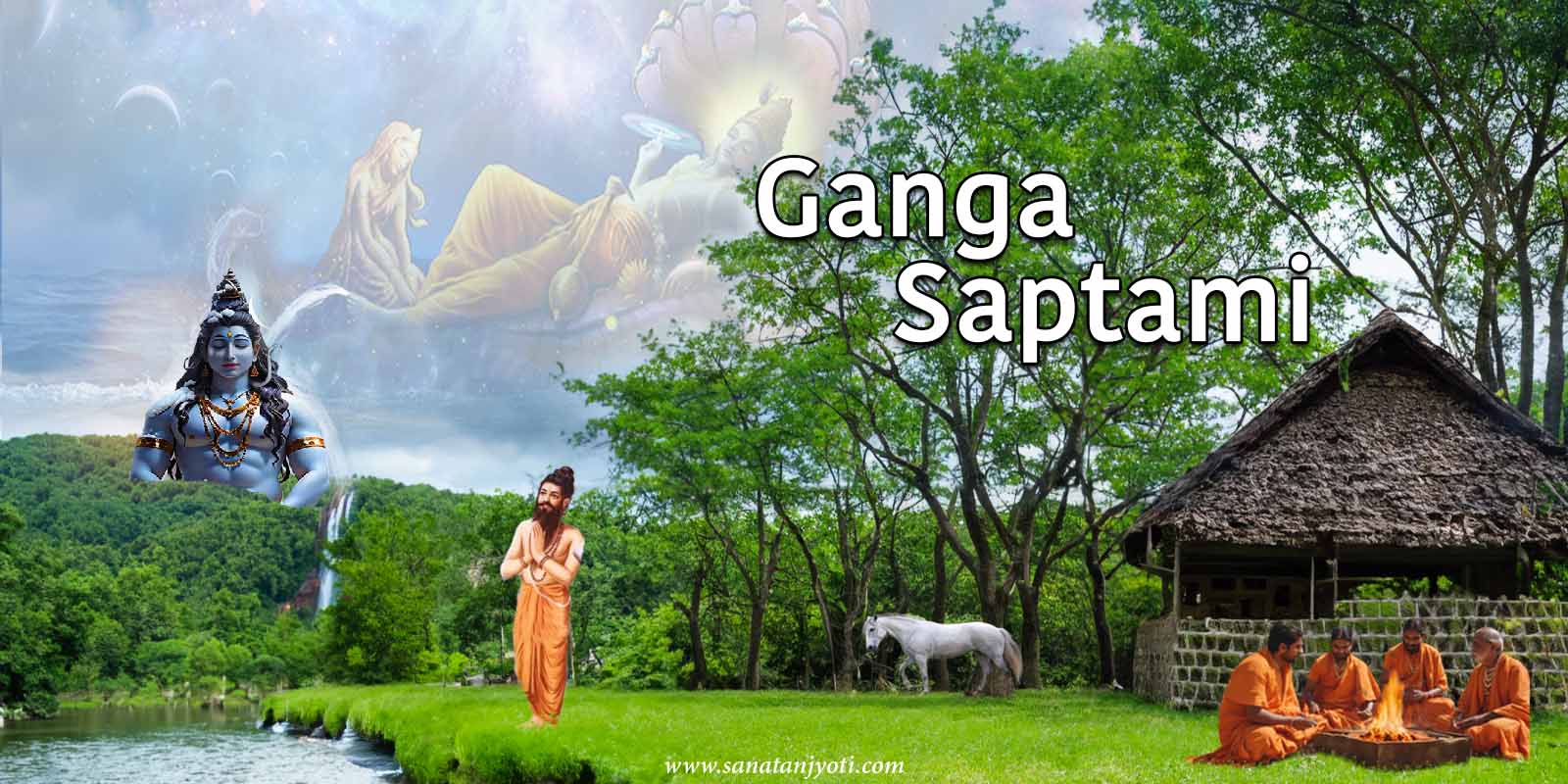
Ganga Saptami will be observed on Wednesday, May 12, 2027. This festival is celebrated on the Saptami Tithi of Shukla Paksha in the month of Vaishakha and is dedicated to Mata Ganga. According to religious beliefs, on this day, Sage Jahnu released the Ganga again through his ear, which is why Mata Ganga is also known as Jahnavi. On Ganga Saptami, devotees perform Ganga Snan, Puja, meditation and charity, and take a pledge to keep the Ganga and other rivers clean.
Ganga Saptami 2027: When Is It?
Ganga Saptami will be observed on Wednesday, May 12, 2027. This day falls on Vaishakha Shukla Saptami Tithi. According to Panchang calculations, the Saptami Tithi will continue until the night of May 12.
In 2027, Ganga Saptami will be observed on May 12, while Ganga Dussehra will be celebrated on June 13, 2027. Both Ganga Saptami and Ganga Dussehra are important festivals associated with Mata Ganga, but their dates and religious contexts are different.
Ganga Saptami 2027 Puja Shubh Muhurat
Performing Puja during the Madhyahna period on Ganga Saptami is considered auspicious. Since sunrise timings and Panchang calculations vary from one city to another, the Puja Muhurat may also differ.
Check the local Panchang according to your city.
Ganga Saptami Puja Vidhi
Along with worshipping Mata Ganga on Ganga Saptami, taking a Sankalp to keep the Ganga River and other water sources clean is also considered religiously significant. If it is not possible to visit the Ganga River for a holy bath, Puja can also be performed at home by respectfully remembering Gangajal.
How to Perform Ganga Saptami Puja?
1. Take a Bath in the Morning:
On Ganga Saptami, take a bath in the morning and wear clean clothes. If possible, take a holy bath in the Ganga or another sacred river.
2. Clean the Puja Area:
Clean the Puja area at home and place a picture or idol of Mata Ganga. If Gangajal is available, keep it at the Puja place.
3. Take a Sankalp:
Meditate on Mata Ganga and pray for happiness, prosperity and purity in the family. Also, take a Sankalp not to pollute rivers and other water sources.
4. Worship Mata Ganga:
Offer flowers, Akshat, Dhoop, Deep and Naivedya to Mata Ganga. According to one's faith, Ganga Stotra, Ganga Chalisa or a Ganga Mantra can also be recited.
5. Worship Gangajal:
Include the Gangajal kept at home in the Puja and respectfully remember its religious significance.
6. Perform Aarti:
At the end of the Puja, perform Mata Ganga's Aarti and pray for happiness and peace in the family.
7. Perform Charity:
On this day, donating food grains, clothes, water or other essential items according to one's capacity is considered auspicious.
8. Take a Pledge to Maintain Cleanliness:
On Ganga Saptami, take a pledge not to throw garbage, plastic, Puja Samagri or other polluting materials into rivers. Keeping water sources clean is in accordance with the spirit of this festival.
If you are looking for personalized guidance regarding Ganga Saptami Puja Vidhi, Vrat, charity or any other religious ritual: -Get free consultation from our expert.
What to Do on Ganga Saptami?
On Ganga Saptami, devotees can perform the following activities according to their faith and capacity:
• Take a holy bath in a sacred river.
• Worship Mata Ganga.
• Worship and respectfully preserve Gangajal.
• Participate in Ganga Aarti.
• Recite a Ganga Mantra or Ganga Stotra.
• Donate to people in need.
• Take a pledge to prevent the wastage of water.
• Take a pledge to keep rivers and other water sources clean.
Significance of Ganga Saptami
In Hindu religious tradition, the Ganga is worshipped as a sacred river and Goddess. Ganga Saptami is observed on Vaishakha Shukla Saptami and is also known as Ganga Jayanti and Jahnu Saptami. According to the religious story, when Ganga descended towards Earth through the efforts of King Bhagiratha, her path crossed the Ashram of Sage Jahnu.
When the force of the Ganga affected his Ashram, Sage Jahnu absorbed the river and later released her again through his ear. This is why Ganga came to be known as Jahnavi, and Ganga Saptami is observed on Vaishakha Shukla Saptami to commemorate this event.
Taking a holy bath, performing Puja, making donations and creating awareness about the purity of water are given special importance on Ganga Saptami.
What Is the Difference Between Ganga Saptami and Ganga Dussehra?
Ganga Saptami and Ganga Dussehra are both important festivals associated with Mata Ganga, but their religious stories are connected with different events.
Ganga Saptami is observed on Vaishakha Shukla Saptami. Its main story is associated with Sage Jahnu releasing Ganga again, after which Ganga came to be known as Jahnavi.
Ganga Dussehra, on the other hand, is observed on Jyeshtha Shukla Dashami and is associated with the descent of Ganga to Earth. In 2027, Ganga Dussehra will be observed on June 13.
To learn more about the religious beliefs associated with the descent of the Ganga to Earth and the Puja Vidhi: -Read our detailed article on Ganga Dussehra 2027.
Story of Ganga Saptami
This story is described in the Bal Kanda of the Ramayana, where Sage Vishwamitra narrated it to Lord Shri Ram when Shri Ram asked him about the descent of Ganga. The story is as follows:
Sage Vishwamitra told Lord Shri Ram the story of Ganga's descent and said that long ago, a righteous king named Sagara of the Ikshvaku dynasty ruled Ayodhya. He had two wives. His elder wife's name was Keshini, who was the daughter of the King of Vidarbha.
She was highly virtuous and always spoke the truth. Sagara's second wife was Sumati, the daughter of Arishtanemi Kashyapa and the sister of Garuda. Since neither wife had a child, King Sagara went to the Himalayas with his wives and began performing austerities at a peak called Bhriguprasravana. Pleased with his penance, Sage Bhrigu granted the king a boon that he would have many sons.
The sage said that one of his wives would have one son who would continue the royal lineage, while the other would have sixty thousand radiant, mighty and extraordinarily powerful sons. Sagara's wives bowed to Sage Bhrigu and asked which of them would have one son and which would have sixty thousand sons.
The sage told both queens to make the wish they desired in their hearts. The one who wished for one son would have one son, while the one who wished for sixty thousand sons would have sixty thousand sons. Queen Keshini wished for one son who would continue the dynasty, while Sumati wished for sixty thousand powerful sons.
Queen Keshini gave birth to a son named Asamanja, while the king's second wife gave birth to an embryo that later produced sixty thousand sons.
Gradually, all the boys grew into young men. Sagara's eldest son, Asamanja, would catch the children of the city and throw them into the Sarayu River. When they began to drown, he would laugh at them.
Because he caused suffering to righteous people, his father banished him from the kingdom. A few days after Asamanja left, his wife gave birth to a son named Anshuman. He was gentle-spoken, radiant and courageous. After some time, King Sagara decided to perform a Yajna.
All the ministers began preparing for it. The Yajna was performed in the sacred land of Aryavarta between the Vindhya and Himalaya mountains. A horse was released, and Anshuman was given the responsibility of protecting it.
The horse passed through several kingdoms, but no one captured it; instead, everyone agreed to establish friendly relations with Sagara. As the Yajna appeared to be progressing successfully, Indra, the king of the gods, became afraid of losing his position. He took the form of a demon, stole the horse and tied it at the Ashram of Sage Kapila.
Because the horse had been stolen, the Yajna could not be completed. The horse had to be seen at the end for the Yajna to be considered successful; otherwise, its failure was regarded as an indication of misfortune. King Sagara ordered his sixty thousand sons to search for the horse. Obeying his command, all sixty thousand sons set out in search of it.
While searching for the horse, they began digging through the Earth, and each of their blows was said to be as powerful as a thunderbolt. Each son took one Yojana of land, and together they dug through sixty thousand Yojanas of Earth.
They killed every living creature they encountered. Seeing this, all the gods became frightened and went to Lord Brahma, saying that if they continued to tear apart the Earth in this way, all living beings would be destroyed and the Earth itself would be devastated, bringing an end to creation. Lord Brahma then explained that Sage Kapila Muni, who was immersed in Lord Hari and residing in the netherworld, would bring about their destruction.
While searching for the horse, King Sagara's sons reached the Ashram of Sage Kapila in the netherworld. The horse was there. The sixty thousand sons mistook Sage Kapila for the thief and began speaking to him disrespectfully, saying, "He is the one who has obstructed our father's Yajna. He stole the horse." They rushed toward him intending to attack him.
heir actions disturbed his meditation. Angered by this, flames emerged from his eyes, and the sixty thousand sons of King Sagara were burned to ashes.
After a long time, when King Sagara's sixty thousand sons had neither returned nor had the horse been found, he ordered his grandson Anshuman to search for them and bring back the horse. Following King Sagara's command, Anshuman set out in search of his uncles. He followed the same path that his uncles had created by digging through the Earth.
Along the way, whenever Anshuman met a brave or learned person, he respectfully greeted them, asked about their well-being and inquired about the whereabouts of his uncles and the horse. In this manner, after receiving the blessings of learned and respected people, Anshuman reached the place where his uncles lay as a heap of ashes.
When Anshuman saw the ashes of his uncles, he became deeply sorrowful. He also saw that the horse was grazing nearby. Anshuman began searching for water so that he could offer water oblations for the liberation of his uncles, but he could not find a water source anywhere nearby. While wandering in search of water, he met Garuda. Anshuman also asked him about a water source. Garuda then told him that his nephews had been reduced to ashes by the fire of divine sight and that only the waters of the Ganga could grant them liberation. He advised Anshuman to take the horse back and complete the Yajna, and then perform penance to bring Ganga to Earth for their liberation.
After hearing Garuda's words, Anshuman returned with the horse and told King Sagara about the death of his uncles and what Garuda had said. After the Yajna was completed, King Sagara continued thinking about bringing Ganga to Earth but could not reach a decision. Some time later, King Sagara passed away.
After this, Anshuman went to the Himalayan mountains and began performing penance for the liberation of his uncles. After performing austerities for some time, he gave up his body and attained heaven. Anshuman's son was named Dileepa.
He too performed penance for the liberation of his ancestors and eventually gave up his body and attained Indra's realm. Dileepa's son was Bhagiratha. He was extremely courageous, righteous and radiant. With the desire for a son and to liberate his ancestors, he too began efforts to bring Mata Ganga down to Earth.
First, he pleased Lord Brahma through his penance. Pleased with his austerities, Lord Brahma told Bhagiratha that Ganga would descend to Earth with tremendous force according to his wish. Only Lord Shiva could control the force of her descent, so he advised Bhagiratha to perform penance to Lord Shiva and persuade him to undertake this task. Bhagiratha then began performing penance to Lord Shiva. Pleased with Bhagiratha's devotion, Lord Shiva granted him the boon that he would indeed hold Goddess Ganga, the daughter of the King of Mountains, upon his head.
After receiving Lord Shiva's consent, Ganga assumed a mighty form and descended from the heavens at tremendous speed onto Lord Shiva's head. When Mother Ganga descended upon Lord Shiva's head, she became proud of her immense force and thought that she would carry Shiva along with her and go directly to the netherworld. Lord Shiva recognised Ganga's pride.
Lord Shiva transformed his matted locks into what seemed like a closed cave. When Ganga descended toward Earth with tremendous force, she became trapped within Shiva's matted hair and could not escape despite her efforts. Bhagiratha then began performing penance to Lord Shiva once again. Pleased with him, Lord Shiva released Ganga from his matted locks and allowed her to descend to Earth, where she flowed into Bindusara. As soon as she emerged there, she divided into seven streams.
Hradini, Pavani and Nalini flowed towards the east. Suchakshu, Sita and the great river Sindhu flowed towards the west. The seventh stream followed Bhagiratha. Goddess Ganga then flowed over the ashes of Sagara's sixty thousand sons, granting them liberation.
Pledge to Keep the Ganga Clean on Ganga Saptami
The Ganga is not merely a river; she is considered highly sacred in Indian religious and cultural traditions. Therefore, along with Puja and Snan on Ganga Saptami, taking a pledge to keep the river and other water sources clean is also important.
Avoiding the disposal of Puja Samagri, plastic or waste into rivers and preventing the wastage of water are practical steps that reflect the spirit of this festival. Keeping the Ganga clean is also an important way of expressing devotion and respect towards Mata Ganga.
Importance of Charity on Ganga Saptami
Performing charity according to one's faith on Ganga Saptami is considered auspicious. On this day, devotees may donate food grains, clothes, water or other useful items according to their capacity to people in need.
While making donations, one should keep one's capacity and devotion in mind.
Frequently Asked Questions About Ganga Saptami 2027
When is Ganga Saptami 2027?
Ganga Saptami will be observed on Wednesday, May 12, 2027. It falls on Vaishakha Shukla Saptami Tithi.
Why is Ganga Saptami celebrated?
Ganga Saptami is a festival dedicated to Mata Ganga. According to religious beliefs, Sage Jahnu released Ganga again on Vaishakha Shukla Saptami, because of which she came to be known as Jahnavi.
Are Ganga Saptami and Ganga Dussehra the same?
No. They are two different festivals. Ganga Saptami is observed on Vaishakha Shukla Saptami, while Ganga Dussehra is observed on Jyeshtha Shukla Dashami. In 2027, they will fall on May 12 and June 13, respectively.
What should be done on Ganga Saptami?
On this day, devotees can take a holy bath in the Ganga, worship Mata Ganga, worship Gangajal, perform charity and take a pledge to keep rivers and other water sources clean.
Why is Ganga Snan performed on Ganga Saptami?
According to religious beliefs, the Ganga is considered sacred and capable of granting liberation. Therefore, taking a holy bath in the Ganga and worshipping her on Ganga Saptami are considered particularly significant in religious tradition.
Why should one take a pledge to keep the Ganga clean on Ganga Saptami?
Ganga Saptami is a festival dedicated to expressing devotion towards Mata Ganga. Therefore, avoiding the disposal of garbage, plastic or Puja Samagri into the river and maintaining the cleanliness of water sources are considered actions that reflect the spirit of the festival.