
What Is a Chandragrahan?
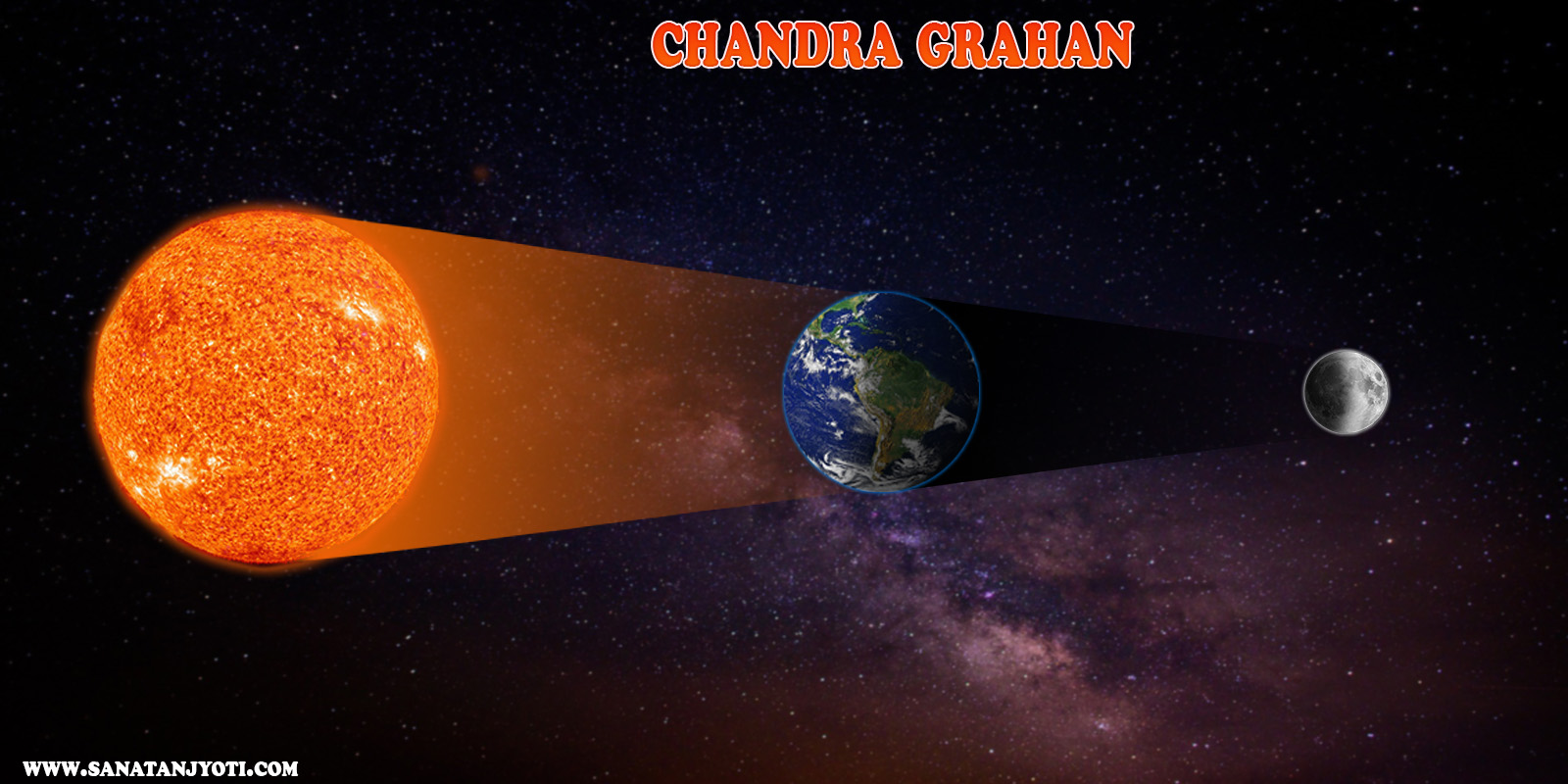
Chandragrahan is an astronomical event that occurs when the Sun, Earth and Moon align in such a way that Earth's shadow falls on the Moon. This event can occur only during a Full Moon. During a lunar eclipse, the Moon may appear completely or partially darkened. The exact appearance of the eclipse depends on which part of Earth's shadow the Moon passes through.
In Hindu religious traditions, a lunar eclipse holds special significance. Various beliefs are associated with chanting Mantras, meditation, charity and worship during this period. The practice of observing the Sutak period before an eclipse is also followed by certain religious communities and according to some Panchangs.
How Does a Chandragrahan Occur?
The Moon revolves around the Earth, while the Earth revolves around the Sun. During a Full Moon, when the Earth comes between the Sun and the Moon, Earth's shadow may fall on the Moon. This phenomenon is known as a lunar eclipse.
However, a lunar eclipse does not occur during every Full Moon. This is because the Moon's orbit is tilted by approximately 5 degrees relative to the plane of Earth's orbit around the Sun. As a result, during most Full Moons, the Moon passes above or below Earth's shadow. A lunar eclipse occurs only when the Sun, Earth and Moon align appropriately during a Full Moon.
What Are the Different Types of Chandragrahan?
Lunar eclipses are mainly classified into three types.
1. Total Chandragrahan
A total lunar eclipse occurs when the Moon moves completely into Earth's dark inner shadow, known as the umbra. During this phase, the Moon may appear red or copper colored. This happens because of sunlight passing through Earth's atmosphere.
2. Partial Chandragrahan
A partial lunar eclipse occurs when only a part of the Moon enters Earth's umbra. In this situation, one portion of the Moon appears darkened while the remaining part stays illuminated.
3. Penumbral Chandragrahan
A penumbral lunar eclipse occurs when the Moon passes through Earth's lighter outer shadow, known as the penumbra. The Moon may appear slightly dimmer during this event. Sometimes, this change is difficult to notice with the naked eye.
What Is the Relationship Between a Chandragrahan and Purnima?
A lunar eclipse can occur only during a Full Moon because the Earth is positioned between the Sun and the Moon at this time. However, not every Full Moon result in a lunar eclipse. Since the Moon's orbit is tilted, it usually passes above or below Earth's shadow.
A lunar eclipse becomes visible only when the Moon passes through Earth's shadow during a Full Moon.
For more information about the Full Moon, read our article: [Purnima]
What Is the Difference Between a Lunar Eclipse and a Solar Eclipse?
Both lunar and solar eclipses are astronomical events, but the positions of the Sun, Earth and Moon differ in each case.
During a lunar eclipse, the Earth comes between the Sun and the Moon, causing Earth's shadow to fall on the Moon. In contrast, during a solar eclipse, the Moon comes between the Sun and the Earth, causing the Moon's shadow to fall on the Earth.
A lunar eclipse can occur during a Full Moon, while a solar eclipse can occur during a New Moon. However, not every Full Moon result in a lunar eclipse, and not every New Moon results in a solar eclipse.
To learn more about how a solar eclipse occurs, its types, the Sutak period and related religious beliefs, read: [Solar Eclipse]
What Is the Sutak Period During a Lunar Eclipse?
In Hindu religious traditions, the period before an eclipse is known as the Sutak Kaal. According to many traditions, the Sutak period for a lunar eclipse begins approximately nine hours before the eclipse. However, the beliefs surrounding Sutak, its duration and the associated rules may vary depending on the visibility of the eclipse, the Panchang and religious customs.
Therefore, it is advisable to consult the Panchang for your city to find the Sutak timings for a particular lunar eclipse. Religious beliefs associated with the Sutak period should be understood separately from scientifically established astronomical effects.
What Should You Do During a Lunar Eclipse?
According to religious beliefs, people may follow these practices during a lunar eclipse according to their traditions and faith:
• Chant Mantras and practice meditation.
• Remember and pray to your Ishta Devta or chosen deity.
• Recite religious scriptures.
• Donate to charity and help people in need.
• After the eclipse ends, take a bath and perform Puja according to your tradition.
These practices should be understood in the context of religious traditions and personal faith. Beliefs about their benefits are not identical across all traditions.
What Should You Avoid During a Lunar Eclipse?
Different religious traditions follow different rules about what should and should not be done during a lunar eclipse. Some traditions prescribe specific rules regarding food, worship and other daily activities during the Sutak period.
• Follow the rules of your religious tradition according to your faith.
• Do not present a religious belief as a scientific fact.
• Avoid believing unverified or fear-inducing claims about eclipses without checking their authenticity.
Viewing a lunar eclipse with the naked eye is generally safe. This differs from a solar eclipse, during which looking directly at the Sun can damage your eyes.
What Are the Beliefs About Food During a Lunar Eclipse?
Some religious traditions advise avoiding food during the Sutak period or while an eclipse is in progress. Some families follow the practice of placing Tulsi leaves in food or eating only after the eclipse has ended.
These are religious and family traditions. There is no scientific evidence that an ordinary lunar eclipse makes regular food poisonous. Decisions about food should take health, age and individual needs into account.
What Should You Do After a Lunar Eclipse?
According to religious traditions, people may take a bath, clean the Puja area, use fresh water and perform worship after a lunar eclipse ends. Some families also practice charity and other meritorious activities after the eclipse.
People may follow these customs according to their religious beliefs, family traditions and regional practices.
What Is the Religious Significance of a Lunar Eclipse?
In Hinduism, the Moon is considered significant from both religious and astrological perspectives. For this reason, a lunar eclipse is also regarded as a special religious event. Many traditions place importance on Mantra chanting, meditation, charity and spiritual practices during this period.
According to religious beliefs, chanting and charitable acts performed during an eclipse may hold special significance. Individuals follow these beliefs according to their faith and traditions.
Why Do People Chant Mantras During a Lunar Eclipse?
According to religious beliefs, Mantra chanting and meditation during a lunar eclipse are considered forms of spiritual practice. Depending on their tradition, people may chant the Mantra of their Ishta Devta, the Mahamrityunjaya Mantra or other commonly practiced Mantras.
From a religious perspective, the purpose of Mantra chanting is to focus the mind, offer prayers and maintain spiritual discipline.
What Is the Significance of Charity During a Lunar Eclipse?
Hindu religious traditions include the practice of donating during a lunar eclipse or after it ends. People may donate food grains, clothes, money or other essential items according to their means.
Charity is also associated with compassion, Seva and helping people in need. When making donations, it is helpful to consider both your means and the recipient's actual needs.
What Is the Relationship Between a Lunar Eclipse and a New Moon?
A lunar eclipse occurs during a Full Moon, whereas a New Moon is the lunar phase in which a solar eclipse can occur. During a Full Moon, the Moon appears opposite the Sun in the sky. During a New Moon, the Moon is positioned close to the Sun's direction.
However, not every Full Moon results in a lunar eclipse, and not every New Moon results in a solar eclipse. The appropriate alignment of the Sun, Earth and Moon is necessary for either event.
To learn about the date, religious significance, Puja Vidhi and Vrat associated with Amavasya, read: [Amavasya]
Frequently Asked Questions About Chandragrahan
1. What is a lunar eclipse?
A lunar eclipse is an astronomical event in which Earth's shadow falls on the Moon. It can occur only during a Full Moon.
2. How does a lunar eclipse occur?
A lunar eclipse occurs when the Earth comes between the Sun and the Moon during a Full Moon, causing Earth's shadow to fall on the Moon.
3. How many types of lunar eclipses are there?
There are three main types of lunar eclipses: total lunar eclipse, partial lunar eclipse and penumbral lunar eclipse.
4. Does a lunar eclipse occur during every Full Moon?
No. The Moon's orbit is tilted relative to Earth's orbital plane, so the Moon does not pass through Earth's shadow during every Full Moon.
5. What is the Sutak period during a lunar eclipse?
In religious traditions, the period before a lunar eclipse is known as the Sutak Kaal. Its duration and associated rules may vary according to the Panchang, visibility and religious customs.
6. What should you do during a lunar eclipse?
According to religious beliefs, people may chant Mantras, meditate, pray and donate to charity. These practices are followed according to individual faith and tradition.
7. Should you eat during a lunar eclipse?
Some religious traditions advise avoiding food during an eclipse or the Sutak period. Scientifically, there is no evidence that a lunar eclipse makes ordinary food poisonous.
8. Is it safe to view a lunar eclipse with the naked eye?
Yes. Viewing a lunar eclipse with the naked eye is safe. Unlike a solar eclipse, a lunar eclipse does not require special glasses for viewing.
9. What is the difference between a lunar eclipse and a solar eclipse?
During a lunar eclipse, Earth's shadow falls on the Moon. During a solar eclipse, the Moon's shadow falls on the Earth.
10. How can you find the date and timing of a lunar eclipse?
To find the date, beginning and ending times, and visibility of a lunar eclipse in a particular city, consult the local Panchang and reliable astronomical sources.
For dates and timings of solar and lunar eclipses, the Sutak period and other important Panchang details, visit: [SanatanJyoti Panchang]