
Introduction
In the Hindu calendar, certain periods are not just a sequence of dates but carry deeper meaning. They create a pause in the usual flow of life, allowing reflection and realignment.
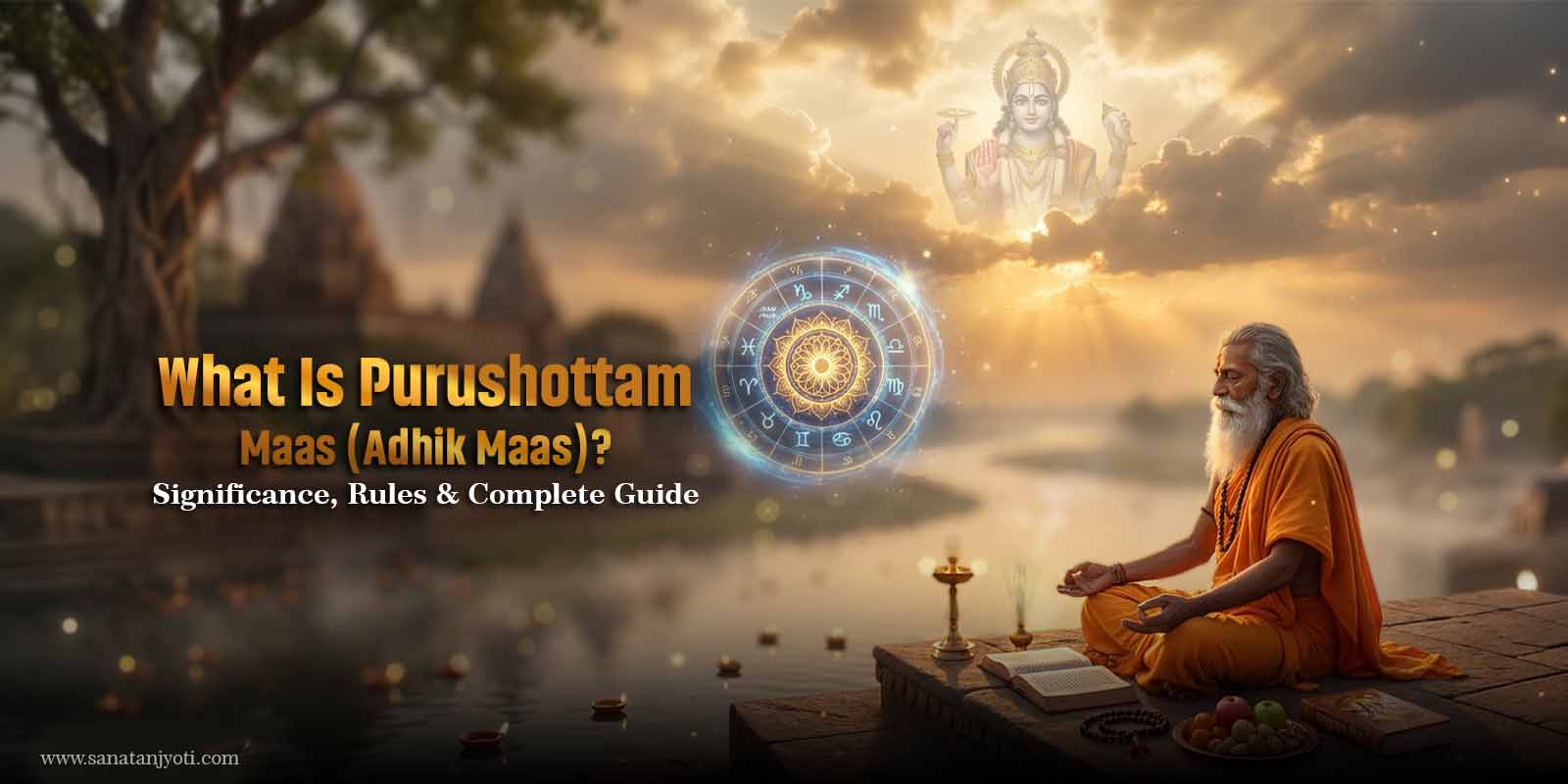
Purushottam Maas, also known as Adhik Maas, is one such period—where the focus shifts from external activity to inner discipline. It does not occur every year, nor is it fixed to a particular month. This makes it important to understand—not just with belief, but with clarity.
When Is Purushottam Maas 2026?
In 2026, Purushottam Maas will begin on 17 May 2026 (Sunday) and end on 15 June 2026 (Monday)
• Start Date: 17 May 2026
• End Date: 15 June 2026
• Duration: Approximately 30 dates
This month occurs when no solar transit (Sankranti) takes place within a lunar month.
How Is Purushottam Maas Calculated?
A natural question arises - why does this month not occur every year?
The Hindu calendar is based on two cycles:
• The Moon (lunar months)
• The Sun (solar transitions)
A lunar month lasts about 29.5 days, while the Sun’s movement across zodiac signs follows a different pace. Over time, a gap develops between the two.
When a complete lunar month passes without any solar transit (Sankranti), that month is declared as Adhik Maas (Purushottam Maas).
Simple Understanding
• Lunar month - Amavasya to Amavasya
• Check - Did the Sun change its zodiac sign?
If no, then it is Adhik Maas
How Often Does It Occur?
It generally occurs every 32 months and 16 days
Which Month Becomes Adhik Maas?
It takes the name of the lunar month in which it occurs
Example:
• Adhik Shravan
• Adhik Ashwin
That is why its name changes every time
Story Behind Purushottam Maas
According to tradition, when this extra month appeared, no deity accepted it. It was considered insignificant. Eventually, it approached Lord Vishnu, who gave it his own name - Purushottam Maas
He declared that any spiritual practice, charity, or discipline performed during this time would yield special results.
Spiritual Significance
This period is not meant for outward expansion, but for inward alignment.
• Self-reflection
• Discipline
• Spiritual growth
It is often seen as a time to reset one’s direction.
What Should Be Avoided?
• Marriage
• Housewarming
• Starting major new ventures
• Large financial decisions
It is a time to pause, not to initiate.
What Should Be Done?
• Worship of Lord Vishnu
• Chanting and meditation
• Reading spiritual texts
• Charity and service
These practices are considered especially beneficial during this period
Does It Affect Everyone the Same Way?
Not necessarily.
While the period is spiritually favourable for all, its deeper impact can vary based on an individual’s birth chart.
• For some, it becomes a phase of introspection
• For others, a turning point in life direction
Special Guidance
If you want to understand:
• Which spiritual practices are suitable for you
• What kind of ritual (Anushthan) aligns with your chart
You can visit our Anushthan Consultation Page and get free guidance.
Purushottam Maas is not just an extra month. It is a pause given by time itself—so that life can be understood more clearly.
“When external motion slows down, inner movement begins.”
Frequently Asked Questions
1. When will Purushottam Maas occur next?
Purushottam Maas does not occur every year. It generally appears after an interval of about 32 months and 16 days. The exact year can be determined through Panchang calculations. Approximately it occurs every 3rd year.
2. Does Purushottam Maas come every year?
No, Purushottam Maas (Adhik Maas) does not occur every year. It appears only when there is no Sun transit (Sankranti) during a lunar month, making it an extra month in the Hindu calendar. Adhik Maas occurs approximately once every three years, depending on the lunar and solar calendar alignment.
The previous Purushottam Maas 2023 was observed during the Shravan month (from 18 July to 16 August 2023). The next Purushottam Maas 2029 will occur from 16 March to 13 April 2029.
3. How to identify which month becomes Adhik Maas?
The lunar month in which no Sankranti occurs is declared as Adhik Maas. Its name changes accordingly (e.g., Adhik Shravan).
4. Are all auspicious activities avoided?
Yes, major events like marriage and housewarming are avoided. However, spiritual practices are highly encouraged.
5. Does it affect everyone equally?
No, its effect varies depending on one’s birth chart and life situation.