
Why Did Samudra Manthan Take Place?
The story of Samudra Manthan is about more than the search for the nectar of immortality. It begins with an event that took away the wealth and glory of Indra, the king of heaven. The gods lost their strength and became helpless against the demons. When heaven came under threat, Lord Vishnu showed the gods a way to regain their power through Samudra Manthan, or the churning of the ocean.
During this great event, many divine objects appeared from the ocean. Goddess Lakshmi also appeared and took her place on Lord Vishnu’s chest. Later, a major struggle began between the gods and demons over the nectar of immortality.
This story includes many important events, such as Sage Durvasa’s curse, Indra’s pride, the helplessness of the gods, Lord Vishnu’s divine plan, and his Mohini Avatar. Let us explore the complete story step by step.
Why Did Sage Durvasa Curse Indra?
Once, Sage Durvasa was traveling across the Earth. He was known for his powerful nature and short temper. He is also considered an avatar of Lord Shiva. During his travels, he saw a celestial woman holding a divine garland made from Sanatanaka flowers. The beauty and sweet fragrance of the garland caught the sage’s attention.
Sage Durvasa asked the woman for the garland. She felt fortunate to give it to him and offered it with great respect. Pleased with her gesture, the sage placed the divine garland around his neck and continued his journey.
Some time later, he met Indra, the king of heaven. Indra was riding his elephant, Airavata. When Sage Durvasa saw him, he took the garland from his neck and offered it to Indra.
Indra accepted the garland, but he did not show respect for its divine value. Instead, he placed it on Airavata’s back.
Attracted by the fragrance of the Sanatanaka flowers, Airavata picked up the garland with his trunk but then dropped it to the ground. When the garland fell, Sage Durvasa became very angry. He had given it to Indra with respect, so he felt insulted when Indra treated it carelessly.
The sage’s anger grew, and he cursed Indra. He declared that all his wealth, glory, and power across the three worlds would be destroyed.
For Indra, this curse was much more than a warning about losing wealth. The glory of heaven, the power of the gods, and their influence were all at risk. Sage Durvasa’s curse brought a dark period to the prosperity of heaven.
How Did Sage Durvasa’s Curse Weaken the Gods?
Sage Durvasa’s curse soon began to take effect. When Indra returned to Amaravati, the capital of heaven, it no longer looked as glorious as before. Indra’s brightness and influence began to fade. The other gods also started losing their strength. The gods who once filled heaven with their power were no longer as strong as they had been.
The demons noticed the gods’ weakness and saw a chance to attack. They launched an attack on the gods. Since the gods had lost their power, they could not fight back successfully and were defeated.
A great crisis spread across heaven. The gods had to leave their home and flee. The place they once ruled was now under the threat of the demons.
The gods faced a serious question: How could they regain their strength and stop the demons from becoming more powerful?
Finally, all the gods went to Lord Brahma for help. They shared their troubles and asked him how they could escape the crisis. Lord Brahma understood their situation and advised them to seek help from Lord Vishnu. From that moment, the gods placed all their hopes in Lord Hari, another name for Lord Vishnu.
Why Did Lord Vishnu Advise the Gods to Churn the Ocean?
Lord Brahma, Indra, the other gods, and the sages went to seek help from Lord Vishnu. They reached the shore of the Kshira Sagar, or the Ocean of Milk, and began praying to him with devotion. Their prayers showed how deeply they wanted to regain their lost strength.
Lord Vishnu heard their prayers. He assured them that they could regain their power, but they would need to follow a special plan. He advised them to stop fighting the demons for the time being and work with them to churn the Ocean of Milk.
The churning would produce the nectar of immortality. By drinking it, the gods would become immortal and unbeatable, and their strength would return. Lord Vishnu’s plan gave the gods new hope.
However, the task was not easy. They needed a huge mountain to use as a churning rod and a strong rope to turn it. Lord Vishnu instructed them to use Mount Mandara as the churning rod and Vasuki, the king of serpents, as the rope. He also asked the gods to collect the herbs needed for the churning.
The gods now had to put aside their old rivalry and work with the demons. Both sides wanted the nectar, so they agreed to take part in the same task.
Thus began the great Samudra Manthan, an event that would affect all three worlds.
How Did Samudra Manthan Take Place? The Roles of Mount Mandara and Vasuki
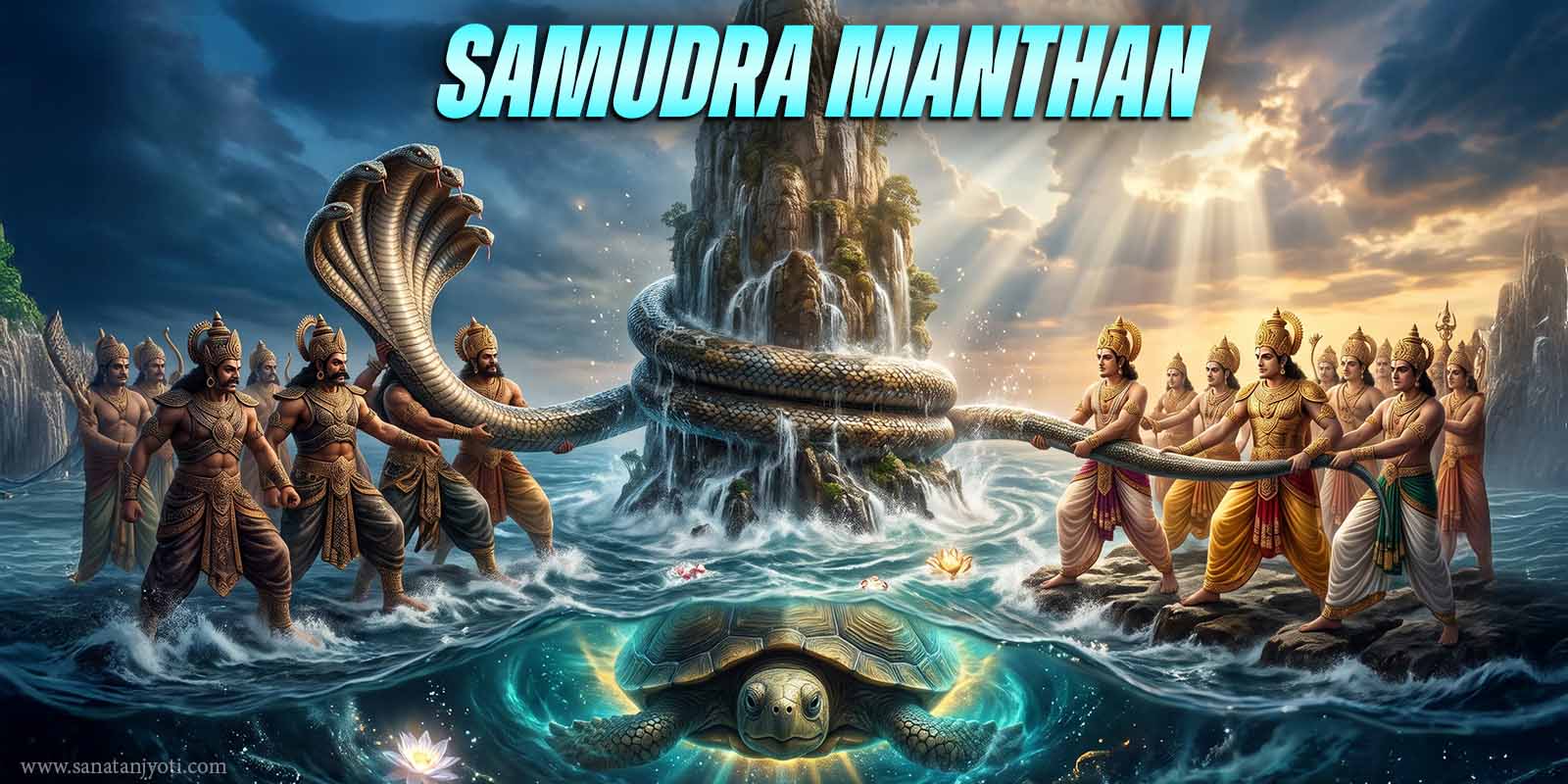
Following Lord Vishnu’s plan, the gods and demons began preparing for the churning of the ocean. They used Mount Mandara as the churning rod and wrapped Vasuki, the king of serpents, around it as a rope.
Lord Vishnu asked the demons to stand near Vasuki’s head and the gods to stand near his tail. Both sides then began pulling the serpent in opposite directions. The mountain started turning like a churning rod, and the Ocean of Milk began to move.
Divine objects hidden deep within the ocean started appearing one by one. Both the gods and demons were waiting for the nectar, but every new object brought another surprise.
No one knew how many wonderful things the ocean would reveal before the nectar appeared. The churning continued, and the ocean began to give up its hidden treasures.
What Came Out of Samudra Manthan?
Many divine objects and wonderful beings appeared during Samudra Manthan. Each new appearance brought a fresh surprise for the gods and demons.
1. The Appearance of Kamadhenu
Kamadhenu appeared first during the churning of the ocean. She was a divine cow. Her appearance was the first wonderful sign of the ocean’s divine treasures. The churning then continued, and more divine objects began to appear.
2. The Appearance of Kalpavriksha
After Kamadhenu, Kalpavriksha appeared. It is believed to be a divine tree that fulfills wishes. Its appearance made the event even more remarkable.
The nectar had not yet appeared, but the ocean was slowly revealing the divine treasures hidden within it.
3. The Appearance of the Apsaras
As the churning continued, the Apsaras, or celestial beings, appeared. Their arrival made the scene even more extraordinary. The Ocean of Milk continued to reveal divine objects and beautiful forms.
4. The Appearance of Chandra Dev
Next, Chandra Dev, the Moon God, appeared from the ocean. After his appearance, Lord Shiva took him and placed him on himself. This event revealed another divine aspect of Samudra Manthan.
5. The Appearance of Poison
Poison also appeared during the churning. According to this story, the Nagas, or serpent beings, took the poison into their care.
While the churning brought out many divine objects, the appearance of poison became a serious turning point in the event.
Still, the churning did not stop. The gods and demons continued their efforts, hoping to obtain the nectar. At last, the moment they had been waiting for arrived.
Lord Dhanvantari Appeared with the Pot of Nectar
The churning of the ocean continued, and after some time, Lord Dhanvantari appeared. He carried a pot filled with the nectar of immortality.
As soon as the gods and demons saw the nectar, their eyes turned toward the pot. After all their efforts, the nectar was finally before them.
Both sides were eager to obtain it. The gods wanted to regain their lost strength, while the demons also wanted to drink the nectar and become unbeatable.
The pot was no longer just a divine object. It became the center of the struggle between the gods and demons.
However, the most remarkable event of Samudra Manthan was still to come. After Lord Dhanvantari appeared, Goddess Lakshmi emerged from the ocean.
The Appearance of Goddess Lakshmi During Samudra Manthan
During the churning, Goddess Lakshmi appeared holding a lotus. She wore beautiful clothes, jewelry, and flower garlands. Her appearance was one of the most beautiful and divine moments of Samudra Manthan.
Goddess Lakshmi bathed in sacred water and decorated herself with beautiful jewelry and flower garlands. After this, she took her place on Lord Vishnu’s chest. Her appearance added a special sense of divinity to the story.
When the demons saw Goddess Lakshmi with Lord Vishnu, they became angry and jealous. They then snatched the pot of nectar from Lord Dhanvantari’s hands.
The nectar was now in the hands of the demons, and the gods faced another crisis. They knew that stopping the demons would become much harder if they drank the nectar.
At this critical moment, Lord Vishnu used his divine power and illusion to find a solution.
Why Did Lord Vishnu Take the Mohini Avatar?
When the demons took control of the pot of nectar, Lord Vishnu took the form of Mohini. She appeared as an extremely beautiful woman. The demons became fascinated by her beauty and lost sight of the real purpose of the nectar.
In the form of Mohini, Lord Vishnu told the demons that everyone would receive the nectar equally. Trusting her words, the demons handed the pot to her.
Mohini took the pot and used her beauty and divine illusion to keep the demons distracted. They became so fascinated by her that they failed to pay close attention to who was drinking the nectar.
Taking advantage of the situation, Mohini began giving the nectar to the gods. Through Lord Vishnu’s divine plan, the nectar reached the gods, and they started regaining their lost strength.
However, one demon among them saw through Mohini’s illusion. His name was Svarbhanu.
How Were Rahu and Ketu Created?
Svarbhanu understood that Lord Vishnu was giving the nectar to the gods in the form of Mohini. He disguised himself as a god and quietly sat among them. In this way, he tried to drink the nectar as well.
When the Sun God and Moon God saw Svarbhanu, they recognized him. They informed Lord Vishnu about his trick.
Lord Vishnu immediately used his Sudarshan Chakra and cut off Svarbhanu’s head from his body. However, the nectar had already entered his body. Because of its power, his head and body did not disappear. Instead, they continued to exist as separate forms.
Svarbhanu’s head became known as Rahu, while his body became known as Ketu. Since the Sun God and Moon God had exposed his trick, Rahu and Ketu became their enemies.
According to this belief, Rahu and Ketu try to swallow the Sun and Moon because of this rivalry. This story is linked to the traditional explanations of solar and lunar eclipses.
Thus, Svarbhanu’s attempt to obtain the nectar led to the origin of Rahu and Ketu. This part of the Samudra Manthan story later became connected with traditional Indian beliefs about eclipses.
According to the Samudra Manthan story, Rahu is believed to continue attempting to swallow the Sun and the Moon, a belief associated with solar and lunar eclipses. In astrology, the Sun, Moon, and zodiac signs hold special significance. To find out what the day holds for your zodiac sign, read Today’s Horoscope.
The Samudra Manthan story describes the origin of Rahu and Ketu and their connection with Surya Dev (the Sun God) and Chandra Dev (the Moon God). To understand the positions of the Sun, Moon, Rahu, and Ketu in your birth chart and their astrological significance, read Rahu and Ketu in Your Birth Chart to learn more about their role in Vedic astrology.
How Did the War Between the Gods and Demons End?
When the demons learned that Mohini had used her divine illusion to distract them and give the nectar to the gods, they became furious. Another battle broke out between the gods and demons.
This time, the situation was different. The gods had already drunk the nectar and regained their strength. They were now able to fight the demons.
The gods defeated the demons in battle. The demons were forced to retreat toward Patala, the underworld.
For the gods, this victory was more than winning a battle. They had escaped the crisis that began after Sage Durvasa’s curse took away their wealth and power. The gods regained control of heaven.
They expressed their gratitude to Lord Vishnu. Through his grace and plan, they received the nectar, regained their strength, and restored their rule over heaven.
Thus, the story of Samudra Manthan ends with the victory of the gods and the return of their rule over heaven.
6 Important Lessons from the Samudra Manthan Story
1. Pride and carelessness can lead to great losses.
Devraj Indra did not show proper respect for the divine garland given to him by Sage Durvasa. As a result, he was cursed, and the prosperity of the Devas began to decline. This teaches us that no matter how much power, position, or prestige we have, we should always remain humble and respect others.
2. Instead of panicking during difficult times, we should look for solutions.
The Devas lost their strength and were defeated by the Asuras. Even then, they did not give up. They sought the guidance of Lord Brahma and Lord Vishnu and looked for a solution. When we face difficult times in life, we should not lose hope. Instead, we should think wisely and find a way forward.
3. Great goals require teamwork.
To obtain Amrit (the nectar of immortality), the Devas and Asuras had to work together to churn the ocean. This teaches us that achieving big and difficult goals often requires cooperation, patience, and continuous effort.
4. We must face difficulties to achieve good results.
During the Samudra Manthan, poison and several divine treasures emerged before the nectar appeared. Yet the churning continued. Similarly, the path to achieving a great goal in life is not always easy. When difficulties arise, we must remain patient and keep moving forward.
5. We should not trust someone based only on their outward appearance.
The Asuras were captivated by Mohini's beauty and handed over the pot of Amrit to her. This episode reminds us not to be influenced only by someone's appearance or outward charm. We should use our wisdom and judgment before making decisions about people or situations.
6. Wisdom and timely decisions can change a situation.
When the pot of Amrit fell into the hands of the Asuras, Lord Vishnu took the form of Mohini and changed the course of events. This teaches us that strength alone cannot solve every problem. Sometimes, wisdom, patience, and the right strategy are equally important.
What Is the Deepest Lesson of the Samudra Manthan Story?
The story of Samudra Manthan reminds us that power and desire alone are not enough to achieve success in life. Humility, patience, cooperation, and wisdom are equally important. Sometimes, we must face difficulties before reaching our goals, but with careful thinking and continuous effort, we can find a way forward.
Just as the nectar of immortality emerged only after continuous churning of the ocean, good results in life also require consistent effort and perseverance.
Frequently Asked Questions About Samudra Manthan
1. Why Did Samudra Manthan Take Place?
Sage Durvasa’s curse caused Indra to lose his wealth and glory, and the gods became weak. The demons took advantage of this weakness and defeated them. To help the gods regain their strength, Lord Vishnu advised them to work with the demons to churn the ocean and obtain the nectar of immortality.
2. What Curse Did Sage Durvasa Give Indra?
Indra placed the divine garland given by Sage Durvasa on Airavata’s back. When Airavata dropped it to the ground, the sage became angry. He cursed Indra, saying that all his wealth and glory across the three worlds would be destroyed.
3. What Were Mount Mandara and Vasuki Used for During Samudra Manthan?
Lord Vishnu instructed the gods and demons to use Mount Mandara as the churning rod and Vasuki, the king of serpents, as the rope. They pulled Vasuki from opposite sides to churn the Ocean of Milk.
4. Which Divine Objects Appeared During Samudra Manthan?
The story describes the appearance of Kamadhenu, Kalpavriksha, the Apsaras, Chandra Dev, poison, the pot of nectar held by Lord Dhanvantari, and Goddess Lakshmi.
5. How Did Goddess Lakshmi Appear During Samudra Manthan?
Goddess Lakshmi appeared from the ocean holding a lotus. After bathing in sacred water and decorating herself, she took her place on Lord Vishnu’s chest.
6. Why Did Lord Vishnu Take the Mohini Avatar?
When the demons took the pot of nectar from Lord Dhanvantari, Lord Vishnu took the form of Mohini. He used his divine illusion to distract the demons and find a way to give the nectar to the gods.
7. How Were Rahu and Ketu Created?
A demon named Svarbhanu disguised himself as a god and sat among the gods to drink the nectar. The Sun God and Moon God exposed him. Lord Vishnu used his Sudarshan Chakra to cut off his head. Because the nectar had already entered his body, his head became Rahu and his body became Ketu.
8. What Did the Gods Gain After Samudra Manthan?
After drinking the nectar, the gods regained their strength. They defeated the demons in battle and restored their rule over heaven.
The story of Samudra Manthan begins with Sage Durvasa’s curse and ends with the victory of the gods. Indra’s loss of wealth and power created a crisis for the gods. To regain their strength, they had to work with the demons to search for the nectar of immortality.
Following Lord Vishnu’s plan, the gods and demons churned the ocean. Many divine objects appeared, Goddess Lakshmi took her place on Lord Vishnu’s chest, and the Mohini Avatar helped the nectar reach the gods.
This story includes many remarkable events, such as Sage Durvasa’s curse, the churning of the Ocean of Milk, Lord Dhanvantari’s pot of nectar, the appearance of Goddess Lakshmi, Mohini’s divine illusion, and the origin of Rahu and Ketu.