

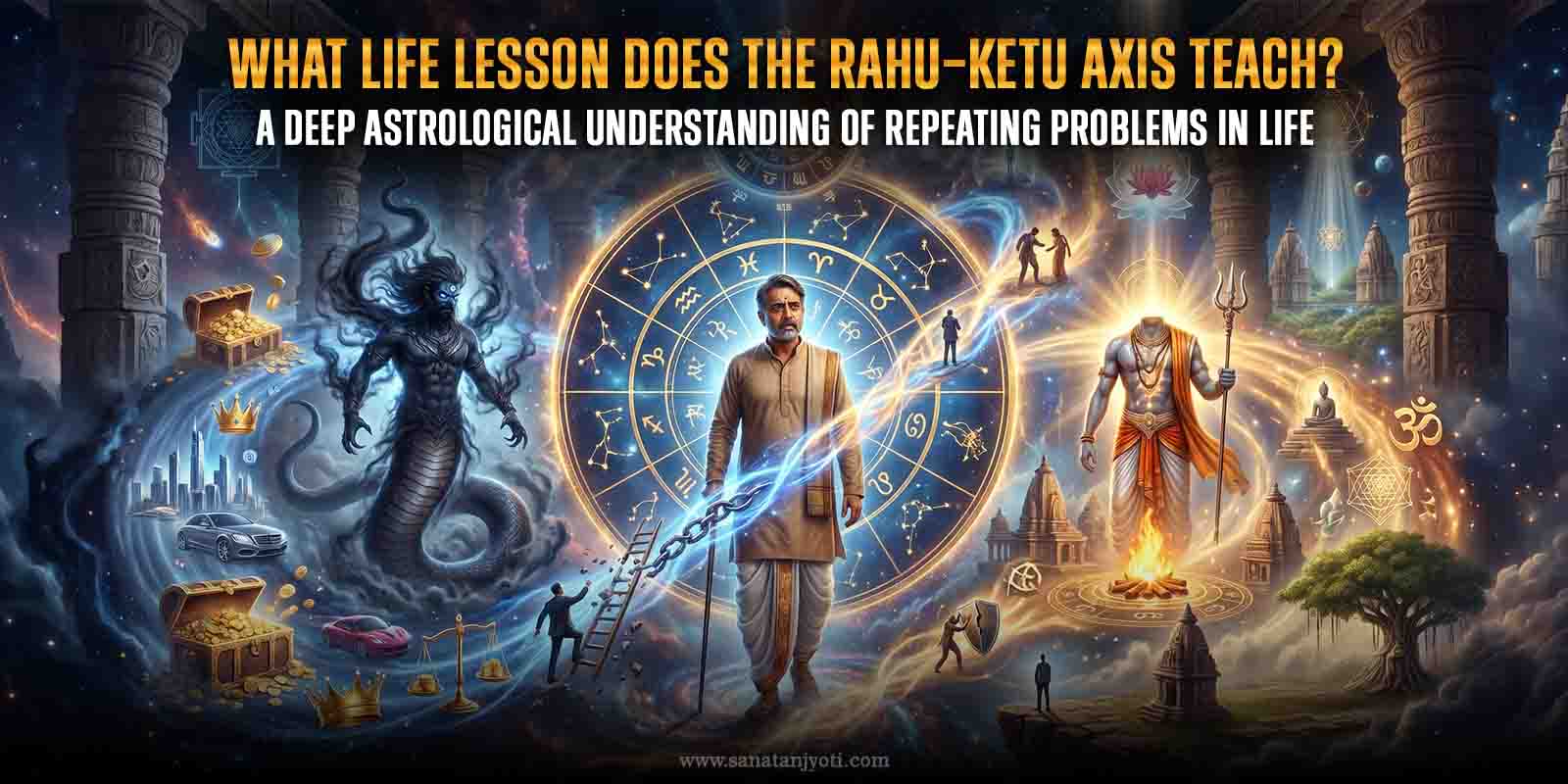
Astrology becomes incomplete if Rahu and Ketu are viewed merely as two shadow planets. In reality, Rahu and Ketu form the most important axis in the entire horoscope. This is not simply a planetary placement; it represents the inner struggle of life where one part of a person wants to move forward while another part keeps pulling them back.
This is one of the reasons why many people experience the same types of problems repeatedly throughout life.
• Relationships breaking again and again
• Frequent career changes
• Constant dissatisfaction
• Feeling empty even after achieving success
• Or experiencing intense struggles in a particular area of life
Behind many of these situations lies the deeper influence of the Rahu–Ketu axis. Rahu and Ketu are always exactly 180 degrees apart from each other. Wherever Rahu is placed, Ketu occupies the house directly opposite to it.
For this reason, this is not merely a planetary influence but a continuous tension between two opposite directions of life.
What Do Rahu and Ketu Actually Represent?
In simple terms:
Ketu = Where experience already exists
and
Rahu = Where growth is required
Ketu represents the area of life where a person feels naturally comfortable. There is experience there. There is familiarity there. A person often feels as though they already understand that area of life. The challenge, however, is that Ketu does not provide lasting satisfaction.
Gradually, it creates detachment from that area. On the other hand, Rahu represents the area where growth must occur.
It is where attraction exists.
It is where hunger exists.
It is where dissatisfaction exists.
It is where a person keeps trying again and again.
And many times, that very area becomes the greatest struggle of life.
Why Does Rahu Always Create Restlessness?
Wherever Rahu is placed, a person often feels:
"If I can just achieve this one thing, then I will finally be satisfied."
But Rahu's nature does not allow complete satisfaction.
Therefore:
• A higher position is desired after attaining a position
• More wealth is desired after earning wealth
• A deeper relationship is desired after finding a relationship
• Greater recognition is desired after becoming recognized
This is why Rahu pushes a person forward while simultaneously keeping them restless.
Why Does Ketu Create Detachment?
Wherever Ketu is placed, a person may possess capability and experience yet gradually lose interest.
Many people find themselves wondering:
"I already have all this. Why am I still not satisfied?"
That is the nature of Ketu.
Even after achievement, it can create an inner feeling of emptiness.
Why Do Similar Problems Keep Repeating in Life?
This is one of the most important psychological aspects of the Rahu–Ketu axis.
People often want to return repeatedly to the area represented by Ketu because it feels comfortable and familiar.
However, life continuously pushes them toward the area represented by Rahu. This is where the struggle begins. And that struggle itself becomes the life lesson.
Rahu in the 1st House – Ketu in the 7th House
Here, the individual must develop a strong personal identity. However, they may repeatedly lose themselves in relationships.
Life Lesson:
Learn to discover who you truly are.
Rahu in the 2nd House – Ketu in the 8th House
Here, the individual must learn stability, family values, and long-term security. However, the mind may repeatedly gravitate toward crises, mysteries, and extreme transformation.
Life Lesson:
Stability is also a part of growth.
Rahu in the 3rd House – Ketu in the 9th House
Here, the person must learn to trust personal effort. However, they may become overly dependent on philosophy, beliefs, or destiny.
Life Lesson:
Action is just as important as ideas.
Rahu in the 4th House – Ketu in the 10th House
Here, the individual must develop inner peace. However, the mind may constantly chase achievement and external success.
Life Lesson:
Success and peace are not the same thing.
Rahu in the 5th House – Ketu in the 11th House
Here, the individual must discover personal creativity and unique talents. However, they may become trapped in group approval and social validation.
Life Lesson:
Value your own uniqueness.
Rahu in the 6th House – Ketu in the 12th House
Here, the person must learn to face practical problems and responsibilities. However, the mind may repeatedly seek escape through fantasy, avoidance, or excessive spirituality.
Life Lesson:
Freedom does not come from running away from responsibility.
Rahu in the 7th House – Ketu in the 1st House
Here, the person must learn partnership and cooperation. However, they may repeatedly become trapped in their own viewpoint.
Life Lesson:
It is not only about "me"; it is also about "us."
Rahu in the 8th House – Ketu in the 2nd House
Here, the individual must understand transformation, depth, and the hidden aspects of life.
However, they may cling too strongly to safety and stability.
Life Lesson:
Learn not to fear transformation.
Rahu in the 9th House – Ketu in the 3rd House
Here, the person must develop a broader perspective on life. However, they may become trapped in limited experiences and narrow viewpoints.
Life Lesson:
Life is greater than personal experience alone.
Rahu in the 10th House – Ketu in the 4th House
This is one of the most discussed Rahu–Ketu axes. Here, the individual must contribute to society and develop worldly achievement.
However, there is often an ongoing inner conflict between public success and emotional security.
Life Lesson:
Learn to balance achievement and personal happiness.
Rahu in the 11th House – Ketu in the 5th House
Here, the individual must learn through networks, communities, and collective growth.
However, the mind may remain attached to personal identity and individual creativity.
Life Lesson:
Collective growth is as important as personal growth.
Rahu in the 12th House – Ketu in the 6th House
This is considered one of the most spiritual Rahu–Ketu axes. Here, the individual must learn surrender, inner growth, and letting go of control.
However, the mind may repeatedly become trapped in small conflicts, daily struggles, and the need to control everything.
Life Lesson:
Not everything can be controlled.
Are Rahu and Ketu Connected to Past Lives?
This subject has been discussed in astrology for centuries. Many traditions believe that:
Ketu indicates experiences already known to the soul. Whereas Rahu points toward the areas where growth is required in this lifetime.
Whether one interprets this through the lens of past lives or psychological tendencies, the practical reality remains the same:
People tend to feel comfortable in Ketu-related areas and restless in Rahu-related areas.
The Rahu–Ketu Axis in D1 and D9
It is not appropriate to draw conclusions based solely on the birth chart. If the same life lessons appear in both D1 and D9, that theme becomes even more important in a person's life.
This is why studying Navamsha (D9) becomes essential.
To understand Navamsha in depth,
Read: "How to Identify Planetary Strength in Navamsha (D9)"
Does the Rahu–Ketu Axis Ruin Life?
No.
In reality, this axis defines the direction of life itself. Without Rahu, growth would stop.
Without Ketu, there would be no foundation of experience. The problem is not Rahu or Ketu.
The problem arises when a person wants to remain only in the comfort zone of Ketu and avoids learning the lessons of Rahu.
Special Guidance
If you feel that:
• The same problems keep repeating in your life
• You are facing constant struggle in one particular area
• Success still fails to bring satisfaction
• Or you cannot understand where life is trying to take you
Then do not rely solely on general astrology videos.
Get a detailed analysis of your complete horoscope
Understand the true direction of your Rahu–Ketu axis : -And consult an experienced astrologer to identify the most important life lessons hidden within your chart.
Related Important Articles
"What is Rahu? Its Effects, Illusion, and True Power"
"What is Ketu? The Deep Mystery of Detachment, Spirituality, and Karma"
"What Happens During Rahu Mahadasha?"
"What Does Rahu and Mercury Conjunction Mean?"
"Rahu and Ketu are not two opposing ends of life; they are two stages of the same journey of growth. Ketu shows where you come from, while Rahu shows where you must go. True maturity arrives when a person learns to create balance between the two."