
When is Kansa Vadh in 2026?
In 2026, the Kansa Vadh festival will be observed on 20 November (Friday). This festival is celebrated on the Dashami Tithi of the Shukla Paksha in the month of Kartik and commemorates the slaying of the tyrannical King Kansa by Lord Krishna. The day symbolizes the victory of Dharma over Adharma, the triumph of truth over falsehood, and the divine valor of Lord Krishna in establishing righteousness.
Significance of Kansa Vadh Day
Kansa Vadh Day is observed on the Dashami Tithi of the Shukla Paksha in the month of Kartik. This festival is celebrated in a manner similar to the commemoration of Ravana’s defeat. According to the Puranas, a grand fair was held in Mathura on the day Kansa was slain. Therefore, fairs and religious celebrations are organized in many places on this occasion.
On this day, Lord Krishna ended the reign of the wicked demon king Kansa, marking the triumph of righteousness (Dharma) over evil (Adharma). Even today, Kansa Vadh is considered one of the important religious observances and is celebrated with great devotion and enthusiasm. The story of Kansa’s death is described in detail in various Puranic texts.
How Did Lord Krishna Slay Kansa?
According to the Padma Purana, King Ugrasena had two sons. The elder son was Kansa, and the younger was Sunama. He also had a daughter named Devaki, who was renowned for her extraordinary beauty and virtues. Some Puranic traditions describe Devaki as the daughter of Devaka, Ugrasena’s brother, which is considered possible due to differences among cosmic cycles (Kalpas).
Devaki was married to Vasudeva, the son of Devamidha. Kansa loved his sister deeply and personally drove the chariot carrying Devaki and Vasudeva after their wedding. During the journey, a divine voice (Akashvani) proclaimed:
"O foolish Kansa! The eighth child born to Devaki, whom you are joyfully escorting, will be the cause of your death."
Enraged by this prophecy, Kansa immediately decided to kill Devaki. However, Vasudeva persuaded him by promising that every child born to Devaki would be handed over to him. Kansa accepted this proposal but imprisoned both Devaki and Vasudeva.
In due course, Devaki gave birth to six children, all of whom were killed by Kansa. The seventh child was mystically transferred from Devaki’s womb to that of Rohini by Yogamaya. This child was later born as Lord Balarama.
Thereafter, Lord Krishna appeared as Devaki’s eighth child. By divine arrangement, Yogamaya took birth as a daughter in the house of Nanda and Yashoda. Vasudeva carried the newborn Krishna across the Yamuna River to Gokul and exchanged Him with Yashoda’s daughter before returning to the prison.
When Kansa learned of the birth, he rushed to kill the infant girl. However, as he attempted to smash her against the ground, she rose into the sky and declared:
"O wicked Kansa! The one destined to kill you has already been born."
Terrified by this revelation, Kansa intensified his efforts to eliminate Krishna by sending numerous demons to Gokul. Yet all of them were defeated and killed by Krishna and Balarama.
One day, Sage Narada visited Kansa and informed him that Krishna, the son of Nanda, was indeed the one destined to end his life. Alarmed by this, Kansa organized a grand Dhanush Yajna in Mathura and invited Krishna and Balarama.
He stationed his mighty wrestlers Chanura and Mushtika and placed the colossal elephant Kuvalayapida at the entrance to stop them. Kansa then sent his trusted friend Akrura to bring Krishna, Balarama, and the cowherds to Mathura.
Upon arriving in Mathura, Krishna and Balarama encountered Kuvalayapida. The elephant charged at Krishna, but He effortlessly subdued it, broke one of its tusks, and killed it.
Later, in the wrestling arena, Chanura and Mushtika challenged Krishna and Balarama. The two brothers defeated and killed both wrestlers with ease. Witnessing these events, Kansa became terrified.
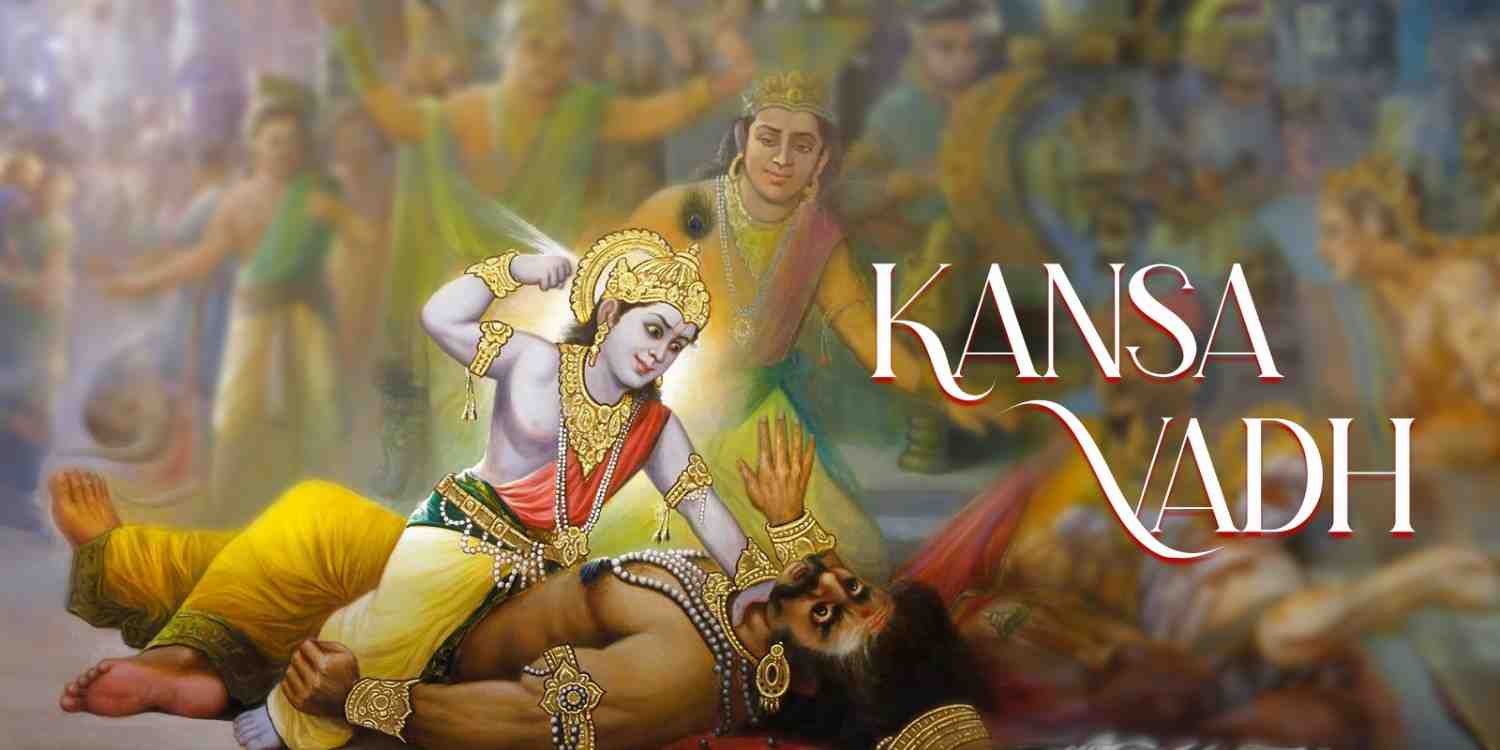
Lord Krishna then leaped onto Kansa’s royal platform, seized him, and hurled him to the ground. With a powerful blow, Krishna ended Kansa’s life. Blood flowed from Kansa’s mouth, and the tyrant died instantly.
Kansa’s younger brother Sunama was also slain by Lord Balarama. Thus, Lord Krishna destroyed the cruel and unrighteous Kansa and restored Dharma.
Kansa Vadh Festival and Its Religious Importance
The slaying of Kansa is not merely the story of a demon’s death; it symbolizes the victory of righteousness over tyranny and evil. By defeating Kansa, Lord Krishna demonstrated that no matter how powerful Adharma may appear, truth and righteousness ultimately prevail.
On the occasion of Kansa Vadh, fairs are organized in many regions. Devotional programs, dramatic reenactments of Krishna’s childhood pastimes, and depictions of Kansa’s downfall are presented. Temples conduct special worship ceremonies, bhajans, kirtans, and other religious events.
Devotees remember Lord Krishna’s courage and divine mission to establish Dharma. The festival inspires people to follow the path of truth, righteousness, and virtue in their own lives. For this reason, Kansa Vadh continues to be celebrated across India with great faith, devotion, and joy.
At Sanatan Jyoti, experienced Acharyas perform a wide range of Vedic rituals dedicated to various deities in accordance with traditional scriptures and sacred procedures. If you would like to learn about the method, religious significance, or spiritual benefits of any specific ritual: -You can visit the Anushthan section to explore detailed information.