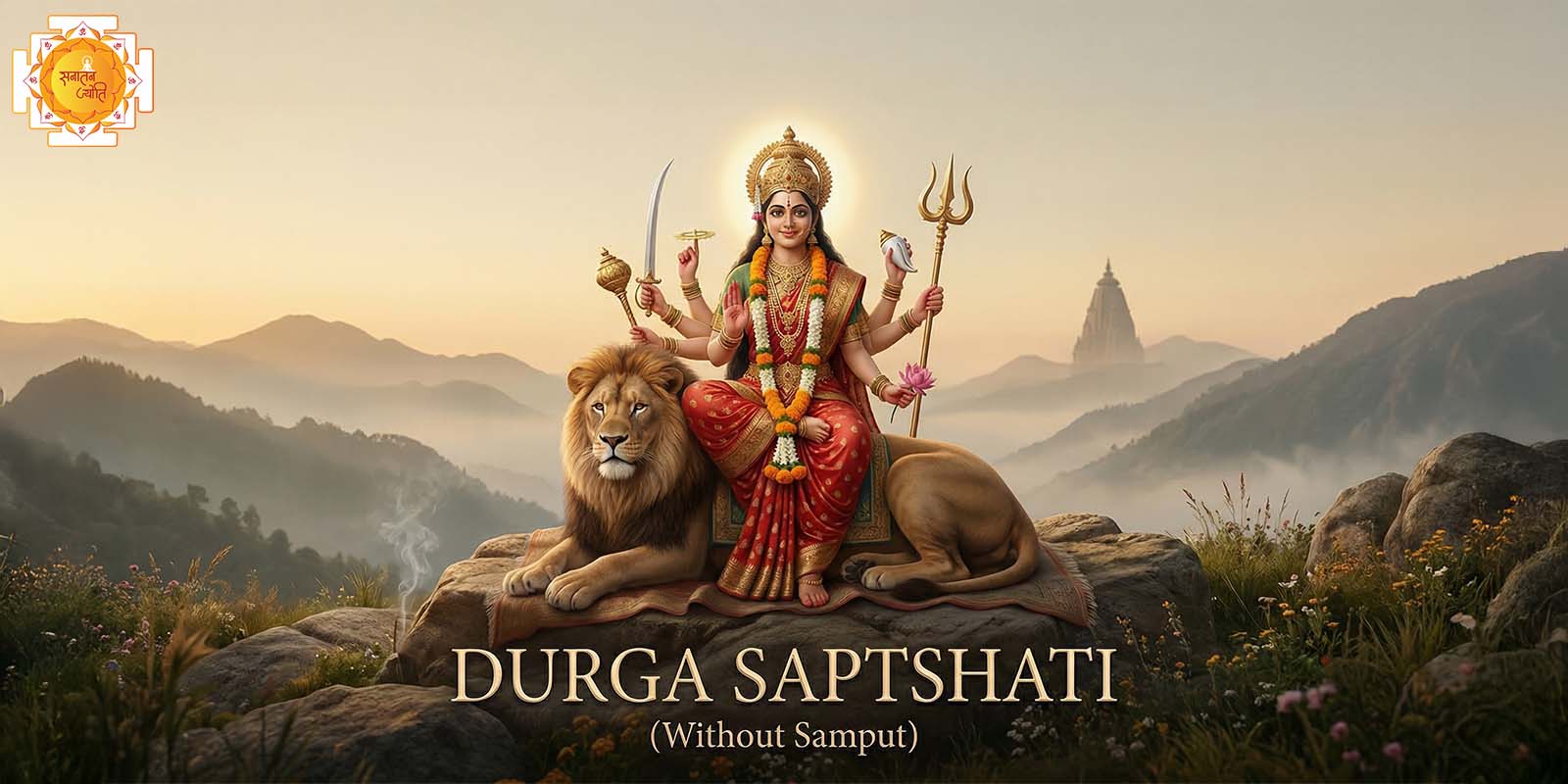
Durga Saptashati Path Without Samput
Durga Saptashati, also known as Shri Chandi Path or Saptashati Mahatmya, is a highly beneficial and powerful scripture of Sanatan Dharma. It is a part of the Markandeya Purana, consisting of 13 chapters and approximately 700 verses (Shlokas). Reciting the Saptashati is not merely a religious ritual but a profound spiritual practice that provides the seeker with inner strength, patience, and divine protection.
This path glorifies the divine powers of Goddess Durga, eliminating negativity and unknown fears from life. Especially when performed in a simple and natural way (without Samput), its purity cleanses the inner self of the devotee. The primary objective of the simple path is to worship the Goddess unconditionally and seek Her general grace.
In this ritual, the 700 verses of the Goddess are recited clearly and melodiously. This generates positive vibrations in the environment, providing the devotee with mental and spiritual tranquillity.
Thus, this simple Durga Saptashati Path ritual is the best medium to deepen a devotee's faith, ensuring all-round progress, auspiciousness, and the effortless grace of the Divine Mother.
Significance and Impact of the Path
Every verse of the Durga Saptashati contains cosmic energy. When recited purely with devotion, without any worldly 'Samput' (add-ons), it purifies the heart of the seeker. This path acts as a 'Divine Shield,' delivering the devotee's prayers directly to the compassionate form of the Goddess. It is particularly effective for those seeking spiritual progress and wishing to remain under the mother’s shelter while following a Sattvic lifestyle.
Who Should Get This Path Performed?
When mental stress begins to rise, concentration in work lacks, and a void of purity is felt in the mind, this worship becomes essential. This ritual is an infallible solution for seekers who:
• Seek Mental Peace: If you are facing constant anxiety or internal conflict, this path can provide stability and profound peace to your mind.
• Desire Spiritual Awakening: For devotees who wish to understand the forms of the Goddess deeply and advance on the path of Bhakti (devotion), this path is ideal.
• Seek Household Purification: If there is an atmosphere of discord at home, this path is extremely helpful in removing negative energy and bringing harmony and sweetness.
• Want to Enhance Concentration: For students and intellectuals, this path proves effective in improving decision-making abilities and memory power.
This ritual is fully supportive in simplifying life's complexities and providing a Sattvic (pure) perspective.
How to Choose the Method of Path?
The impact of the Durga Saptashati Path depends on the sincerity and faith of the seeker. In a simple path, the purity of the procedure and clarity of pronunciation are most important. Several classical sequences are prevalent in tradition:
• Navahna Parayana Method: Completion of the full path in 9 days.
• One-Day Complete Path: Akhand Path (uninterrupted).
Learned Acharyas believe that the commencement of the path should always be in accordance with scriptural dignities. This path, performed without Samput, is a symbol of selfless devotion (Nishkam Bhakti), leading the devotee to a state of complete surrender.
Precautions During Durga Saptashati Path
This ritual is an extremely sacred and high-level spiritual practice. To gain full spiritual benefits, certain rules must be followed:
• Pure Pronunciation: The chanting of mantras and verses must be accurate and rhythmic; hence, selecting an experienced Acharya is recommended.
• Celibacy and Restraint: Maintain a Sattvic diet during the period of the path and keep full control over speech and thoughts.
• Posture and Place: Choose a quiet and clean place for the path and complete the recitation sitting on a single 'Asana' throughout.
• Consistency of Rules: If the path is for nine days, maintaining consistency in time and procedure is considered very important.
Benefits of Durga Saptashati Path
Reciting the Durga Saptashati methodically grants the seeker all-round benefits. Its primary spiritual and worldly benefits are listed below:
1. Spiritual Awakening and Self-Purification:
o The divine mantras purify the subconscious and develop Sattvic qualities.
o The sound waves generated from the chanting fill the seeker's Aura with positive energy.
o This practice helps the devotee to be fully dedicated to God and achieve self-realization.
2. Mental Peace and Freedom from Fear:
o Regular recitation completely destroys unknown fear, anxiety, depression, and mental distress.
o It increases concentration and provides the seeker with mental courage and stability to face life's challenges.
3. Family Harmony and Home Peace:
o The Saptashati Path dispels negative energy from the house and infuses positivity.
o Mutual differences among family members are resolved, increasing love, sweetness, and harmony in relationships.
4. Protection from Unseen Obstacles:
o This path creates a 'Divine Shield' around the individual, protecting them from enemies and the 'evil eye.'
o This ritual is considered very effective in pacifying 'Grah Doshas' (planetary afflictions) and ill effects in the horoscope.
5. Worldly Progress and Prosperity:
o By the grace of the Divine Mother, obstacles in the workplace are removed, and new paths to career success open.
o This path destroys poverty and ensures the increase of pure wealth, fame, and grandeur in the household.
Procedure of Worship for Durga Saptashati Path
The Durga Saptashati Paath Anushthan is considered highly important and should be performed in accordance with scriptural guidelines. In this method, all 13 chapters of the Durga Saptashati are recited daily for a continuous period of 9 days. Completing the full recitation each day typically takes around 2 to 2.5 hours, ensuring the proper accomplishment and spiritual effectiveness of the ritual:
1. Purification & Resolution (Sankalp): The seeker purifies themselves and offers a resolution at the feet of the mother with their name, Gotra, and devotion.
2. Ganpati & Kalash Pujan: Like any worship, first Lord Ganesha, Navgrahas, and the Kalash are worshipped, and the Goddess is invoked.
3. Kavach, Argala, and Keelak: Reciting these three is mandatory before the Saptashati Path, as they provide protection to the seeker and make the path successful.
4. Shapoddhar & Utkeelan: This procedure is performed by experienced Acharyas before the path to awaken the power of the mantras.
5. Recitation of Chapters: Now, the 700 verses are recited devotionally across 13 chapters. Listening to or reading this with faith grants immense merit (Punya).
6. Aarti & Stuti: After the path, the ritual is concluded with the Siddha Kunjika Stotram or the Aarti of the Goddess and Pushpanjali.
7. Forgiveness Prayer (Kshama Prarthana): Finally, a request is made to the Goddess through the 'Aparadh Kshamapan Stotram' for any human errors during the path.
Worship Material for Durga Saptashati Path
• Beautiful idol or picture of Goddess Durga
• Woolen or red silk Asana (seating mat)
• Gangajal, Sandalwood, Kumkum, Akshat (unbroken rice)
• Fresh red flowers and garlands
• Pure cow ghee lamp and incense sticks
• Fresh fruits, sweets, and Naivedya
• Kalash (urn), Coconut, Kalawa (sacred thread)
• Camphor and Havan materials (if performing Havan)
• Red sandalwood rosary for chanting
You too can organize the Durga Saptashati Path through the classical method for your spiritual progress and peace at home.
Frequently Asked Questions
1. What is the difference between a simple Durga Saptashati Path and a Samput Path?
In a simple path, the verses are read in their original form, which is for general grace and spiritual purification. In a Samput Path, a specific mantra is added to the verses to fulfill a particular desire or wish.
2. Is it beneficial to perform the Durga Saptashati Path oneself at home?
Yes, if you can follow the correct pronunciation and rules, performing the path yourself is excellent. However, for complete methodology and purity of mantras, getting it performed by experienced Acharyas is considered especially beneficial.
3. What is the best time to perform this path?
While devotion to the mother can be done anytime, performing this path during Sharadiya or Chaitra Navratri, Gupt Navratri, or any auspicious date (like Ashtami, Chaturdashi) is considered extremely auspicious.
4. Is fasting mandatory during the path?
It is not mandatory, but if capable, performing the path while observing a fruit diet or taking a Sattvic meal once a day is more meritorious and helps in concentrating the mind.
5. Does one get full benefits through an online Sankalp?
Yes, according to scriptures, the host receives the fruits of worship even through a 'representative.' If you cannot be present yourself, a qualified Acharya takes the resolution in your name and Gotra and completes the path, providing you with full benefits.




 +91 9219765437