You may be wondering: If the literal meaning of Bhadra is “the one who brings welfare,” why are auspicious activities prohibited during this period? Is Bhadra never considered auspicious?
Bhadra is described as having a fierce and formidable form. Activities such as Raksha Bandhan, starting a business or undertaking, agricultural activities, marriage, Griha Pravesh, and other auspicious ceremonies should not be performed during Bhadra. Before performing any auspicious activity, it is considered very important to check whether Bhadra is present.
You may be wondering: If the literal meaning of Bhadra is “the one who brings welfare,” why are auspicious activities prohibited during this period? Is Bhadra never considered auspicious?
According to the Puranas, when the demons attacked the Devas, Bhadra was born from the combined power of Surya Dev and his wife Chhaya to destroy the demons. Therefore, she is regarded as the daughter of Surya Dev and Chhaya and the sister of Shani Dev. Just as Shani Dev is known for his intense nature, Bhadra is also described as having an angry and fierce temperament.
Immediately after her birth, she began disrupting auspicious and religious activities because her aim was believed to be the destruction of the entire Earth. Brahma Ji then explained the consequences of her actions and assigned her a place in the seventh Karana, Vishti Karana, while also giving her a boon-like restriction that auspicious activities performed during Bhadra would not be successful.
What Is Bhadra? Why Are People Afraid of It?
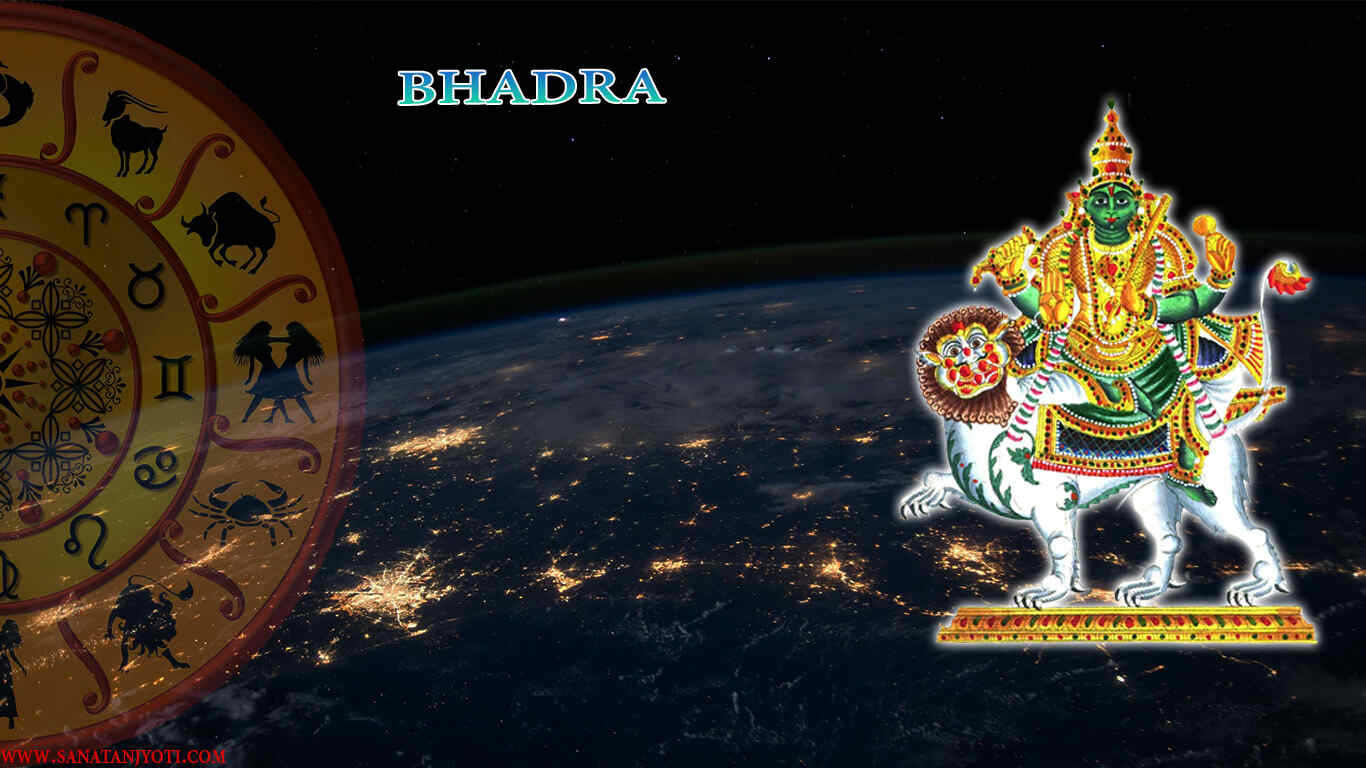
According to the scriptures, Bhadra is described as having a black and terrifying appearance, with a long and broad nose and chin, a mouth capable of devouring everything, and flames emerging from her mouth. She is portrayed as a destructive force capable of destroying everything.
Bhadra is considered an inauspicious period that should generally be avoided for auspicious activities. According to the Panchang, Vishti Karana is known as Bhadra.
Half of a Tithi is called a Karana. There are two Karanas in one Tithi, and they are broadly classified into two types—Chara and Achara.
There are a total of 11 Karanas, of which 4 are Achara and 7 are Chara:
Chara Karanas: Bav, Balav, Kaulav, Taitila, Gar, Vanija and Vishti.
The seventh Chara Karana, Vishti, is known as Bhadra.
Achara Karanas: Shakuni, Chatushpada, Naga and Kimstughna.
Bhadra Calculation
Bhadra occurs during the latter half (Parardha) of Tritiya and Dashami Tithis of Krishna Paksha, and during the first half (Purvardha) of Saptami and Chaturdashi Tithis.
In Shukla Paksha, Bhadra occurs during the latter half (Parardha) of Ekadashi and Chaturthi Tithis, and during the first half (Purvardha) of Ashtami and Purnima Tithis.
Bhadra is believed to reside in all three worlds. Therefore, Bhadra is described in three forms according to her place of residence—Swargaloka, Patala and Mrityuloka.
To know when Bhadra will occur throughout the year: -Check the Panchang now.
The Panchang provides the dates and timings of Bhadra Kaal, along with important fasts, festivals, and other significant dates throughout the year.
Bhadra in Swargaloka
When the Moon transits through Aries, Taurus, Gemini or Scorpio, Bhadra is considered to reside in Swargaloka.
Bhadra in Patala Loka
When the Moon transits through Virgo, Capricorn, Sagittarius or Libra, Bhadra is considered to reside in Patala Loka.
Bhadra in Mrityuloka
When the Moon transits through Cancer, Aquarius, Leo or Pisces, Bhadra is considered to reside in Mrityuloka.
Results Based on Bhadra's Residence
“Swarga Bhadra Shubham Kuryat, Patale Cha Dhanagamam.
Mrityu Loka Gata Bhadra, Sarva Karya Vinashyati.”
When Bhadra resides in Swargaloka, she is believed to produce auspicious results.
When Bhadra resides in Patala Loka, she is believed to bring financial gains.
When Bhadra resides in Mrityuloka, she is believed to cause the destruction or failure of activities.
How Many Names Does Bhadra Have? What Are They?
Bhadra is said to have twelve names, which are:
1. Dhanya
2. Dadhimukhi
3. Bhadra
4. Mahamari
5. Kharanana
6. Kalaratri
7. Maharudra
8. Vishti
9. Kulaputrika
10. Bhairavi
11. Mahakali
12. Asurakshayakari
In reality, Bhadra is regarded as a divine Shakti, considered to be a manifestation of Maa Durga herself. Because of her destructive nature, she is described as a fierce and formidable form of divine energy.
She has twelve names, and according to the tradition, she can also be pleased through the twelve Mantras associated with these names. These twelve Mantras are:
1. Om Dhanya Swaha
2. Om Dadhimukhi Swaha
3. Om Bhadra Swaha
4. Om Mahamari Swaha
5. Om Kharanana Swaha
6. Om Kalaratri Swaha
7. Om Maharudra Swaha
8. Om Vishti Swaha
9. Om Kulaputrika Swaha
10. Om Bhairavi Swaha
11. Om Mahakali Swaha
12. Om Asurakshayakari Swaha
Om Shanti Svah
Om Shanti Svah
Om Shanti Svah
According to the stated tradition, chanting these twelve Mantras twice each in the morning and twice each in the evening every day is believed to help remove various types of troubles and difficulties.
To get accurate information about auspicious Muhurat and find the right Muhurat according to your birth chart: -Consult our astrologer now.