
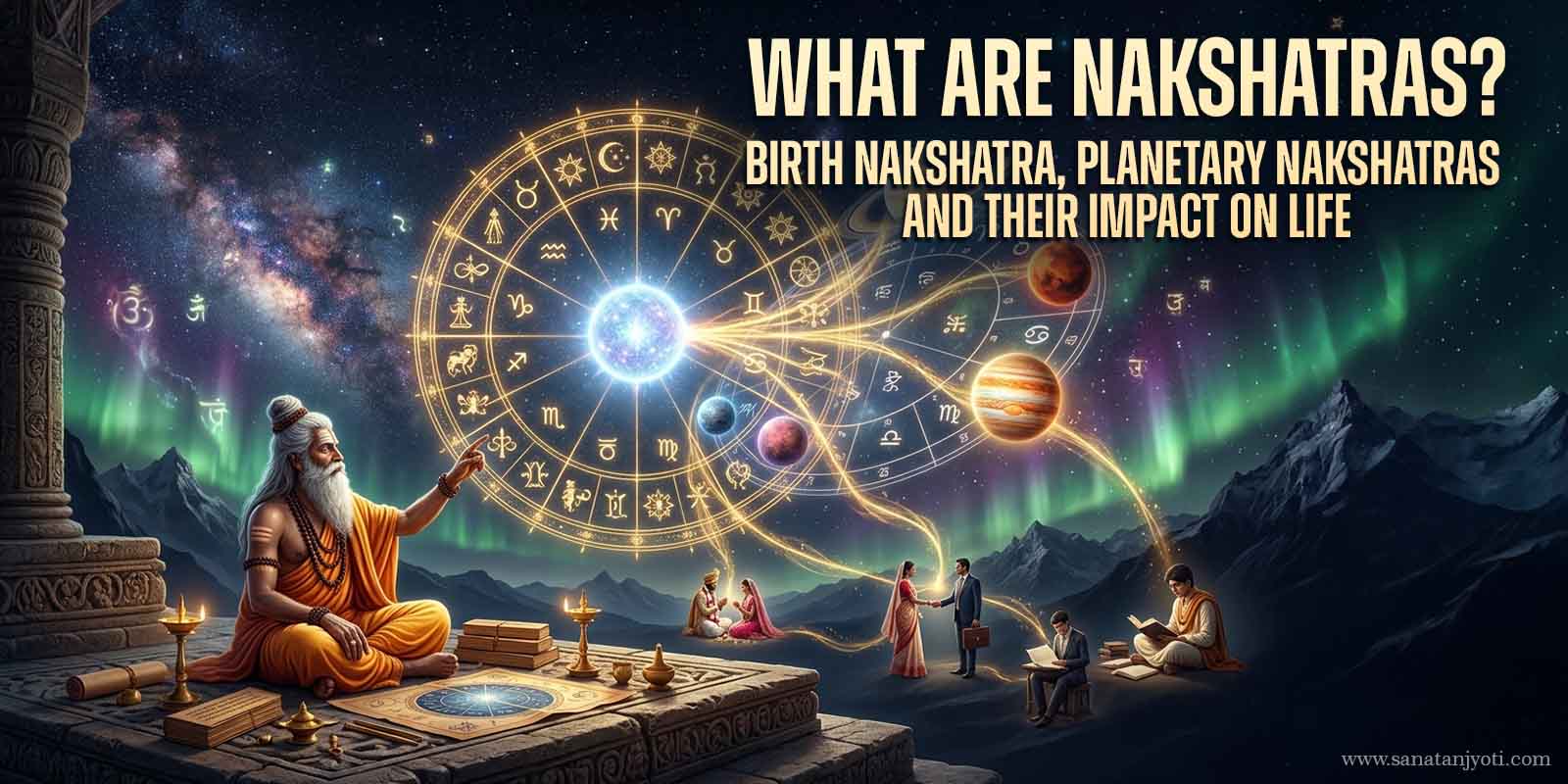
Have you ever wondered why two people belonging to the same zodiac sign can have completely different personalities? Why does one person appear highly spiritual, calm, and introspective, while another person of the same zodiac sign may be ambitious, materialistic, and leadership-oriented?
Why are some people naturally drawn toward knowledge and wisdom, some toward art and beauty, some toward business and wealth creation, while others are fascinated by research, mysteries, psychology, and spirituality? If zodiac signs alone determined everything, then all people born under the same sign should be almost identical.
But real life clearly shows that this is not the case. This is where the world of Nakshatras begins. In Vedic Astrology, zodiac signs are important, but experienced astrologers know that signs alone cannot fully explain a person's personality, mindset, karmic tendencies, and life path.
The Nakshatra occupied by a planet can significantly alter the way that planet functions. This is why Nakshatras are considered one of the most subtle and profound dimensions of Vedic Astrology.
If a zodiac sign is the body, the Nakshatra is its consciousness. If a zodiac sign is the stage, the Nakshatra is the actor performing on that stage. If a zodiac sign provides direction, the Nakshatra reveals the hidden purpose behind that direction.
In this detailed series, we will not only explore all 27 Nakshatras but also understand:
• What is a Birth Nakshatra?
• What is an Ascendant Nakshatra?
• What is a Planetary Nakshatra?
• What happens when the Sun occupies a particular Nakshatra?
• How does the Moon behave in different Nakshatras?
• How do Mars, Mercury, Jupiter, Venus, Saturn, Rahu, and Ketu function through different Nakshatras?
Before we explore these advanced concepts, it is important to understand what Nakshatras actually are.
What Are Nakshatras?
In Vedic Astrology, the celestial zodiac is considered to be 360 degrees. This zodiac is divided into 12 signs, each occupying 30 degrees. However, ancient sages observed that even within the same zodiac sign, people displayed remarkably different personalities, karmic tendencies, and life experiences.
To understand these subtle differences, they divided the zodiac into smaller segments. The 360-degree zodiac was divided into 27 equal sections.
These sections are known as Nakshatras.
Each Nakshatra:
• Occupies 13°20' degrees
• Is ruled by a planetary lord
• Is associated with a specific deity
• Carries a unique psychological energy
• Represents a distinct karmic purpose
In simple terms:
A Nakshatra is the subtle energetic field through which a planet delivers its results. This is why many modern astrology students stop at zodiac signs, while experienced Vedic astrologers give tremendous importance to Nakshatras.
Why Did the Ancient Sages Create the Nakshatra System?
This is one of the most important questions in Vedic Astrology. If zodiac signs already existed, why was there a need for Nakshatras? The answer is simple: Precision.
Imagine two individuals whose Sun is placed in Aries. At the sign level, both may display:
• Leadership qualities
• Courage
• Confidence
However, in real life, these individuals may be completely different.
One person may be:
• Impulsive
• Fast-moving
• Quick in decision-making
Another may be:
• Patient
• Enduring
• Strategic
A third person may be:
• Authoritative
• Leadership-oriented
• Highly direct and outspoken
All three have their Sun in Aries. So where does the difference come from?
The answer lies in the Nakshatra. This is why the sages developed the Nakshatra system—to understand the subtle behavioral patterns of planets.
What Is the Difference Between Zodiac Signs and Nakshatras?
This is one of the most fundamental topics in astrology.
Zodiac signs and Nakshatras operate on different levels.
What Does a Zodiac Sign Reveal?
A zodiac sign tells us:
• The environment in which a planet operates
• The external expression of the planet
• The broad direction of its energy
What Does a Nakshatra Reveal?
A Nakshatra tells us:
• Why the planet acts the way it does
• Its inner motivation
• Its psychological pattern
• How its energy manifests in reality
An Example
Let us assume Mars is placed in Aries. Now consider three possibilities.
Mars in Ashwini Nakshatra
Such a person may:
• Take quick decisions
• Initiate action rapidly
• Be willing to take risks
Mars in Bharani Nakshatra
Such a person may:
• Display greater patience
• Possess strong inner willpower
• Have the ability to endure pressure
Mars in Krittika Nakshatra
Such a person may be:
• Direct
• Aggressive
• Leadership-oriented
Notice something important. In all three cases, Mars is in Aries. Yet the behavior changes completely when the Nakshatra changes. This is the true power of Nakshatras.
Why Are People of the Same Zodiac Sign So Different?
Every serious student of astrology must understand this concept.
Imagine three individuals who all belong to Gemini.
The first person has:
Mrigashira Nakshatra
The second has:
Ardra Nakshatra
The third has:
Punarvasu Nakshatra
All three belong to Gemini. Yet their personalities may be dramatically different.
Mrigashira
Associated with:
• Exploration
• Curiosity
• The desire to learn
Ardra
Associated with:
• Transformation
• Challenges
• Rebuilding after destruction
Punarvasu
Associated with:
• Optimism
• Renewal
• Protection
Now it becomes clear why these three individuals may approach life very differently. This is why zodiac signs alone cannot provide a complete astrological interpretation.
What Is a Birth Nakshatra?
The Nakshatra occupied by the Moon at the time of birth is known as the Birth Nakshatra or Janma Nakshatra. It is considered one of the most important factors in Vedic Astrology. Why? Because the Moon represents the mind.
The Moon governs:
• Emotions
• Thoughts
• Reactions
• Memory
• Psychological tendencies
• The subconscious mind
As a result, the Birth Nakshatra reveals the person's inner nature. Many people appear one way externally but feel completely different internally. The Birth Nakshatra helps explain this hidden dimension.
What Can Be Learned From the Birth Nakshatra?
In Vedic Astrology, the Birth Nakshatra is used to understand:
• Mental nature
• Emotional patterns
• Life direction
• Naming conventions
• Beginning of planetary periods (Dashas)
• Karmic tendencies
This is why, traditionally, one of the first things calculated after a child's birth was the Birth Nakshatra.
Do You Know Your Birth Nakshatra?
Most people know only their zodiac sign.
However, experienced astrologers first examine:
• What is your Birth Nakshatra?
• What is your Ascendant Nakshatra?
• Which Nakshatras are occupied by your planets?
Get your detailed 86-page Birth Chart Report
and discover how your Birth Nakshatra, Planetary Nakshatras, and karmic patterns are influencing your life.
Does the Birth Nakshatra Influence You Throughout Life?
Yes.
However, this does not mean that the entire life is controlled solely by the Birth Nakshatra.
In reality, life is shaped by the combined influence of:
• Birth Nakshatra
• Ascendant
• Planets
• Houses
• Planetary aspects
• Mahadashas and Antardashas
Nevertheless, the Birth Nakshatra remains one of the strongest indicators of the mind and fundamental personality.
Birth Nakshatra and Personality
Many people spend years trying to understand themselves.
They ask questions such as:
• Why do I think this way?
• Why am I drawn to certain subjects?
• Why do I feel different from others?
• Why do some experiences affect me so deeply?
The answers to these questions are often hidden within the Birth Nakshatra.
This is why Vedic Astrology places so much importance on the Moon.
Ancient sages declared: "Chandrama Manaso Jatah" (The Moon is the source of the mind.) And the Nakshatra occupied by the Moon reveals how that mind functions.
What Is an Ascendant Nakshatra?
After the Birth Nakshatra, one of the most important Nakshatras in a horoscope is the Ascendant Nakshatra.
While the Birth Nakshatra represents the mind and inner nature of an individual, the Ascendant Nakshatra reflects the outer personality, life approach, and the way a person interacts with the world.
In simple terms:
• Birth Nakshatra = Who you are internally
• Ascendant Nakshatra = How the world perceives you
This is why many people appear confident and strong externally while being deeply sensitive internally.
Similarly, some individuals may appear calm and reserved, yet possess tremendous ambition and determination beneath the surface.
The difference often arises because the Birth Nakshatra and Ascendant Nakshatra influence different dimensions of life.
How Does the Ascendant Nakshatra Influence a Person?
The Ascendant Nakshatra impacts:
• Personality
• Behaviour
• Life philosophy
• Decision-making style
• Social image
• Career direction
• Overall approach toward life
For example:
If the Ascendant Falls in Ashwini Nakshatra
The person may:
• Take quick decisions
• Embrace new beginnings
• Be adventurous
• Possess pioneering qualities
If the Ascendant Falls in Pushya Nakshatra
The person may be:
• Protective
• Responsible
• Supportive
• Naturally nurturing
This is why knowing only the Ascendant sign is not enough.
Understanding the Ascendant Nakshatra adds a much deeper layer to astrological interpretation.
What Is a Planetary Nakshatra?
This is where Nakshatra Astrology becomes truly fascinating.
Most people know:
• Which sign their Sun occupies
• Which sign their Moon occupies
• Which sign their Mars occupies
But far fewer people know:
• Which Nakshatra the Sun occupies
• Which Nakshatra the Moon occupies
• Which Nakshatra Mars occupies
• Which Nakshatra Venus occupies
Whenever a planet is placed in a Nakshatra, it begins expressing itself through the energy of that Nakshatra.
In advanced Vedic Astrology, understanding the Nakshatra placement of a planet is often just as important as understanding its sign placement.
Why Are Planetary Nakshatras So Important?
Imagine two individuals whose Sun is placed in Leo.
Both may possess leadership qualities.
However:
First Individual
Sun in Magha Nakshatra
Such a person may be strongly connected to:
• Legacy
• Family lineage
• Ancestral traditions
• Authority
Second Individual
Sun in Purva Phalguni Nakshatra
Such a person may be more inclined toward:
• Creativity
• Popularity
• Art
• Social recognition
The sign remains the same.
The planet remains the same.
Only the Nakshatra changes.
Yet the expression of the planet changes dramatically.
This demonstrates why Nakshatras are considered one of the most advanced tools in Vedic Astrology.
How Do Planetary Nakshatras Actually Work?
Experienced astrologers follow an important principle:
A planet behaves not only according to its own nature but also according to the Nakshatra lord governing the Nakshatra it occupies.
For example:
Venus in Ashwini Nakshatra
• Planet = Venus
• Nakshatra Lord = Ketu
Venus naturally represents:
• Love
• Relationships
• Beauty
• Attraction
• Harmony
However, when Venus operates through Ashwini, it also receives the influence of Ketu.
Possible manifestations may include:
• Spiritual love
• Karmic relationships
• Detachment within relationships
• A search for deeper emotional meaning
This is precisely why Nakshatra-based astrology provides insights that cannot be obtained through signs alone.
Do You Know Which Nakshatras Your Planets Occupy?
Most people know their zodiac sign.
Very few know:
• Which Nakshatra their Sun occupies
• Which Nakshatra their Moon occupies
• Which Nakshatra their Mars occupies
• Which Nakshatra their Venus occupies
Get your detailed 86-page Birth Chart Report
and discover the true Nakshatra-based influences shaping your personality, relationships, career, and destiny.
The Importance of Nakshatra Lords
The 27 Nakshatras are governed by 9 planetary lords. Each planet rules three Nakshatras. Understanding these planetary rulers is essential because they provide the underlying energy through which a Nakshatra operates.
Ketu Ruled Nakshatras
• Ashwini
• Magha
• Mula
Primary themes:
• Spiritual evolution
• Detachment
• Karmic lessons
• Liberation
Venus Ruled Nakshatras
• Bharani
• Purva Phalguni
• Purva Ashadha
Primary themes:
• Love
• Beauty
• Pleasure
• Creativity
Sun Ruled Nakshatras
• Krittika
• Uttara Phalguni
• Uttara Ashadha
Primary themes:
• Leadership
• Authority
• Recognition
• Responsibility
Moon Ruled Nakshatras
• Rohini
• Hasta
• Shravana
Primary themes:
• Growth
• Nurturing
• Learning
• Emotional development
Mars Ruled Nakshatras
• Mrigashira
• Chitra
• Dhanishta
Primary themes:
• Action
• Ambition
• Achievement
• Initiative
Rahu Ruled Nakshatras
• Ardra
• Swati
• Shatabhisha
Primary themes:
• Innovation
• Transformation
• Independence
• Breaking boundaries
Jupiter Ruled Nakshatras
• Punarvasu
• Vishakha
• Purva Bhadrapada
Primary themes:
• Wisdom
• Expansion
• Dharma
• Knowledge
Saturn Ruled Nakshatras
• Pushya
• Anuradha
• Uttara Bhadrapada
Primary themes:
• Discipline
• Patience
• Responsibility
• Karma
Mercury Ruled Nakshatras
• Ashlesha
• Jyeshtha
• Revati
Primary themes:
• Communication
• Intelligence
• Adaptability
• Strategy
The Relationship Between Mahadasha and Nakshatras
This is one of the most powerful aspects of Nakshatra Astrology.
Many people do not realize that the famous Vimshottari Dasha System is completely based on Nakshatras.
At the time of birth:
• The Moon occupies a specific Nakshatra.
• The ruler of that Nakshatra determines the starting Mahadasha.
For example:
Birth in Ashwini Nakshatra
The Dasha sequence begins with Ketu.
Birth in Rohini Nakshatra
The Dasha sequence begins with the Moon.
This is why Nakshatras do not merely describe personality.
They also describe timing.
Why Are Nakshatras Important During Mahadashas?
Many people ask:
• Why did this event happen now?
• Why did this opportunity appear at this specific time?
• Why did a particular struggle emerge during this period?
The answer is often hidden within:
• Mahadasha
• Antardasha
• Nakshatra Lord
• Planetary activations
This is one of the reasons why Nakshatras play a critical role in predictive astrology.
Importance of Nakshatras in D1, D9, and D10 Charts
Advanced Vedic Astrology does not stop at the birth chart alone.
Astrologers also study divisional charts to understand deeper dimensions of life.
D1 (Rashi Chart)
Represents:
• Overall life framework
• Personality
• Major life events
D9 (Navamsha Chart)
Represents:
• Spiritual maturity
• Marriage
• Inner strength
• Fortune
D10 (Dashamsha Chart)
Represents:
• Career
• Profession
• Public achievements
• Professional growth
When a planet shows similar Nakshatra influences across D1 and D9, its results often become significantly stronger.
This is why advanced astrologers analyze Nakshatras across multiple divisional charts instead of relying solely on signs.
Get Your Detailed Birth Chart Report
If you want to know:
• What your Birth Nakshatra reveals about you
• Which Nakshatra governs your Ascendant
• Which Nakshatras your Sun, Moon, Mars, Venus, and other planets occupy
• Which Nakshatra is currently influencing your life the most
Then obtain your Detailed 86-Page Birth Chart Report.
This comprehensive report can help you understand the Nakshatra-based, planetary, and Dasha-related influences operating in your life.
Talk to an Experienced Astrologer
If you want to:
• Understand your Birth Nakshatra in depth
• Learn how your planetary Nakshatras influence your destiny
• Analyze your current Mahadasha and Antardasha
• Understand the Nakshatra influences on marriage, career, finances, and spirituality
• Receive personalized horoscope guidance
Then connect with the experienced astrologers at SanatanJyoti.
A skilled astrologer can analyze your complete horoscope and explain how Nakshatras, planetary placements, and Dashas are shaping your life journey.
Nakshatras are not merely a chapter within Vedic Astrology. They are the soul of Vedic Astrology. Zodiac signs provide direction. Planets provide power. But Nakshatras reveal the purpose behind that power.
Many answers that cannot be fully explained through zodiac signs alone become clear when viewed through the lens of Nakshatras. Perhaps that is why the ancient sages never considered Nakshatras to be merely groups of stars.
They saw them as gateways of consciousness. And perhaps this is where the real journey of astrology truly begins. In the next article of this series, we will explore the first Nakshatra — Ashwini Nakshatra — in complete detail and begin our journey through all 27 Nakshatras.