
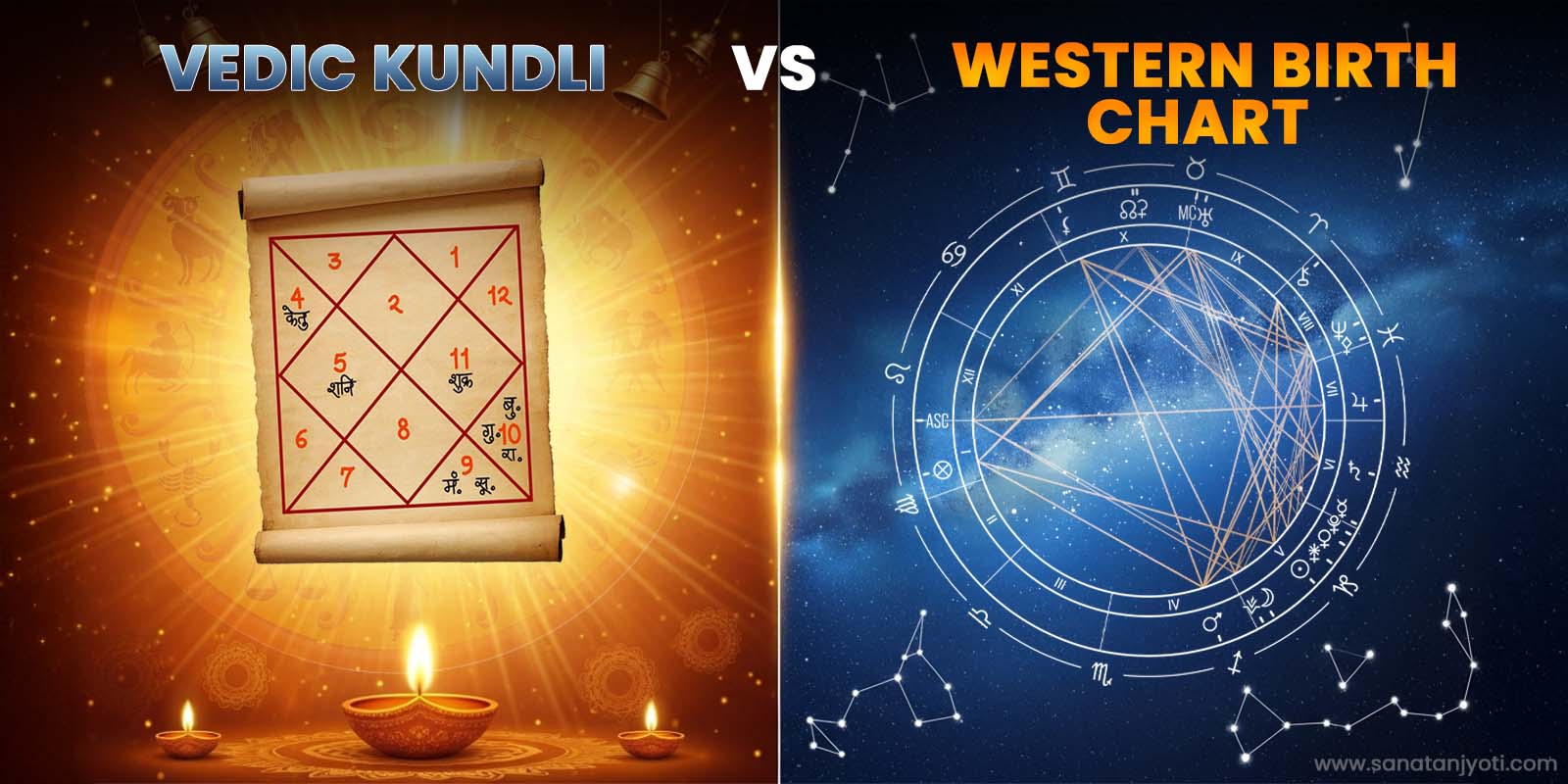
Vedic vs Western Kundali – What Is the Key Difference?
Astrology has been a helpful tool to understanding life for thousands of years. As we read a birth Kundali, not only do we pinpoint where our weak and strong points are but also what is going to be the course of our challenges and possibilities — telling us which way to move on decisions that need to be made. To deeply examine various aspects of your life and receive accurate guidance, obtaining acomprehensive horoscope reportcan be an excellent option.
Both Vedic and Western astrology read the future through a natal chart, but they differ in certain key respects in their perspectives and fundamental tenets. What follows is a straightforward examination of those differences.
1. The Foundation of Calculation
This is the most significant distinction between the two systems.
- Vedic Astrology (Sidereal/Nakshatra-based): Vedic astrology uses the Nakshatra (sidereal) system. It is based on the actual positions of planets and stars in the sky and also takes into account the tilt of the Earth’s axis, which is why its predictions are considered more accurate.
- Western Astrology (Tropical/Moving Zodiac): Western astrology uses the Tropical system (moving zodiac). It prepares the birth chart according to the Sun’s position and considers the Vernal Equinox as a fixed point. This is why your zodiac sign may differ in Vedic and Western astrology.
2. The Importance of Planets
- Vedic Astrology: In Vedic astrology, the nine planets (Navagraha) are considered extremely important. To accurately understand their influence and strength in your birth chart,Planetary Analysisis an effective way. This includes Rahu and Ketu as well, and the Moon sign is considered primary.
- Western Astrology: Western astrology primarily emphasizes the Sun, Moon, and the other eight planets. Here, the Sun sign holds the greatest importance, as it reflects a person’s core personality.
3. Houses and Their Meanings
- Vedic Astrology: Uses 12 bhavas (houses) which play certain roles detailing various life circumstances—self, money, family, children, health, marriage etc.
- Western Astrology: Western astrology also has 12 houses. However, their division and interpretation may differ slightly from Vedic astrology.
4. Remedies
- Vedic Astrology: Diagnoses problems, not only offering treatment but also proposedsolutions. To alleviate negative planetary effects, the text suggests propitiatory practices such as gemstone therapy, mantras recitation, yajña/havan (fire rituals), puja and scripture reading, charity giving (dana) and devotional fasting (vrata).
- Western Astrology: Depends less hevily on ritual cures. Its approach is to get to know someone and then provide counseling-type advice so they can confront life armed with mindfulness and useful tools.
5. Method of Prediction
- Vedic Astrology: In Vedic astrology, theDasha systemis used for making predictions. To understand the ups and downs of life that change over time, it is essential to study the planetary Mahadasha in depth, as it has a profound impact on an individual’s life.
- Western Astrology: In Western astrology, techniques like progressions and transits are used for making predictions.
Which system is best for you?
If you want to understand every area of your life in depth—and you’re looking for ways to reduce adverse planetary effects—Vedic astrology is the most suitable choice.
Why is Vedic astrology preferable?
- Greater accuracy: It is based on the actual positions of the stars, so itsforecasts tend to be more precise.
- Clear remedial guidance: It also prescribes targeted remedies—such as worship/Anushthan, charity, and ap propriate gemstones—to help protect against negative influences.
- In-depth analysis: It studies each planet, house, and dasa in detail, giving you a comprehensive understanding of your life.
Sanatan Jyoti: Your reliable partner for true Vedic astrology
Sanatan Jyoti provides online astrological advice through which you can avail yourself of expert advice on yourbirth chart, dosha (affliction) reports, and efficient remedies. If you require guidance for career, relationship, health, or marriage, Sanatan Jyoti's trained and experienced astrologers stand by to help you.
Frequently Asked Questions
1. Which is more accurate – Vedic or Western astrology?
Vedic astrology is considered more precise as it is based on actual planetary positions and detailed Kundali Vishleshan, along with predictive systems like Dasha.
2. Why is my zodiac sign different in Vedic and Western astrology?
This happens because Vedic astrology uses the sidereal system, while Western follows the tropical system, leading to different planetary placements in your Kundali.
3. Does Western astrology provide remedies like Vedic astrology?
No, Western astrology mainly offers guidance and psychological insights, whereas Vedic astrology provides practical solutions like Anushthan and Muhurat Paramarsh.
4. Can I rely only on online astrology tools for predictions?
Online tools give calculations, but accurate interpretation requires expert Kundali Vishleshan by an experienced Jyotishacharya.
5. Which astrology system is better for life decisions?
For major life decisions like marriage, career, or health, Vedic astrology is preferred due to its detailed analysis and remedy-based approach.