
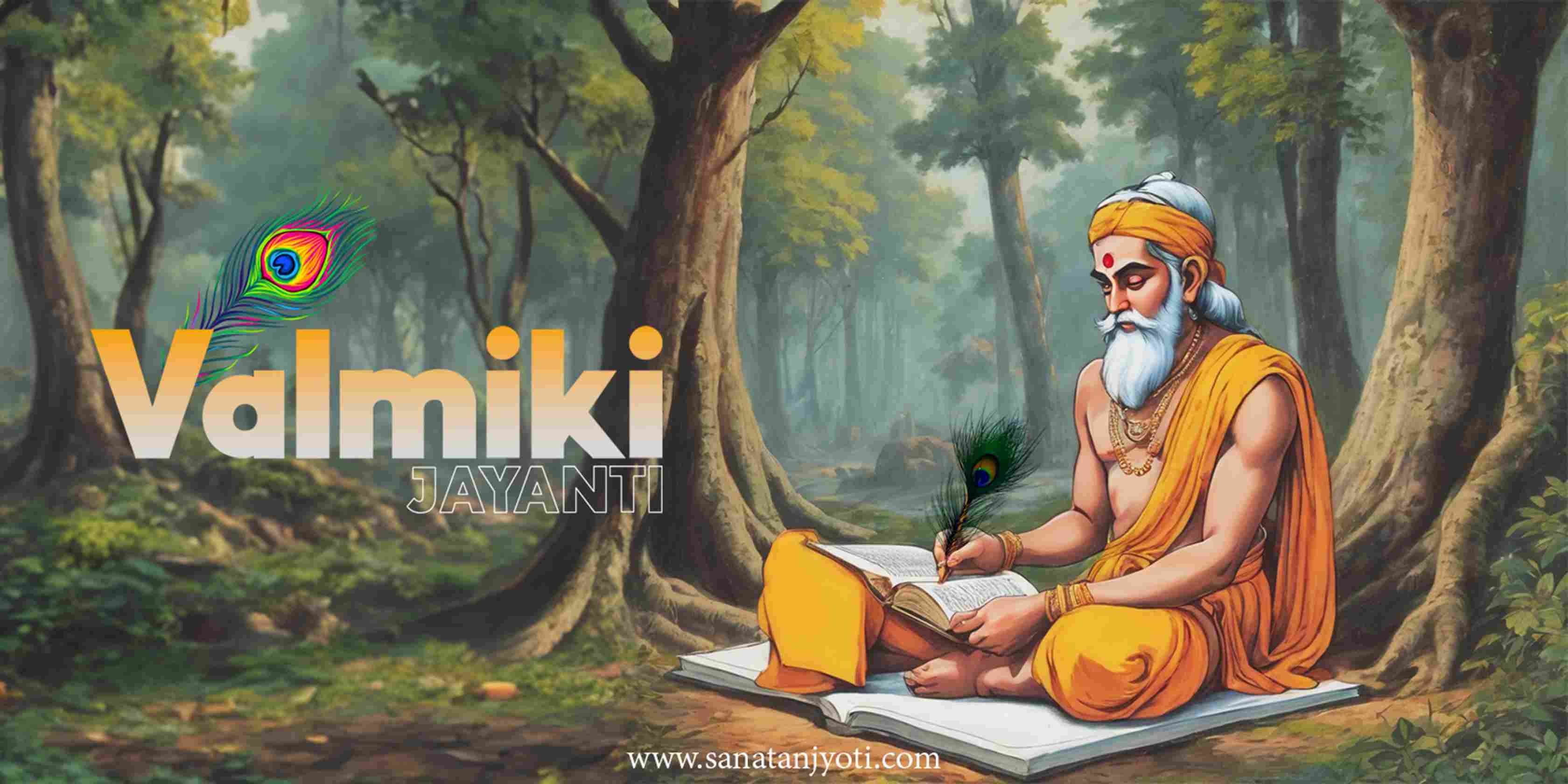
Maharishi Valmiki holds a special place in Indian religious and literary traditions. He is known as the Adi Kavi, or the first poet, and is traditionally credited with composing the great Sanskrit epic Ramayana. Stories about his life convey the message that a person can leave behind past actions and move toward devotion, meditation and knowledge.
Valmiki Jayanti is celebrated every year on the Purnima Tithi of the Ashwin month. On this day, devotees worship Maharishi Valmiki, listen to stories about his life and recite the Ramayana.
If you want to know when Valmiki Jayanti 2026 is, who Maharishi Valmiki was, what his life was like, how he got the name Valmiki, how he composed the Ramayana and what the religious significance of Valmiki Jayanti is, this article provides detailed information.
When is Valmiki Jayanti 2026?
Valmiki Jayanti 2026 will be celebrated on October 26, 2026, Monday.
Valmiki Jayanti is celebrated on the Purnima Tithi of the Ashwin month. On this day, devotees worship Maharishi Valmiki and listen to stories about his life. At many religious places, Ramayana recitations, religious programs and processions are also organized.
To know the exact Purnima Tithi, Valmiki Jayanti date and auspicious puja timings according to your city: -Check our detailed Panchang.
Valmiki Jayanti will be celebrated on October 26, 2026, Monday.
Who Was Maharishi Valmiki?
Maharishi Valmiki is considered one of the great sages of the Vedic period. He is known as the Adi Kavi because he is traditionally credited with composing the great Sanskrit epic Ramayana.
The life of Maharishi Valmiki is associated with an inspiring story of penance, devotion to Lord Rama and the search for knowledge. According to religious traditions, his life shows that a person can change the direction of their life and move toward a spiritual path.
The Ramayana, traditionally attributed to Maharishi Valmiki, is one of the most important texts in Indian religious and literary traditions.
Life History of Maharishi Valmiki
In the Valmiki Ramayana, Maharishi Valmiki introduces himself as the son of Pracheta. Different religious texts and traditions describe different stories about his birth and early life.
According to a popular tradition, his earlier name was Agnisharma, while some traditions also refer to him as Ratnakara. At one stage of his life, he came into contact with people who lived as robbers in the forest. He began robbing travelers to support his family.
During this period, he met the Saptarishis, or seven sages. The sages explained to him that his family members would not share the consequences of his sinful actions. This question became the turning point in his life.
Agnisharma asked his parents, wife and son whether they would share the consequences of his actions. They all refused. This deeply affected him, and he decided to give up his wrong actions and follow the path of meditation and devotion to Lord Rama.
The Story of Ratnakara Becoming Maharishi Valmiki
The story of Maharishi Valmiki's transformation is one of the most well-known stories associated with his life.
According to the traditional story, Agnisharma supported his family by robbing people in the forest. One day, the Saptarishis passed through the forest, and Agnisharma tried to rob them as well.
The sages asked him whether the people for whom he was committing these sinful actions would also share the consequences of his sins.
To find the answer, Agnisharma went to his family. His parents, wife and son refused to take responsibility for his sinful actions. He then realized that he alone would have to face the consequences of his deeds.
After this realization, he gave up his weapons and sought the guidance of the sages. He decided to change the direction of his life.
How the Chanting of Rama's Name Changed His Life
The sages guided Agnisharma toward chanting the name of Lord Rama and practicing meditation.
According to the traditional story, he was unable to pronounce the name Rama correctly. Therefore, he began chanting the word "Mara-Mara." As he continued chanting, the sound gradually became "Rama-Rama."
He remained absorbed in meditation and penance for a long period. During his meditation, an anthill formed around his body. This story of the anthill is traditionally associated with the origin of the name Valmiki.
How Did Maharishi Valmiki Get His Name?
According to religious tradition, Agnisharma sat in meditation at one place for a very long time. He became so deeply absorbed in meditation that an anthill formed around his body.
Many years later, the Saptarishis returned to the same place. They heard the chanting of Rama's name coming from inside the anthill. They removed the anthill and brought Agnisharma out.
The sages said that he had remained inside a Valmika, meaning an anthill, for a long time. Because of this, he came to be known as Valmiki.
In this way, Agnisharma's life changed through meditation, devotion to Lord Rama and the pursuit of knowledge, and he became known as Maharishi Valmiki.
How Did Maharishi Valmiki Compose the Ramayana?
Maharishi Valmiki is known as the first great poet in Sanskrit and is called the Adi Kavi. According to religious tradition, he composed the great epic Ramayana, which is based on the life of Lord Rama.
The Ramayana describes important events from Lord Rama's life, including his birth, exile, the abduction of Sita, the battle with Ravana and his return to Ayodhya.
The Ramayana attributed to Maharishi Valmiki has had a deep influence on Indian culture, religion, literature and philosophy.
Maharishi Valmiki and Devotion to Lord Rama
The life of Maharishi Valmiki is closely associated with devotion to Lord Rama and meditation. His life story gives special importance to the chanting of Rama's name.
According to religious belief, the chanting of Rama's name and continuous penance completely transformed Agnisharma's life and led him to become a great sage.
His life gives the message that a person can rise above their past actions and circumstances by choosing the path of knowledge, devotion and good conduct.
Religious Significance of Valmiki Jayanti
Valmiki Jayanti holds special significance in Sanatan Dharma. On this day, Maharishi Valmiki is remembered and worshipped.
Maharishi Valmiki is respected as the author of the Ramayana and the Adi Kavi. Therefore, listening to his life story, reading the Ramayana and learning from his life are considered meaningful practices on Valmiki Jayanti.
Religious programs, processions and Ramayana recitations are also organized at many places on this occasion.
According to religious belief, worshipping Maharishi Valmiki with devotion can help devotees seek his blessings, knowledge and wisdom.
What to Do on Valmiki Jayanti?
On Valmiki Jayanti, devotees can follow these practices according to their faith and family traditions:
• Worship Maharishi Valmiki.
• Read or listen to the Ramayana.
• Listen to stories about Maharishi Valmiki's life.
• Remember Lord Rama and chant his name.
• Participate in religious programs organized at temples and other religious places.
• Donate food and useful items to people in need.
• Take a resolution to follow good conduct and perform good deeds in life.
What Should You Read on Valmiki Jayanti?
Reading or listening to the Ramayana is considered especially appropriate on Valmiki Jayanti. Devotees can read a particular Kanda, or section, of the Ramayana according to their time and tradition, or listen to the complete epic.
The life story of Maharishi Valmiki can also be read or heard on this day. It provides an opportunity to understand the important events related to his life, penance and devotion to Lord Rama.
Spiritual Message of Valmiki Jayanti
The life of Maharishi Valmiki gives an inspiring message of transformation and self-purification.
His story teaches that regardless of one's circumstances, positive change is possible when a person gives up wrong actions and follows the path of knowledge, devotion and penance.
Valmiki Jayanti inspires us to reflect on our actions, stay away from wrongdoing and follow the path of truth, devotion and good conduct.
Valmiki Jayanti 2026: Frequently Asked Questions
1. When is Valmiki Jayanti 2026?
Valmiki Jayanti 2026 will be celebrated on October 26, 2026, Monday.
2. On which Tithi is Valmiki Jayanti celebrated?
Valmiki Jayanti is celebrated on the Purnima Tithi of the Ashwin month.
3. What is Maharishi Valmiki also known as?
Maharishi Valmiki is known as the Adi Kavi, or the first poet.
4. Which scripture did Maharishi Valmiki write?
Maharishi Valmiki is traditionally considered the author of the great Sanskrit epic Ramayana.
5. How did Valmiki get his name?
According to the traditional story, an anthill formed around him while he was engaged in long meditation. Since Valmika means an anthill, he came to be known as Valmiki.
6. What should you do on Valmiki Jayanti?
On this day, devotees can worship Maharishi Valmiki, read or listen to the Ramayana, chant the name of Lord Rama and donate food or useful items to people in need according to their faith and traditions.
Valmiki Jayanti is an opportunity to remember Maharishi Valmiki, his life, his penance, his devotion to Lord Rama and his contribution to the Ramayana.
On this day, devotees can worship Maharishi Valmiki, read or listen to the Ramayana and learn from his inspiring life. His story encourages people to leave behind wrong actions and follow the path of truth, devotion, knowledge and good conduct.
Valmiki Jayanti 2026 will be celebrated on October 26, 2026, Monday. Devotees can observe the day according to their family traditions and seek the blessings of Maharishi Valmiki for wisdom, spiritual growth and a righteous life.