
Krishna Janmashtami is one of the most sacred and widely celebrated festivals in Sanatan Dharma. It marks the birth of Lord Krishna, the eighth incarnation of Lord Vishnu, who descended to Earth to restore righteousness and protect Dharma. The festival is observed on the Ashtami Tithi of Krishna Paksha in the month of Bhadrapada, especially when it coincides with the Rohini Nakshatra.
On this auspicious day, devotees observe a fast, worship Lord Krishna with great devotion, celebrate His divine birth at midnight, and participate in Bhajans, Kirtans, and beautifully decorated Jhankis (tableaux) in temples and homes.
Every year, millions of devotees search for answers to questions such as When is Krishna Janmashtami 2026?, What is its religious significance?, How should the fast and Puja be observed?, Why was Lord Krishna born at midnight?, and What is the difference between Janmashtami and Dahi Handi?
If you are looking for authentic and detailed information about Krishna Janmashtami 2026, including its date, auspicious timings, Puja Vidhi, fasting rules, birth story, religious significance, and Lord Krishna's divine Leelas, this guide covers everything you need to know.
When is Krishna Janmashtami 2026?
In 2026, Krishna Janmashtami will be celebrated on Friday, 4 September 2026. This sacred festival marks the divine appearance of Lord Krishna on Earth.
On this day, devotees observe a fast, worship Lord Krishna with devotion, and celebrate His birth at midnight, which is considered the most auspicious time for the Janmashtami Puja.
If you would like to know the Krishna Janmashtami 2026 date, Ashtami Tithi, Rohini Nakshatra, auspicious Muhurat, and details of other important Vedic festivals: -Be sure to explore our detailed Vedic Panchang.
Janmashtami 2026 Date and Time
Janmashtami 2026 Date: September 4, 2026, Friday
• Ashtami Tithi Begins: September 4, 2026, at 2:27 AM
• Ashtami Tithi Ends: September 5, 2026, at 12:14 AM
• Rohini Nakshatra Begins: September 4, 2026, at 12:30 AM
• Rohini Nakshatra Ends: September 4, 2026, at 11:05 PM
• Auspicious Puja Muhurat : 4 September 2026 from 11:57 P.M to 5 September 2026 at 12:43 A.M
• Temple Puja Timing : According to tradition, the saints celebrate Janmashtami one day later in the temple, so Janmashtami will be celebrated in the temple on 5 September 2026.
What is Krishna Janmashtami?
Krishna Janmashtami is the sacred festival that celebrates the birth of Lord Krishna.
According to Sanatan tradition, Lord Vishnu incarnated as Lord Krishna to destroy evil, protect righteousness, and restore Dharma on Earth. He was born in a prison cell in Mathura to free the world from the tyranny of King Kansa and to establish justice.
Krishna Janmashtami is not only a celebration of His birth but also a reminder to live a life guided by truth, righteousness, compassion, love, and duty.
Why is Krishna Janmashtami Celebrated?
Krishna Janmashtami is celebrated to honor the divine birth of Lord Krishna.
According to Hindu beliefs, when Adharma (unrighteousness) and injustice spread across the Earth and the cruel rule of King Kansa brought suffering to countless people, Lord Vishnu took birth as Lord Krishna to protect Dharma and destroy evil.
Every year, devotees celebrate this divine incarnation with deep faith and devotion, remembering Lord Krishna's promise to restore righteousness whenever it is threatened.
The Birth Story of Lord Krishna
During the Dwapara Yuga, Maharaja Ugrasena ruled the kingdom of Mathura. His son, Kansa, was known for his cruel and ruthless nature. Driven by greed and arrogance, Kansa forcefully seized the throne from his own father, imprisoned him, and declared himself the king of Mathura.
Some time later, Devaki, Kansa's cousin, was married to Vasudeva. As part of the wedding tradition, Kansa personally drove the chariot to escort his beloved cousin to her new home. While they were on their journey, a divine voice from the heavens proclaimed:
"O Kansa! The eighth child born to your sister Devaki will be the cause of your death."
The prophecy filled Kansa with fear and rage. Without hesitation, he drew his sword and grabbed Devaki by the hair, determined to kill her before the prophecy could come true.
Kansa believed that if Devaki died, she would never give birth to the child destined to end his life. Seeing Kansa consumed by anger, Vasudeva calmly tried to reason with him. He explained that Devaki herself posed no threat and pleaded for her life. Vasudeva then made a solemn promise that every child born to them would be handed over to Kansa, including the eighth child mentioned in the prophecy.
Although Kansa accepted Vasudeva's promise, he could not overcome his fear. He imprisoned both Vasudeva and Devaki and mercilessly killed each of their children as they were born.
When Devaki's eighth child was born, Lord Vishnu incarnated as Lord Krishna. The prison cell was instantly filled with a brilliant divine light. Astonished by the miraculous sight, Vasudeva and Devaki witnessed Lord Vishnu appear before them in His four-armed divine form.
The Lord instructed Vasudeva to carry the newborn Krishna to Gokul, where Nanda Baba and Mother Yashoda had just welcomed a baby girl. He told Vasudeva to exchange the children and return to the prison with the infant girl.
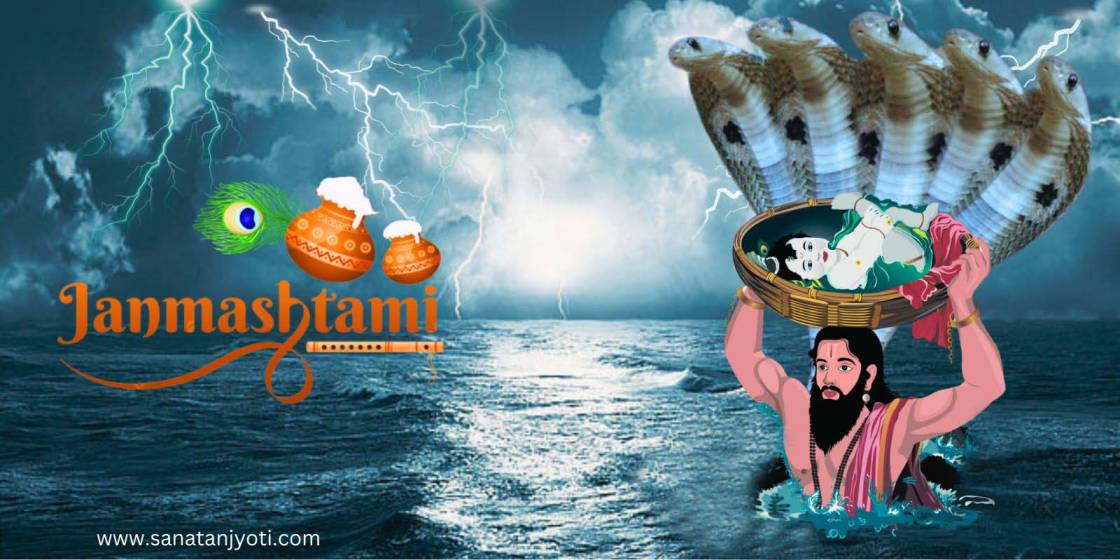
As soon as Vasudeva lifted the divine child, the prison doors opened on their own, and the guards fell into a deep sleep. Protected by divine grace, he crossed the Yamuna River and safely reached Gokul. After exchanging the babies, he returned to the prison exactly as instructed.
When Kansa heard that Devaki had given birth again, he rushed to the prison, convinced that the child destined to kill him had finally arrived. He snatched the baby girl from Devaki's arms and tried to kill her.
Before he could do so, the infant slipped from his hands, rose into the sky, and revealed herself as Goddess Yogmaya. She declared:
"O wicked Kansa! Your destroyer has already been born elsewhere. Your end is certain. Stop killing innocent children, for you cannot escape your destiny."
After delivering this divine message, Goddess Yogmaya disappeared.
The miraculous event left Kansa terrified. Realizing that the prophecy was unfolding, he was filled with fear and remorse. He apologized to Devaki and Vasudeva, and after seeing his repentance, they forgave him. Kansa then released them from prison.
Meanwhile, in Gokul, the birth of Lord Krishna brought immense joy. At sunrise, Nanda Baba learned that Mother Yashoda had given birth to a son. He celebrated the occasion with great enthusiasm, and the entire village of Gokul rejoiced with music, festivities, and devotion.
From that day onward, devotees have celebrated the birth of Lord Krishna as Krishna Janmashtami. This sacred festival continues to fill millions of hearts with joy, devotion, faith, and spiritual bliss, inspiring people to deepen their love for the Lord and follow the path of Dharma.
Religious Significance of Krishna Janmashtami
Krishna Janmashtami is regarded as one of the holiest festivals in Hinduism because it celebrates the divine incarnation of Lord Krishna.
On this sacred day, fasting, prayer, chanting, Bhajans, Kirtans, and remembering the holy name of Lord Krishna are believed to bring immense spiritual merit.
From a spiritual perspective, the festival teaches the timeless values of Dharma, truth, compassion, selfless action, devotion, and humanity. The teachings of the Bhagavad Gita, delivered by Lord Krishna, continue to inspire millions of people to live with wisdom, courage, and righteousness.
Special Vedic Rituals Dedicated to Lord Krishna
If you wish to seek Lord Krishna's blessings for peace in the family, spiritual growth, positive energy, and overall well-being, you can learn about the special Vedic rituals dedicated to Lord Krishna.
Krishna Janmashtami Puja Vidhi
Krishna Janmashtami is the joyful celebration of Lord Krishna's divine birth. It is a festival of happiness, devotion, and spiritual celebration. On this sacred day, devotees welcome Lord Krishna with love and gratitude, filling their hearts with the joy of His divine arrival.
There is no single way to celebrate Janmashtami. You can observe the festival according to your faith and family traditions. Some devotees spend the day reciting the Bhagavad Gita, while others organize Bhajans and Kirtans, meditate on Lord Krishna, or observe a fast while chanting His holy names throughout the day.
The main Janmashtami Puja is performed at midnight, the sacred time believed to be Lord Krishna's birth moment. In some parts of India, devotees symbolically cut the stem of a cucumber at midnight to represent Lord Krishna's birth. This tradition symbolizes the separation of a newborn child from the mother's womb. However, this ritual is optional, and devotees may simply celebrate the Lord's arrival with heartfelt devotion.
Before beginning the Puja, thoroughly clean the worship area, sprinkle Gangajal to purify the space, and decorate it with flowers and other auspicious items. Offer prayers to the Sun, Wind, Earth, and Sky, then sit facing either the east or north.
Spread a clean white cloth over a wooden platform and place the idol of Laddu Gopal (made of any suitable metal) on it. Arrange the essential Puja items, including:
• Kumkum
• Sandalwood paste
• Incense sticks
• A ghee or oil lamp for Aarti
• Water
• Fresh flowers
Prepare Prasad by placing items such as:
• Panchamrit
• Panjiri
• Coconut sweets
• Fresh fruits
• Any other sattvic offering according to your tradition
After the symbolic birth of Lord Krishna at midnight, perform the Abhishek of Laddu Gopal using honey, ghee, sugar, milk, curd, dry fruits, and finally Gangajal.
Once the Abhishek is complete, apply a sandalwood tilak, dress the deity in clean clothes, and adorn Him with a crown and flute. Perform the Aarti, offer your preferred Bhog, and distribute the Prasad among your family members and other devotees.
If you have observed a fast, you may break it after the midnight Puja according to your family tradition. Before eating, first offer the prepared meal to Lord Krishna as Bhog, and then partake of it as Prasad.
Krishna Janmashtami Fasting Rules
The Janmashtami fast symbolizes faith, self-discipline, and devotion. While customs may vary among families and regions, devotees generally follow these traditional practices:
• Take a holy bath early in the morning and remember Lord Krishna.
• Make a sincere vow to observe the fast with purity and devotion.
• Spend the day chanting the Lord's name, singing Bhajans, and reading the Bhagavad Gita or Shrimad Bhagavatam.
• Offer Tulsi leaves, butter, Mishri, and Panchamrit to Lord Krishna.
• Perform the special midnight Puja and Aarti.
• Break the fast the following day according to the prescribed tradition.
Why Was Lord Krishna Born at Midnight?
According to Hindu tradition, Lord Krishna was born at midnight on the Ashtami Tithi of the Krishna Paksha during the month of Bhadrapada. This is why the main Janmashtami Puja is performed at midnight.
Spiritually, midnight represents much more than a point in time. It symbolizes the journey from darkness to light. Lord Krishna's birth reminds us that whenever injustice, fear, and suffering become overwhelming, the divine appears to restore hope, righteousness, and truth.
His birth teaches that no matter how dark the circumstances may seem, the light of Dharma will always prevail.
What is the Difference Between Krishna Janmashtami and Dahi Handi?
Many people think Krishna Janmashtami and Dahi Handi are the same festival. While they are closely connected, they celebrate different aspects of Lord Krishna's life.
Krishna Janmashtami marks the birth of Lord Krishna. Devotees observe a fast, celebrate His birth at midnight, and perform special Puja and Aarti.
Dahi Handi, on the other hand, celebrates Lord Krishna's childhood Leelas, especially His famous Makhan-Chori (butter-stealing) Leela. In many parts of India, it is observed on the day after Janmashtami. During the celebration, Govinda teams form human pyramids to break an earthen pot (Handi) filled with curd, butter, and other offerings.
If you would like to learn more about the history, religious significance, Govinda teams, and traditions of Dahi Handi: -Be sure to read our detailed guide on the festival.
How is Lord Krishna's Birth Celebrated at Midnight?
Across India, temples and homes celebrate Lord Krishna's birth with great devotion at midnight, the sacred time believed to be His birth moment.
During the celebration:
• Laddu Gopal is ceremonially bathed with Panchamrit.
• The deity is dressed in beautiful new clothes and ornaments.
• Lord Krishna is placed in a decorated cradle and gently rocked by devotees.
• Bhajans, Kirtans, and Aarti performed with great joy.
• Butter, Mishri, fruits, and another Prasad are offered to the Lord.
• Many temples also organize Jhankis and cultural performances based on Lord Krishna's childhood Leelas.
The midnight celebration symbolizes welcoming the Divine into one's heart with faith, devotion, and gratitude.
What Bhog is Offered to Lord Krishna on Janmashtami?
On Krishna Janmashtami, devotees offer Lord Krishna a variety of sattvic foods, especially those traditionally believed to be His favorites.
Common offerings include:
• Butter
• Mishri (rock sugar)
• Panchamrit
• Milk
• Curd
• Butter with Mishri
• Fresh fruits
• Panjiri
• Coriander Panjiri
• Dry fruit Prasad
The exact offerings may vary according to family traditions and regional customs, but they are always prepared with devotion and purity.
What Should You Do and Avoid on Krishna Janmashtami?
Krishna Janmashtami is not just a festival of fasting and worship; it is also a day of devotion, self-discipline, and spiritual reflection. Observing a few traditional practices can help devotees celebrate the occasion with greater reverence.
What to Do
• Observe the fast and perform the puja with sincerity.
• Offer Tulsi leaves, butter, Mishri, and other sattvic foods to Lord Krishna.
• Chant the names of Lord Krishna or read the Bhagavad Gita and Shrimad Bhagavatam.
• Visit a temple, participate in bhajans, and perform acts of charity.
• Celebrate Lord Krishna's birth with devotion and gratitude.
What to Avoid
• Avoid anger, arguments, and harsh speech.
• Stay away from intoxicants, non-vegetarian food, and tamasic habits.
• Do not neglect cleanliness and devotion during worship.
• If it aligns with your tradition and Tulsi is available, avoid offering bhog without Tulsi leaves.
• Do not treat the festival as a mere ritual; observe it with faith and devotion.
The Spiritual Significance of Krishna Janmashtami
Krishna Janmashtami is much more than a celebration of Lord Krishna's birth. It is a festival that inspires faith, devotion, self-reflection, and righteous living.
Lord Krishna's life teaches us to remain committed to truth, Dharma, compassion, and selfless action, even during difficult times.
Through the Bhagavad Gita, Lord Krishna shared timeless teachings on Karma Yoga, Bhakti Yoga, and Jnana Yoga, which continue to guide millions of people around the world. These teachings encourage us to perform our duties sincerely, remain devoted to God, and seek wisdom throughout life.
For this reason, Krishna Janmashtami is not only a religious festival but also a powerful reminder to live with purpose, integrity, and spiritual awareness.
How is Krishna Janmashtami Celebrated Across India?
Krishna Janmashtami is celebrated throughout India, with each region following its own traditions while honoring the same spirit of devotion.
• Mathura and Vrindavan: As the birthplace and childhood land of Lord Krishna, these cities host grand celebrations featuring special Puja, Jhankis, and Ras Leela performances.
• Dwarka: Magnificent celebrations take place at the temples of Dwarkadhish, where thousands of devotees gather for Darshan and worship.
• Maharashtra: The day after Janmashtami is marked by the energetic Dahi Handi festival, where Govinda teams build human pyramids to break the Handi.
• Gujarat, Rajasthan, Odisha, West Bengal, South India, and many other regions celebrate the festival with fasting, temple visits, Bhajans, Kirtans, and devotional gatherings.
Although the customs differ from place to place, the devotion to Lord Krishna remains the heart of every celebration.
The Importance of Charity and Service on Janmashtami
Along with fasting and worship, charity (Daan) and selfless service (Seva) are considered highly auspicious on Krishna Janmashtami.
Devotees often donate:
• Food grains
• Clothes
• Fruits
• Sweets
• Other essential items
Many people also perform Gau Seva (service to cows), help those in need, volunteer at temples, and study sacred scriptures. According to Hindu tradition, acts of charity performed with compassion and without expecting anything in return bring great spiritual merit.
Is Janmashtami Only About Fasting?
No. The significance of Krishna Janmashtami goes far beyond observing fast.
The festival encourages devotees to live by Lord Krishna's teachings and apply His values in daily life.
Its true message is to:
• Follow the path of Dharma.
• Stand for truth and justice.
• Fulfill your responsibilities toward family and society.
• Strengthen your love, faith, and devotion to God.
• Serve humanity through selfless actions.
For this reason, Krishna Janmashtami is also regarded as a festival of spiritual growth, inner transformation, and self-improvement.
Frequently Asked Questions
1. When is Krishna Janmashtami 2026?
In 2026, Krishna Janmashtami will be celebrated on Friday, 4 September 2026. On this sacred day, devotees observe a fast, worship Lord Krishna, and celebrate His divine birth at midnight.
2. Why is Krishna Janmashtami Celebrated?
Krishna Janmashtami is celebrated to commemorate the divine birth of Lord Krishna. According to Hindu tradition, Lord Vishnu incarnated as Lord Krishna to destroy evil, protect Dharma, and restore righteousness on Earth.
3. What Time is the Janmashtami Puja Performed?
The main Janmashtami Puja is performed during Nishita Kaal (midnight), the sacred time believed to be Lord Krishna's birth moment. At this time, devotees perform the Abhishek of Laddu Gopal, offer Aarti, and celebrate the Lord's divine appearance.
4. What Bhog is Offered to Lord Krishna on Janmashtami?
Devotees traditionally offer Lord Krishna His favorite sattvic foods, including:
• Butter
• Mishri (rock sugar)
• Panchamrit
• Milk
• Curd
• Fresh fruits
• Panjiri
• Coriander Panjiri
• Dry fruit Prasad
The exact offerings may vary according to family traditions and regional customs.
5. What is the Difference Between Janmashtami and Dahi Handi?
Krishna Janmashtami celebrates the birth of Lord Krishna, while Dahi Handi commemorates His joyful childhood Makhan-Chori (butter-stealing) Leela. In many regions of India, Dahi Handi is celebrated on the day after Janmashtami.
6. Is Fasting Mandatory on Krishna Janmashtami?
No. Observing fast is a matter of personal faith and devotion. While many devotees keep a full or partial fast, others celebrate the festival through Puja, chanting, Bhajans, meditation, and remembrance of Lord Krishna.
7. What is the Spiritual Message of Krishna Janmashtami?
Krishna Janmashtami inspires us to follow the path of Dharma, truth, selfless action, compassion, and devotion. Lord Krishna's life and teachings encourage us to perform our duties with sincerity, remain steadfast in difficult times, and strengthen our connection with the Divine.
Krishna Janmashtami is one of the most sacred festivals in Sanatan Dharma, celebrating the divine birth of Lord Krishna, the eighth incarnation of Lord Vishnu. In 2026, the festival will be observed on Friday, 4 September.
More than a celebration of Lord Krishna's birth, Janmashtami reminds us to embrace the timeless values of Dharma, devotion, selfless service, truth, compassion, and humanity. Through His life and the teachings of the Bhagavad Gita, Lord Krishna continues to inspire millions of people to live with wisdom, courage, and righteousness.
Celebrating Krishna Janmashtami with faith, devotion, and gratitude not only enriches one's spiritual journey but also strengthens the bond with India's rich cultural heritage and the eternal traditions of Sanatan Dharma.