
When is Hayagriva Jayanti 2026?
In 2026, Hayagriva Jayanti will be celebrated on Thursday, 27 August 2026. This holy festival falls on the Purnima (Full Moon) Tithi of Shukla Paksha in the month of Bhadrapada. It marks the birth of Lord Vishnu's Hayagriva Avatar. Devotees celebrate this day with faith and prayers.
In Sanatan Dharma, Lord Hayagriva is known as the God of knowledge, learning, wisdom, and the protector of the Vedas. Many people believe that Lord Vishnu took the form of Hayagriva to bring back the Vedas from the demons and protect them. Because of this, Hayagriva Jayanti is an important day for students, teachers, and everyone who wants to gain knowledge.
On Hayagriva Jayanti, devotees worship Lord Vishnu and Lord Hayagriva. They read the Vishnu Sahasranama, honor the Vedas, and pray for knowledge, wisdom, success, and a better life.
For more information, the date, auspicious timings, and detailed details about Hayagriva Jayanti: -Be sure to check our detailed Panchang.
Who is Lord Hayagriva?
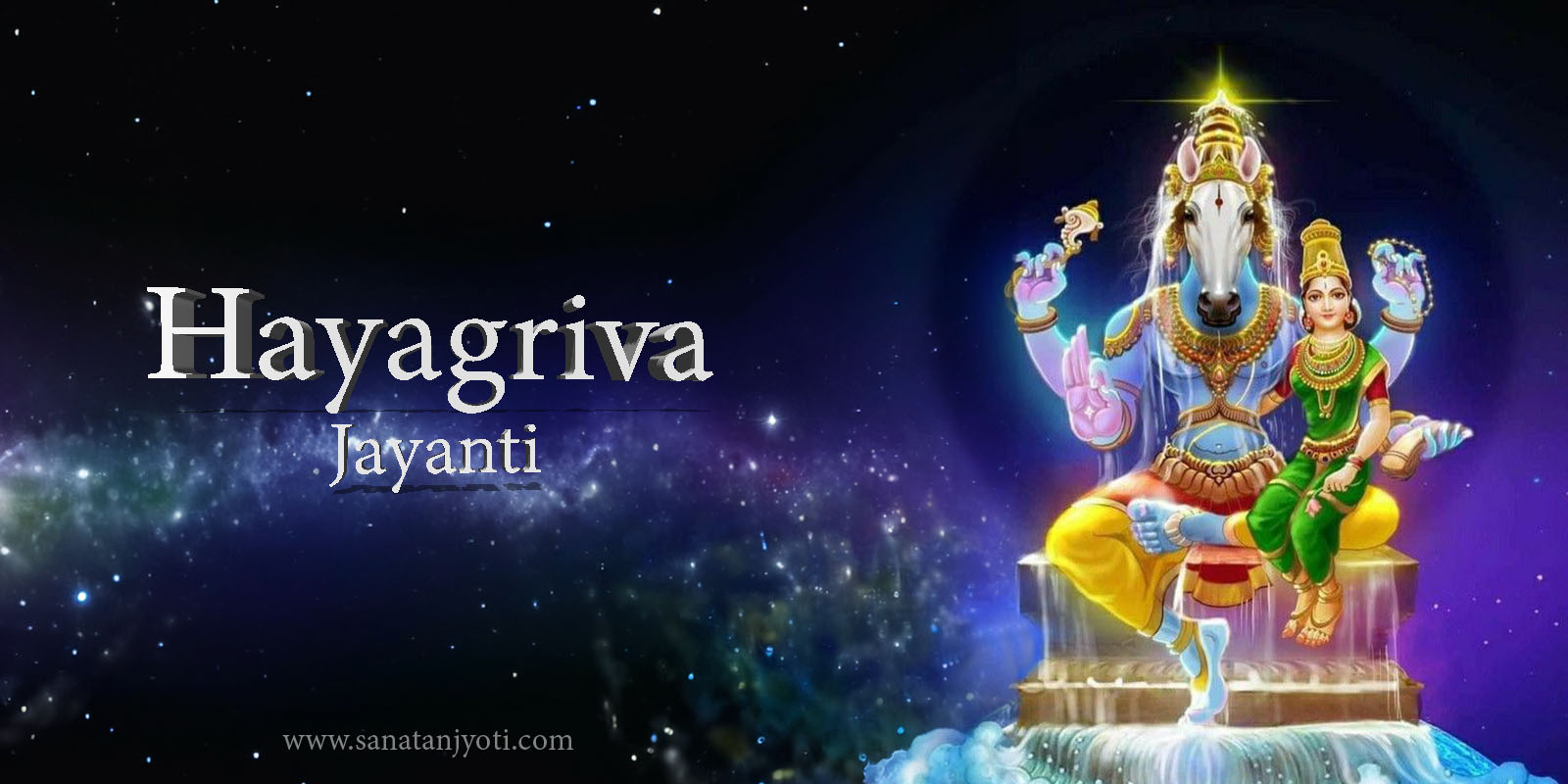
Lord Hayagriva is one of the main avatars of Lord Vishnu. His form is unique. He has the body of a human and the head of a horse. That is why He is called Hayagriva. The word "Haya" means horse, and "Griva" means neck.
In Sanatan Dharma, Lord Hayagriva is known as the God of knowledge, learning, wisdom, memory, and the Vedas. Many people believe that He brought back the Vedas after demons stole them. He then returned them to Lord Brahma. This brought back the light of knowledge and helped the world continue in the right way.
Lord Hayagriva is widely worshipped in Tamil Nadu, Andhra Pradesh, Telangana, Karnataka, and Kerala. Many Vishnu temples have His idol. Students also pray to Him for success in their studies, exams, and learning.
Why is Hayagriva Jayanti Celebrated?
Hayagriva Jayanti is celebrated to honor Lord Vishnu's Hayagriva Avatar. Many people believe that Lord Hayagriva protected the Vedas and brought the light of knowledge back to the world.
According to Hindu tradition, demons stole the Vedas. Without them, the world began to lose the path of Dharma, truth, and knowledge. To save the Vedas, Lord Vishnu took the form of Lord Hayagriva. He defeated the demons, brought back the Vedas, and returned them to Lord Brahma. This helped spread knowledge and Dharma again.
Because of this, Hayagriva Jayanti is more than the celebration of a divine avatar. It is also a festival of knowledge, learning, wisdom, and Sanatan Dharma. Many people believe that praying to Lord Hayagriva on this day helps improve memory, learning, success in studies, and faith in God.
The Form of Lord Hayagriva and His Spiritual Significance
The form of Lord Hayagriva has a special meaning in Sanatan Dharma. His horse's head stands for knowledge, wisdom, strength, and clear thinking. His human body stands for balance, truth, and Dharma.
Many pictures and idols show Lord Hayagriva with four arms. He holds a Shankha (conch), Chakra (discus), a sacred book, and a prayer mala or a lotus. These show knowledge, faith, Dharma, and Moksha.
Many people believe that the blessings of Lord Hayagriva help to:
• Do well in studies.
• Improve memory and focus.
• Better understand the Vedas and other sacred books.
• Remove confusion and wrong thinking.
• Make good and wise decisions.
Because of this, many students, teachers, writers, and people who want to learn more pray to Lord Hayagriva.
Importance of Worshipping Lord Hayagriva for Students
In Sanatan Dharma, Lord Hayagriva is known as the God of knowledge and learning. Many people believe that students who pray to Lord Hayagriva with faith can improve their focus, memory, and wisdom. They also pray for success in their studies.
On Hayagriva Jayanti, many students pray to their books, notebooks, and study tools. They ask Lord Hayagriva to help them learn well and do their best in school or college. Many people also believe this is a good day to start reading the Vedas, Upanishads, Bhagavad Gita, and other sacred books.
If you would like to learn more about Lord Hayagriva, the avatars of Lord Vishnu, the importance of the Vedas, the pursuit of knowledge, or the spiritual traditions of Sanatan Dharma: -You can receive free consultation and detailed guidance from the experienced Acharyas of Sanatan Jyoti.
The Legend of Lord Hayagriva
According to Hindu tradition, Hayagriva was the powerful son of Sage Kashyapa and Danu. Following his father's instructions, he went to the banks of the Saraswati River and performed intense penance to worship Goddess Mahamaya. For many years, he continued his meditation without eating or drinking.
Pleased with his devotion, the Goddess appeared before him and asked him to request a boon. Hayagriva bowed to Her and said, "O Mother, if You are truly pleased with me, grant me immortality."
The Goddess replied, "My child, everyone who is born must one day die. No one can escape the laws of creation. Even the most virtuous souls must leave the mortal world when their merits come to an end. Ask for another boon."
Hayagriva then said, "If I cannot become immortal, then let only someone with the same form as mine—another Hayagriva—be able to kill me. No one else should be able to defeat me."
The Goddess replied, "Tathastu" (So be it) and disappeared.
Hayagriva believed he had become invincible because there was no one in the three worlds who looked like him. Since he was a demon, he soon began to misuse his power and oppress the people. Wherever sacred Yajnas were performed, he sent his demon army to disrupt them. He also troubled sages, saints, and the devotees of Lord Vishnu.
As Hayagriva's cruelty increased, fear spread everywhere. When he learned that the Devas gained strength through worship, Yajnas, and religious rituals, he issued a strict order throughout his kingdom.
He declared that no one would worship the Devas anymore. Anyone who continued to worship them would face severe punishment. In this way, he began persecuting devotees and sages.
Hayagriva then ordered his people to worship only him. Filled with pride, he proclaimed, "I alone am the ruler of the three worlds. Therefore, everyone should worship only me."
Even after this order, many people continued to endure his punishment rather than stop worshipping the Devas. His commander then told him that the true foundation of the worship of the Devas was the sacred knowledge preserved in the Vedas, which had been revealed by Lord Vishnu. Since the demons had no such sacred authority, people refused to worship them.
Hayagriva realized that if the Vedas no longer existed, people would stop worshipping the Devas. When Lord Brahma learned that Hayagriva planned to steal the Vedas, He went to Lord Shiva and suggested that the sacred knowledge should be passed on to humanity so people could study the Vedas and gain wisdom.
Taking advantage of Lord Brahma's absence, Hayagriva stole all four Vedas. When Lord Brahma discovered this, all the Devas approached Lord Vishnu for help.
Lord Brahma prayed, "O Lord, please help us quickly. The demon Hayagriva has stolen the four Vedas. Because of this, Dharma is declining and ignorance is spreading across the world. If the Vedas are not restored soon, the world will fall into the darkness of unrighteousness and ignorance."
Lord Vishnu replied, "The four Vedas originated from Me. It is My duty to protect them."
With these words, Lord Vishnu entered the battlefield to fight Hayagriva. The battle continued for many days, but neither side could defeat the other.
After fighting for a long time, both Lord Vishnu and the demon Hayagriva became exhausted. By mutual agreement, they paused the battle to rest. During His rest, Lord Vishnu entered Yoga Nidra (divine sleep) while His bow remained fully strung.
Lord Brahma tried to awaken Him but was unsuccessful. To wake the Lord, He created a tiny insect called Vamri and instructed it to cut the bowstring.
As soon as the bowstring snapped, it produced a tremendous sound, and Lord Vishnu's head became separated from His body and disappeared.
Seeing this, the Devas were filled with fear and sorrow. Their only hope of defeating Hayagriva seemed to be lost. Distressed by the situation, they began praying earnestly to Goddess Mahamaya.
Pleased with their prayers, the Goddess blessed the Devas and instructed Lord Brahma to place the head of a horse on Lord Vishnu's body. She explained that only by taking a form similar to Hayagriva could Lord Vishnu defeat the demon.
Hearing the Goddess's instructions, the Devas were filled with hope. Lord Brahma immediately placed a horse's head on Lord Vishnu's body. In this way, Lord Vishnu manifested as Lord Hayagriva. He then returned to the battlefield, defeated the demon Hayagriva, and recovered the four Vedas, restoring the light of knowledge to the world.
This sacred story is considered highly auspicious. It is believed that reading or listening to it helps increase knowledge and wisdom and destroys the sins committed in daily life.
Why Did Lord Vishnu Take the Hayagriva Avatar?
Every avatar of Lord Vishnu comes with a special purpose. He takes different forms to protect Dharma and stop Adharma. Lord Hayagriva also took this avatar to protect the Vedas and bring back knowledge.
According to Hindu tradition, demons took the Vedas away. Without the Vedas, people could not follow Dharma, perform Yajnas, or learn the sacred teachings. To bring back the light of knowledge, Lord Vishnu took the form of Lord Hayagriva and returned the Vedas.
This avatar teaches that knowledge is one of life's greatest strengths. When knowledge is safe, Dharma, culture, and good values also stay strong. That is why Lord Hayagriva is worshipped as the protector of the Vedas and the God of knowledge and wisdom.
Religious Significance of Protecting the Vedas
In Sanatan Dharma, the Vedas are believed to be divine knowledge that did not come from any human. The Rigveda, Yajurveda, Samaveda, and Atharvaveda are the four Vedas. They teach about Dharma, health, yoga, music, and many other parts of life.
The story of Lord Hayagriva protecting the Vedas teaches us to value and protect knowledge. It reminds us that learning, truth, and wisdom help people and society grow.
Because of this, many people believe Hayagriva Jayanti is a good day to read or listen to the Vedas, Upanishads, Bhagavad Gita, and other sacred books.
How is Hayagriva Jayanti Celebrated?
Hayagriva Jayanti is celebrated with great faith in South India and by Vaishnava followers. On this day, temples of Lord Vishnu and Lord Hayagriva hold special Pujas, Vishnu Sahasranama chanting, Bhajans, and prayer programs.
Many students and teachers pray to their books, notebooks, and study tools. In many places, children start their first lessons through the Vidyarambham ceremony. Many people believe this is a good day to begin learning.
People pray to Lord Hayagriva for knowledge, a good memory, wisdom, and success in their studies and life. Many devotees also keep a fast and eat only Satvik food on this day.
Hayagriva Jayanti Puja Vidhi
On Hayagriva Jayanti, wake up during Brahma Muhurta, take a holy bath, and wear clean or yellow clothes. Clean your prayer place and keep a picture or idol of Lord Vishnu or Lord Hayagriva there.
Offer sandalwood paste, Akshata (unbroken rice), yellow flowers, Tulsi leaves, incense, a ghee lamp, fruits, and Naivedya. Then chant the name of Lord Vishnu, read the Vishnu Sahasranama, or say a Hayagriva Stotra with faith.
If you can, read the Bhagavad Gita, the Vedas, the Upanishads, or other sacred books. Students can also pray to their books and study tools. They ask Lord Hayagriva for knowledge, wisdom, and success in their studies.
After the puja, perform the Aarti and share the Prasad with everyone. If possible, donate books, notebooks, pens, or food to students or people in need. Many people believe that giving books or learning materials on this day brings good blessings.
Religious Significance of Hayagriva Jayanti
Hayagriva Jayanti is an important day in Sanatan Dharma. It is the day of Lord Vishnu's Hayagriva Avatar. Many people believe that Lord Hayagriva brought back the Vedas and helped spread the light of knowledge. He is known as the God of learning and wisdom.
On Hayagriva Jayanti, many people pray to Lord Vishnu and Lord Hayagriva. They read the Vishnu Sahasranama, the Vedas, and other holy books. They pray for knowledge, a good memory, peace, and success in life.
This festival teaches us to love and protect knowledge. It also reminds us to speak the truth, keep learning, and share what we know with others. Just as Lord Hayagriva saved the Vedas, we should also protect learning and good values.
Importance of Lord Hayagriva for Students
Lord Hayagriva is known as the God of learning, wisdom, memory, and focus. That is why many students, teachers, writers, and people preparing for exams pray to Him on Hayagriva Jayanti.
Many people believe that the blessings of Lord Hayagriva can help:
• Improve focus while studying.
• Make memory stronger.
• Understand difficult lessons.
• Build a love for learning.
• Bring success in exams.
• Help people think clearly and make good choices.
Because of this, many schools, Gurukuls, and Vaishnava temples in South India hold special Pujas and Vedic chanting on Hayagriva Jayanti.
Which Mantras Should Be Chanted on Hayagriva Jayanti?
On Hayagriva Jayanti, many people chant the mantras of Lord Vishnu and Lord Hayagriva with faith. Many believe these mantras help improve focus, learning, wisdom, and memory. They also pray for success in their studies and a peaceful mind.
1. Lord Hayagriva Mantra
Om Shri Hayagrivaya Namah॥
This is a simple and highly powerful mantra dedicated to Lord Hayagriva.
2. Lord Vishnu Mantra
Om Namo Bhagavate Vasudevaya॥
This mantra is considered highly auspicious for seeking the blessings of Lord Vishnu.
3. Vishnu Gayatri Mantra
Om Narayanaya Vidmahe। Vasudevaya Dhimahi। Tanno Vishnuh Prachodayat॥
It is believed that chanting this mantra with devotion and concentration brings spiritual growth and inner peace.
What Should You Do on Hayagriva Jayanti?
The following activities are considered auspicious on Hayagriva Jayanti:
• Take a holy bath in the morning and worship Lord Vishnu and Lord Hayagriva.
• Recite the Vishnu Sahasranama, Bhagavad Gita, or other sacred scriptures.
• Students should worship their books and study materials.
• Donate books, notebooks, pens, or other educational supplies to students in need.
• Show respect to teachers, scholars, and Gurus.
• Eat Satvik food and perform acts of charity according to your ability.
• Take a pledge to gain knowledge and use it for the welfare of society.
What Should You Avoid on Hayagriva Jayanti?
On this sacred day, it is important to observe the following:
• Avoid lying, anger, pride, and harsh speech.
• Do not disrespect sacred scriptures or books.
• Stay away from Tamasic food and intoxicants.
• Avoid insulting others or getting into unnecessary arguments.
• Never show disrespect toward education, teachers, or knowledge.
• Instead of wasting time, spend it on study, mantra chanting, and self-reflection.
If you would like to learn more about Lord Vishnu, Lord Hayagriva, the importance of the Vedas, the pursuit of knowledge, or the Vedic traditions of Sanatan Dharma: - You can receive free consultation and detailed guidance from the experienced Acharyas of Sanatan Jyoti.
Frequently Asked Questions
1. When is Hayagriva Jayanti 2026?
In 2026, Hayagriva Jayanti will be celebrated on Thursday, 27 August 2026.
2. Who is Lord Hayagriva?
Lord Hayagriva is a divine avatar of Lord Vishnu. He is worshipped as the deity of knowledge, learning, wisdom, and the protector of the Vedas.
3. Why is Hayagriva Jayanti celebrated?
Hayagriva Jayanti is celebrated to honor Lord Hayagriva, who protected the Vedas and restored the light of knowledge to the world.
4. On which Tithi is Hayagriva Jayanti observed?
The festival is observed on the Purnima (Full Moon) Tithi of Shukla Paksha in the month of Bhadrapada.
5. What should you do on Hayagriva Jayanti?
It is considered auspicious to worship Lord Hayagriva, recite the Vishnu Sahasranama, study the Vedas, and perform acts of charity on this day.
6. What are the benefits of worshipping Lord Hayagriva?
According to religious beliefs, worshipping Lord Hayagriva helps improve knowledge, wisdom, memory, concentration, and spiritual growth.
7. Can students worship Lord Hayagriva?
Yes. Worshipping Lord Hayagriva is considered especially auspicious for students.
8. Whose avatar is Lord Hayagriva?
Lord Hayagriva is one of the principal avatars of Lord Vishnu.
9. Where is Hayagriva Jayanti mainly celebrated?
The festival is widely celebrated in South India, especially in Tamil Nadu, Andhra Pradesh, Telangana, Karnataka, and Kerala.
10. What is the main message of Hayagriva Jayanti?
Hayagriva Jayanti teaches the importance of knowledge, truth, education, Dharma, humility, and the preservation of culture.
If you wish to perform a special Vedic ritual to seek the blessings of Lord Vishnu, gain knowledge, wisdom, academic success, spiritual growth, and freedom from life's obstacles: -You can learn more about the Vishnu Sahasranama Chanting Ritual (Vishnu Sahasranamam Path Anushthan).
Hayagriva Jayanti is more than the birth anniversary of Lord Vishnu's Hayagriva Avatar. It is a special day to honor knowledge, learning, the Vedas, and Sanatan Dharma.
Lord Hayagriva teaches that true success does not come from money or power. It comes from knowledge, wisdom, truth, and doing the right thing.
On Hayagriva Jayanti, many people pray to Lord Hayagriva, read the Vedas and other holy books, and thank God for the gift of knowledge. By following the teachings of Lord Hayagriva, we can learn good values, help others, and build a better society.