

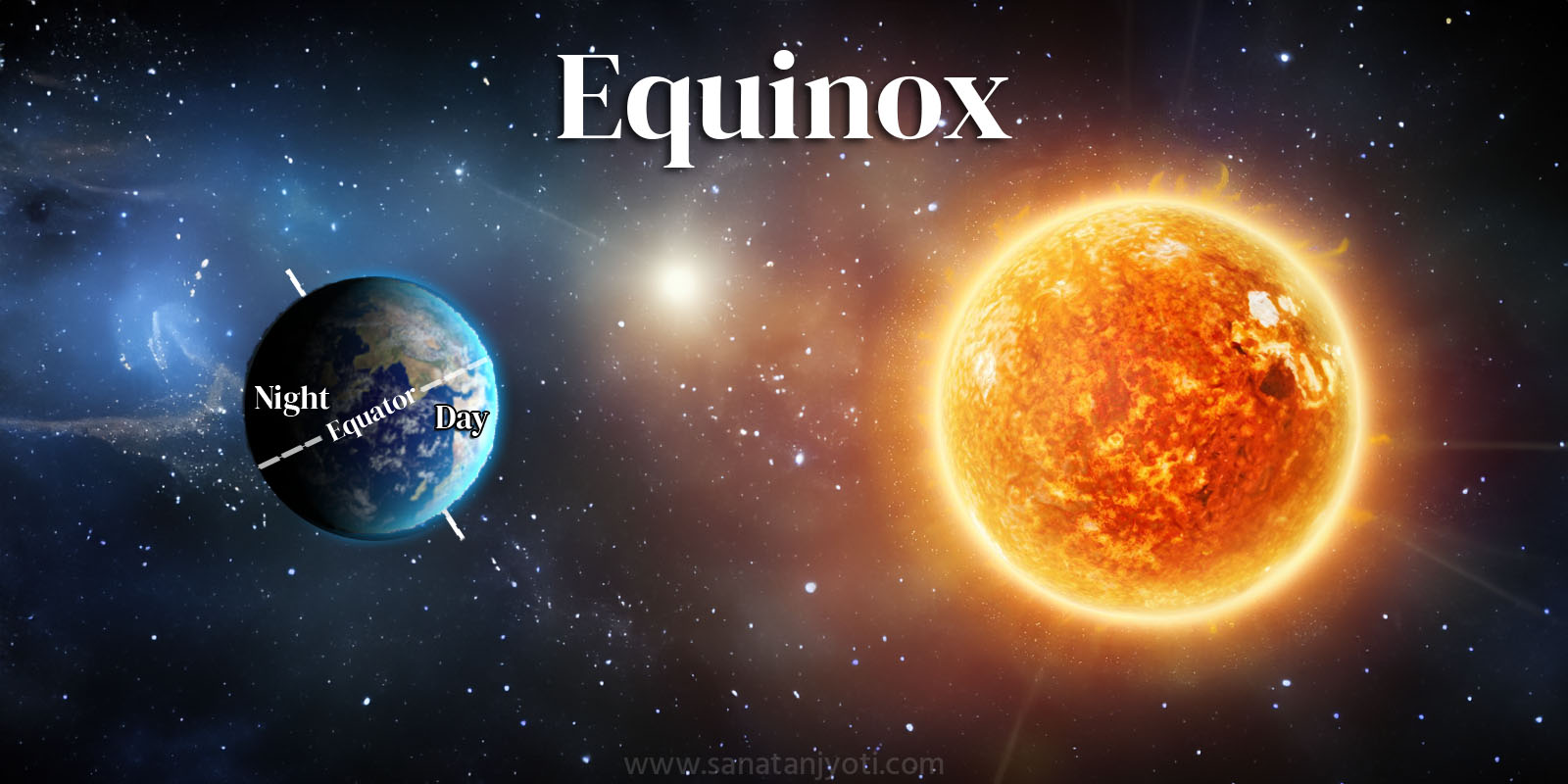
Equinox is an important astronomical event that occurs twice a year. It occurs when the apparent position of the Sun's center crosses Earth's equatorial plane. At this time, the Sun's rays fall most directly around the equator, and the Northern and Southern Hemispheres receive approximately equal amounts of sunlight.
The equinox is commonly understood as the time when day and night are approximately equal in length. However, scientifically, day and night are not exactly 12 hours each at every location on the day of an equinox. Factors such as the Sun's apparent size, atmospheric refraction, and the latitude of location affect the actual duration of daylight and darkness.
There are two equinoxes each year:
1. Vernal Equinox (March Equinox)
2. Autumnal Equinox (September Equinox)
What Are the Vernal and Autumnal Equinoxes?
Vernal Equinox (March Equinox)
The equinox that occurs in March is called the Vernal Equinox. In the Northern Hemisphere, it marks the beginning of astronomical spring, while astronomical autumn begins in the Southern Hemisphere at the same time.
During the March Equinox, the Sun's apparent position moves from south to north and crosses the celestial equator. This does not mean that the Sun is physically moving northward. It is an apparent change caused by Earth's orbit around the Sun and the tilt of Earth's rotational axis.
Autumnal Equinox (September Equinox)
The equinox that occurs in September is called the Autumnal Equinox. In the Northern Hemisphere, it marks the beginning of astronomical autumn, while spring begins in the Southern Hemisphere.
During the September Equinox, the Sun's apparent position moves from north to south and crosses the celestial equator.
The date of an equinox is not exactly the same every year. Generally, the March Equinox occurs between March 19 and 21, while the September Equinox occurs around September 22 or 23. The exact date and time can vary from year to year because of Earth's orbital motion and the way our calendar is structured.
What Causes an Equinox?
To understand an equinox, it is important to understand Earth's axial tilt and its revolution around the Sun.
Earth's rotational axis is tilted by approximately 23.4° from the perpendicular to its orbital plane. As Earth revolves around the Sun, it maintains this axial tilt. As a result, different parts of the year expose the Northern and Southern Hemispheres to sunlight at different angles and for different lengths of time. This is the primary reason Earth experiences seasons.
Twice a year, Earth reaches a position in its orbit where neither hemisphere is tilted specifically toward or away from the Sun. At these points, the center of the Sun crosses Earth's equatorial plane, resulting in an equinox.
Therefore, scientifically speaking, an equinox is not a special stage of Earth's rotation; rather, it is an astronomical event associated with Earth's position in its orbit around the Sun.
Does the Sun Actually Move North and South?
When we observe the sky, it appears that the Sun changes its position toward the north and south during the year. However, the Sun is not actually moving around Earth in a north-south direction.
Earth revolves around the Sun, and its rotational axis is tilted by approximately 23.4°. Because of this tilt and Earth's orbital motion, the Sun's apparent position appears to shift north and south across the sky throughout the year.
The apparent movement can be summarized as follows:
• After March Equinox, the Sun's apparent position moves northward.
• Around June Solstice reaches its northernmost position.
• At the September Equinox, it crosses the equatorial plane again.
• Around December Solstice, it reaches its southernmost position.
Therefore, saying that the Sun moves from north to south or south to north is scientifically accurate only when referring to its apparent motion as observed from Earth.
Why Are Day and Night Not Exactly Equal on the Equinox?
The word equinox is associated with the idea of an "equal night," so it is commonly said that day and night are equal on this day. However, the actual duration from sunrise to sunset is not exactly 12 hours at every location.
There are two major reasons for this.
1. The Size of the Sun
The Sun appears in the sky as a disk rather than a point.
Sunrise is considered to occur when the upper edge of the Sun becomes visible above the horizon. Sunset occurs when the visible portion of the Sun has completely disappeared below the horizon.
Therefore, at sunrise and sunset, the center of the Sun is not in exactly the same geometric position that it would be if the Sun were treated as a point source.
2. Atmospheric Refraction
Earth's atmosphere slightly changes the direction of sunlight as it passes through the atmosphere. This phenomenon is known as atmospheric refraction.
The effect is particularly significant near the horizon. Because of atmospheric refraction, the Sun appears slightly higher than its actual geometric position. As a result, the upper edge of the Sun may become visible in the morning before it geometrically reaches the horizon, and in the evening, the Sun may remain visible for a short time after it has geometrically moved below the horizon.
For this reason, even on an equinox, the observed period of daylight is generally not exactly 12 hours.
Important: The date on which day and night are actually closest to equal is not the same everywhere. It depends on the latitude of the location.
Where Is the Sun During an Equinox?
During an equinox, the center of the Sun crosses Earth's equatorial plane.
At the equator, the Sun appears almost directly overhead at noon during an equinox. Around the time of an equinox, the Sun also rises approximately due east and sets approximately due west at most locations on Earth.
This alignment is important for understanding the geometric relationship between Earth and the Sun.
What Is the Relationship Between Equinoxes and Seasonal Change?
Equinoxes and seasonal changes are closely connected, but an equinox itself is not the cause of the seasons.
The primary cause of Earth's seasons is its approximately 23.4° axial tilt combined with its revolution around the Sun. As Earth moves through different points in its orbit, the Northern and Southern Hemispheres receive sunlight at different angles and for different lengths of time.
When the Northern Hemisphere is tilted more toward the Sun, sunlight falls more directly there and the days are longer. These conditions contribute to warmer temperatures and summer. At the same time, the Southern Hemisphere is tilted relatively away from the Sun and experiences winter.
Approximately six months later, the situation reverses.
Therefore, Earth's axial tilt and its revolution around the Sun are the fundamental causes of the seasons, while equinoxes mark two important astronomical transition points in the seasonal cycle.
Importance of Equinoxes on Earth
Equinoxes are important for understanding the Earth-Sun system and the annual seasonal cycle.
1. Astronomical Marker of Seasonal Change
The March and September Equinoxes are important astronomical markers of seasonal transitions in the Northern and Southern Hemispheres.
After the March Equinox, the Northern Hemisphere moves toward summer, while after the September Equinox, it moves toward winter. The sequence is reversed in the Southern Hemisphere.
2. Approximately Equal Distribution of Sunlight Between the Hemispheres
During an equinox, sunlight is distributed approximately equally between the Northern and Southern Hemispheres. As a result, the amount of daylight received by the two hemispheres is relatively similar.
3. Approximately Equal Day and Night
Around an equinox, day and night are approximately equal in duration at most locations. However, they are not necessarily exactly 12 hours each because of the definitions of sunrise and sunset, the Sun's apparent size, and atmospheric refraction.
4. The Sun Rises Approximately in the East and Sets Approximately in the West
Around an equinox, the Sun rises approximately due east and sets approximately due west at most locations on Earth.
5. Importance in Astronomy
Equinoxes serve as important astronomical reference points for understanding Earth's orbit, axial tilt, the Sun's apparent motion, and the seasonal cycle.
Difference Between Equinox and Solstice
Equinoxes and solstices are both important astronomical events associated with Earth's annual revolution around the Sun, but they occur at different points in Earth's orbit.
Equinox
An equinox occurs in March and September, when the center of the Sun crosses Earth's equatorial plane. At this time, the two hemispheres receive approximately equal amounts of sunlight.
Solstice
A solstice occurs in June and December. At these times, the Sun's apparent position reaches its maximum northward or southward distance from the celestial equator.
In the Northern Hemisphere, the June Solstice is associated with the year's longest daylight period, while the December Solstice is associated with the shortest daylight period.
Important Scientific Facts About the Equinox
• An equinox occurs twice a year—once in March and once in September.
• During an equinox, the center of the Sun crosses Earth's equatorial plane.
• At the equator, the Sun appears almost directly overhead at noon during an equinox.
• Day and night are approximately equal around an equinox, but they are not exactly 12 hours each everywhere.
• Atmospheric refraction contributes to the Sun appearing slightly earlier at sunrise and remaining visible slightly longer after sunset.
• Earth's approximately 23.4° axial tilt is the primary cause of the seasons.
• After the March Equinox, the Sun's apparent position moves northward, while after the September Equinox, it moves southward.
• Around an equinox, the Sun rises approximately in the east and sets approximately in the west.
Frequently Asked Questions
What is an equinox?
An equinox is an astronomical event that occurs twice a year when the center of the Sun crosses Earth's equatorial plane. At this time, the Northern and Southern Hemispheres receive approximately equal amounts of sunlight.
How many times does an equinox occur each year?
An equinox occurs twice a year- once in March and once in September.
Are day and night exactly 12 hours each on an equinox?
No. They are not exactly 12 hours each at every location. The Sun's apparent size, atmospheric refraction, and the latitude of the location can affect the actual duration of daylight.
Where is the Sun during an equinox?
During an equinox, the center of the Sun crosses Earth's equatorial plane. At the equator, the Sun appears almost directly overhead at noon.
Is an equinox the cause of seasonal change?
No. The main causes of the seasons are Earth's approximately 23.4° axial tilt and its revolution around the Sun. Equinoxes are important astronomical markers within the seasonal cycle.
What is the difference between the March and September Equinox?
During the March Equinox, the Northern Hemisphere moves toward spring while the Southern Hemisphere moves toward autumn. During the September Equinox, the situation is reversed.
An equinox is an important astronomical event related to the motion of Earth and the Sun. It occurs twice a year, in March and September. During an equinox, the center of the Sun crosses Earth's equatorial plane, and the Northern and Southern Hemispheres receive approximately equal amounts of sunlight.
Equinoxes are commonly associated with equal day and night, but scientifically, day and night do not have to be exactly 12 hours each. The Sun's apparent size and atmospheric refraction contribute to the observed daylight being slightly longer than 12 hours at many locations.
Most importantly, the seasons are caused by Earth's axial tilt and its revolution around the Sun, not by the equinox itself. Equinoxes simply mark two important astronomical transition points in Earth's annual seasonal cycle.