

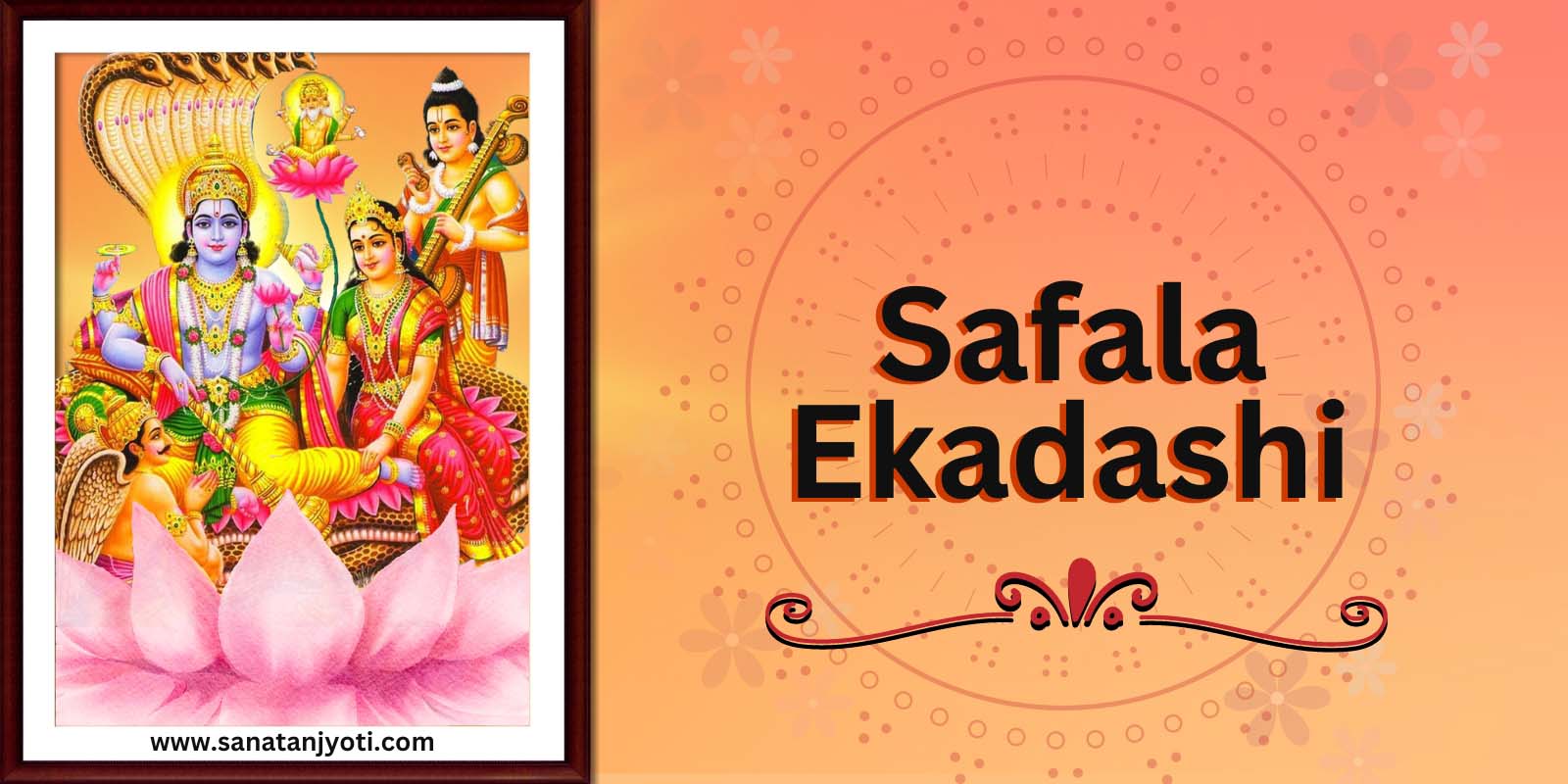
Ekadashi Vrat is considered highly significant for the worship of Lord Shri Hari Vishnu. Every Ekadashi observed during the year has its own religious significance, Vrat Katha and Puja Vidhi. Among these, the Ekadashi of the Krishna Paksha of Paush month is known as Safala Ekadashi.
The word ‘Safala’ means that which brings success. According to religious beliefs, observing Safala Ekadashi with faith and devotion invokes the blessings of Lord Vishnu and creates a positive path toward the fulfillment of auspicious endeavors and greater positivity in life.
On this Ekadashi, Lord Narayan Puja, Vrat, Deep Daan, offering fruits and night-long devotional vigil are considered especially significant. The glory of Safala Ekadashi was narrated by Lord Shri Krishna himself to Dharmaraj Yudhishthira. Its Vrat Katha tells the story of Lumbhaka, the son of King Mahishmat, whose life underwent a profound transformation through the observance of Safala Ekadashi.
Let us find out when Safala Ekadashi 2027 will be observed, what its religious significance is, what the Vrat Katha says, and how Lord Vishnu should be worshipped on this day.
When is Safala Ekadashi 2027?
Safala Ekadashi will be observed on Sunday, January 3, 2027.
It will fall on the Ekadashi Tithi of the Krishna Paksha of Paush month. According to the Panchang calculation, the Ekadashi Tithi will begin at around 2:26 PM on January 2, 2027, and end at around 4:10 PM on January 3, 2027.
Safala Ekadashi Vrat: Sunday, January 3, 2027
Paksha: Krishna Paksha
Month: Paush
Tithi: Ekadashi
For the Vrat and Parana, it is advisable to give priority to the local Panchang applicable to your location.
Significance of Safala Ekadashi in the Krishna Paksha of Paush Month
Yudhishthira asked:
“O Lord! What is the name of the Ekadashi that falls during the Krishna Paksha of Paush month? What is the proper method of observing it, and which deity should be worshipped on this day? Please tell me.”
Lord Shri Krishna said:
“O King of Kings! I shall tell you; listen carefully. Even the grandest Yajnas performed with generous Dakshina do not please me as much as the observance of Ekadashi Vrat. Therefore, one should make every effort to observe Ekadashi. The Ekadashi that falls during the Krishna Paksha of Paush month is known as ‘Safala Ekadashi.’ On this day, Lord Narayan should be worshipped according to the prescribed method.”
Ekadashi is considered beneficial and auspicious, and therefore, one should observe this Vrat with devotion. Just as Sheshnag is foremost among serpents, Garuda among birds, Lord Vishnu among the Devas, and Brahmins among human beings, Ekadashi Tithi is considered the greatest among all Vrats.
On Safala Ekadashi, one should worship Shri Hari by chanting His divine names and offering fruits. Coconut, betel nut, Bijora lemon, Jambira lemon, pomegranate, fresh Amla, cloves, berries and especially mangoes should be offered to Lord Hari, the Lord of all Devas. The Lord should also be worshipped with Dhup and Deep.
Deep Daan holds special significance on Safala Ekadashi. Devotees are also advised to stay awake at night in devotional company with Vaishnavas. It is believed that the spiritual merit gained through such a night-long vigil cannot be attained even through thousands of years of Tapasya.
Safala Ekadashi Vrat Katha
Lord Shri Krishna said to Yudhishthira:
“O best among kings! Now listen to the auspicious and beneficial story of Safala Ekadashi.
There was a famous city called Champavati, which was once the capital of King Mahishmat. King Mahishmat had five sons. The eldest among them was constantly engaged in sinful activities. He was immoral, attached to prostitutes and spent his father’s wealth on sinful pursuits.
He was always devoted to wrongdoing and frequently spoke ill of Brahmins. He also constantly criticized Vaishnavas and the Devas. Seeing his son’s sinful ways, King Mahishmat named the prince Lumbhaka. Eventually, his father and brothers joined together and banished him from the kingdom.
Lumbhaka left the city and went into a dense forest. Living there, the sinful man began robbing the wealth of people from the city. One day, when he entered the city to steal, the guards caught him. However, when he revealed that he was the son of King Mahishmat, the soldiers released him.
He returned to the forest and survived by eating meat and fruits from trees. His resting place was near a Peepal tree. The ancient Peepal tree was considered a sacred tree and revered as a great Deity in that forest. Lumbhaka, despite his sinful nature, continued to live there.
After a long time, due to the influence of some accumulated merit from his past, he happened to observe Ekadashi Vrat.
On the Dashami Tithi of the Krishna Paksha of Paush month, the sinful Lumbhaka ate fruits from the trees. Since he had no clothes, he suffered from the cold throughout the night. He could neither sleep nor rest and became almost lifeless.
Even after sunrise, the sinful Lumbhaka remained unconscious. On Safala Ekadashi, he continued to lie unconscious. Around noon, he regained consciousness. Looking around, he got up from his resting place and wandered into the forest, repeatedly stumbling as he walked. He was weak and suffering from severe hunger.
O King! When Lumbhaka returned to his resting place carrying many fruits, the Sun had already set. He then offered the fruits at the root of the tree and said, ‘May Lord Vishnu, the husband of Goddess Lakshmi, be pleased with these fruits.’
After saying this, Lumbhaka remained awake throughout the night. In this way, he unknowingly completed the observance of Safala Ekadashi Vrat.
Suddenly, a divine voice from the sky declared:
“Prince! By the merit of Safala Ekadashi, you will regain your kingdom and be blessed with a son.”
Lumbhaka accepted the divine blessing with gratitude. From that moment onward, his nature underwent a remarkable transformation. His mind became devoted to the worship of Lord Vishnu.
Adorned with divine ornaments, he regained his kingdom and ruled it peacefully for fifteen years.
By the grace of Lord Shri Krishna, he was blessed with a son named Manojna. When his son grew up, Lumbhaka immediately gave up his attachment to the kingdom and handed it over to his son. He then devoted himself to Lord Shri Krishna, attaining the spiritual path from which a person never falls into sorrow.
O King! In this way, a person who sincerely observes the sacred Safala Ekadashi Vrat enjoys happiness in this life and attains Moksha after death. Blessed are those who devote themselves to the observance of Safala Ekadashi. Their birth is considered truly fruitful.
O Maharaj! It is believed that reading, listening to and following the teachings associated with the glory of Safala Ekadashi grants a person the merit of performing a Rajasuya Yajna.”
Safala Ekadashi Vrat Puja Vidhi
O Rajendra! Listen as I explain the auspicious procedure for observing this Vrat.
On the auspicious Dashami Tithi of the Krishna Paksha of Paush month, one should take a bath in the morning with a pure and devoted mind. Then, after bathing again around midday, one should eat only one meal and sleep on the floor at night.
At the end of the night, after the arrival of a pure morning, one should complete the daily rituals and take a bath on Ekadashi. After this, with devotion, one should take the Sankalp for fasting while reciting the following mantra:
Adya sthitva niraharah sarvabhogavivarjitah.
Shvo bhokshye Pundarikaksha sharanam me bhavachyuta.
Meaning:
“O Lotus-Eyed Lord Narayan, today I shall remain without food and stay away from all worldly enjoyments. I shall eat tomorrow. O Achyuta, please accept me into Your refuge.”
After taking the Sankalp, worship Lord Harikesh with Dhup, fragrance and other traditional offerings. Devotees should remain awake near the Lord during the night in devotion.
The following morning, on Dwadashi, worship Shri Hari once again with devotion. After that, feed Brahmins and then have your meal peacefully with family members, relatives, grandchildren and children while maintaining silence as prescribed.
Read the Story of the Origin of Ekadashi
The story associated with the origin of Ekadashi Tithi describes the episode involving Lord Vishnu and the demon Mura. To learn more about the origin of Ekadashi, Lord Vishnu’s divine Leela and the religious significance of this sacred Tithi, read our related article.
Read in detail about the origin of Ekadashi and the story of Ekadashi Vrat.
How to Observe Safala Ekadashi Vrat?
A person observing the Vrat should follow the fasting tradition according to their physical capacity and family customs. Traditionally, devotees are advised to have Sattvik food and maintain self-restraint on Dashami Tithi before the fast.
On Ekadashi, devotees take the Sankalp for the Vrat after worshipping Lord Vishnu. According to their tradition, devotees may observe Nirjala Vrat, Phalahar Vrat or another prescribed form of fasting.
If someone has a health-related issue or is unable to fast, it is better to maintain the spirit of the Vrat through remembrance and worship of Lord Vishnu along with a Sattvik diet rather than undertaking a strict fast that may affect their well-being.
Free Consultation for Rituals on Safala Ekadashi
If you wish to learn about a specific Jaap, Paath or Anushthan according to your personal needs instead of performing only the general Puja on Safala Ekadashi, consulting an expert beforehand can be helpful.
Different Anushthans are performed for different purposes, and the appropriate ritual can be selected according to an individual’s circumstances.
Which Anushthan may be suitable for you on Safala Ekadashi?Get a free consultation to learn more.
Which Anushthans Can Be Performed on Safala Ekadashi?
Safala Ekadashi is considered a special occasion for the worship of Lord Vishnu. Devotees may recite Vishnu-related Stotras, chant Mantras and perform Paath according to their faith and tradition.
Among these, Vishnu Sahasranama Paath is considered particularly significant. Vishnu Sahasranama involves the recitation of the thousand names of Lord Vishnu and is regarded as an important Stotra dedicated to the worship of Shri Hari.
If you are unable to perform the Paath yourself or wish to have the Anushthan conducted according to the prescribed procedure, you may also choose to have Vishnu Sahasranama Anushthan performed by qualified Acharyas.
Book Vishnu Sahasranama Anushthan on Safala Ekadashi.
What to Do on Safala Ekadashi?
Devotees can perform the following activities on Safala Ekadashi:
• Worship Lord Vishnu.
• Chant Vishnu Mantras.
• Recite Vishnu Sahasranama.
• Offer fruits to the Lord.
• Perform Deep Daan.
• Read or listen to religious scriptures.
• Donate according to your capacity.
• Spend the night remembering Lord Vishnu and singing devotional Bhajans.
• Perform the Vrat Parana on Dwadashi according to the prescribed procedure.
What Should You Avoid on Safala Ekadashi?
Ekadashi is associated with devotion to Lord Vishnu, self-restraint and a Sattvik way of life. Therefore, devotees should make an effort to maintain purity and restraint in thought, speech and actions.
One should avoid anger, criticism, deceit, unnecessary arguments and other negative activities. For food and fasting rules, it is advisable to follow your family tradition and the religious customs observed in your region.
Spiritual Message of Safala Ekadashi
The story of Safala Ekadashi is not merely about the tradition of fasting. It also conveys a deeper message about the power of devotion and the possibility of transformation in life.
The story of Lumbhaka shows that no matter how far a person may have gone in the wrong direction, the possibility of transformation and a return to the path of devotion to God always remains open.
Therefore, Safala Ekadashi can be viewed as an opportunity to deepen devotion to Lord Vishnu, practice self-restraint and move toward a more positive and spiritually conscious way of life.
Safala Ekadashi Vrat 2027 will be observed on Sunday, January 3. On this day, worship Lord Vishnu with devotion, perform Deep Daan, offer fruits and observe the Vrat according to your tradition.
May the blessings of Lord Shri Hari Vishnu bring happiness, peace, prosperity and spiritual growth into everyone’s life. This is our heartfelt prayer.