

When is Kamada Ekadashi in 2027?
The Ekadashi Tithi of the Shukla Paksha in the month of Chaitra is known as Kamada Ekadashi. In 2027, the Kamada Ekadashi Vrat will be observed on April 17, 2027, Saturday. It is considered an important Ekadashi that falls during the Shukla Paksha of Chaitra.
Kamada Ekadashi 2027 Date and Time:
• Kamada Ekadashi Vrat: April 17, 2027, Saturday
• Ekadashi Tithi Begins: April 16, 2027, at 11:23 AM
• Ekadashi Tithi Ends: April 17, 2027, at 9:30 AM
The Tithi and Parana timings may vary slightly depending on the location.
Therefore, devotees observing the Vrat should confirm the timings according to their local Panchang.
Significance of Kamada Ekadashi
Yudhishthira asked, “O Vasudeva! I bow to you. Please tell me, which Ekadashi falls during the Shukla Paksha of the month of Chaitra?”
Lord Shri Krishna said, “O King! Listen with a focused mind to this ancient story, which Sage Vashishtha narrated in response to King Dilipa’s question.”
King Dilipa asked, “O revered sage! I wish to know which Ekadashi occurs during the Shukla Paksha of Chaitra?”
Sage Vashishtha said, “O King! The Ekadashi that falls during the Shukla Paksha of Chaitra is known as Kamada Ekadashi. It is considered highly meritorious and is described as being like a raging forest fire that burns away the fuel of sins. According to religious beliefs, observing Kamada Ekadashi helps devotees seek freedom from sins and the blessings of Lord Vishnu.”
The Vrat Katha of Kamada Ekadashi describes how Lalita observed this Vrat to free her husband Lalit from a demonic form. According to the story, when Lalita dedicated the merit of her Kamada Ekadashi Vrat to her husband, Lalit was freed from his demonic state and regained his Gandharva form.
To learn more about the origin of Ekadashi Vrat, its mythological story and its religious significance associated with Lord Vishnu: -Read our detailed article on the Origin of Ekadashi.
Kamada Ekadashi Vrat Katha
In ancient times, there was a beautiful city called Nagpur, where magnificent golden palaces were built. Powerful Nagas, including Pundarika, lived in this city. Pundarika was the ruler of the Nagas at that time.
Gandharvas, Kinnaras and Apsaras also lived in the city.
Among them was a beautiful Apsara named Lalita. She was accompanied by a Gandharva named Lalit. The two lived as husband and wife and were deeply devoted to each other. Lalita constantly thought of her husband, while the beautiful Lalita always remained in Lalit’s thoughts.
One day, Naga King Pundarika was seated in his royal court and enjoying a performance. At that time, Lalit was singing, but his beloved wife Lalita was not present there. While singing, he suddenly remembered Lalita. His mind became distracted, causing his movements to stop and his speech to falter.
Karkotaka, one of the prominent Nagas, noticed Lalit’s state of mind. He informed King Pundarika about the mistake Lalit had made during his singing and told him that Lalit had become distracted.
Hearing Karkotaka’s words, Naga King Pundarika became extremely angry. He cursed Lalit, saying, “Even while singing before me, you have become completely controlled by your wife. Therefore, from this very moment, become a demon.”
As soon as King Pundarika uttered these words, Lalit was transformed from a Gandharva into a demon.
Seeing her husband’s terrifying appearance, Lalita became deeply distressed. She was filled with sorrow and wondered what she could do and where she could go. Unable to bear seeing her husband in such a condition, she followed him through the dense forests, weeping in grief.
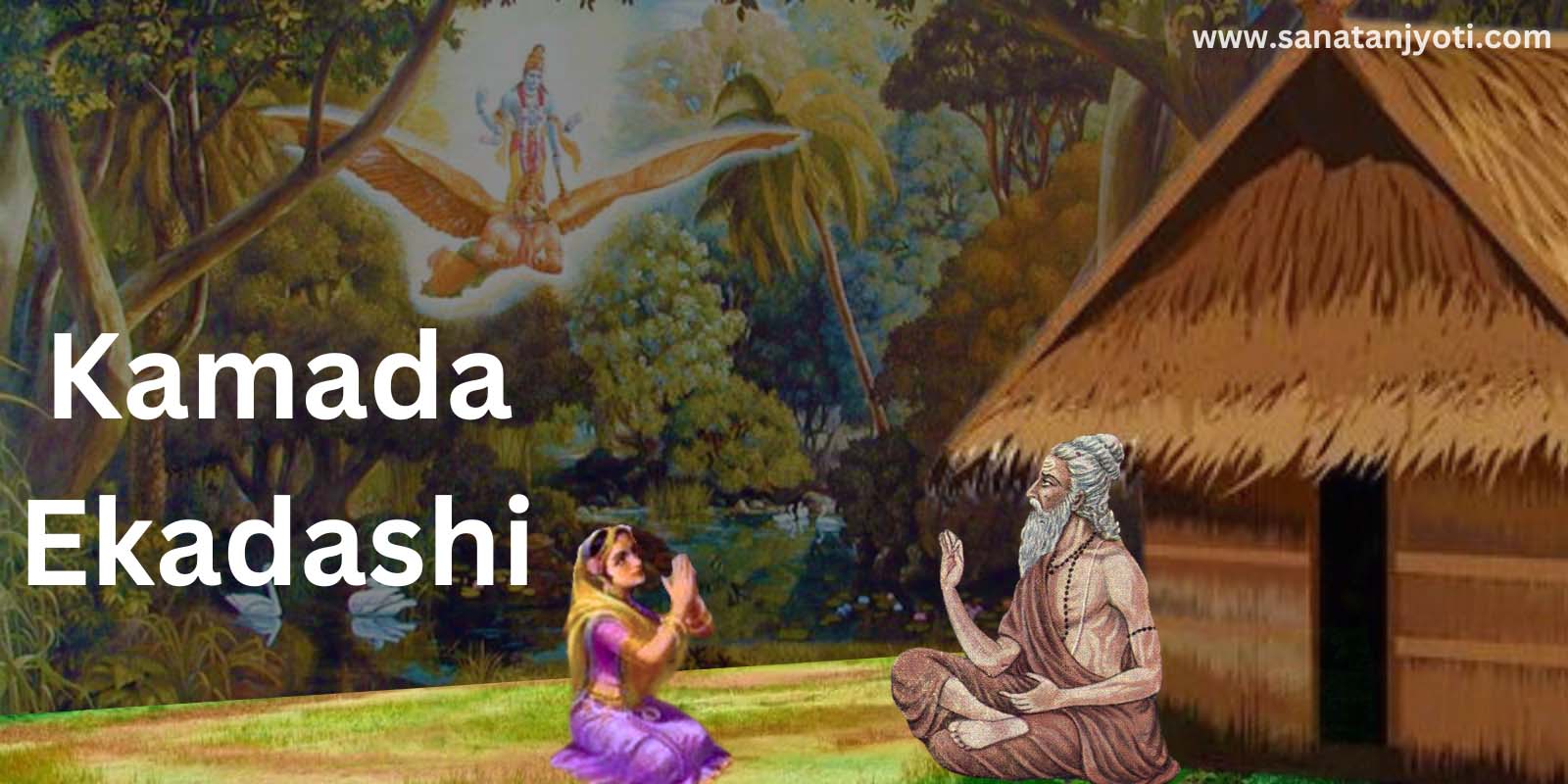
While wandering through the forest, she came across a beautiful hermitage. A peaceful and compassionate sage was sitting there. He had no enmity toward any living being. Lalita quickly approached him, bowed before him and stood respectfully in front of him.
Seeing Lalita in distress, the sage asked, “Who are you, and how did you come here? Tell me the truth.”
Lalita replied, “O great sage! My husband is a Gandharva, and my name is Lalita. Because of his sin, my husband has been transformed into a demon. I cannot find peace after seeing him in this condition. Please tell me of a way through which my husband can be freed from this demonic form.”
The sage said, “The Kamada Ekadashi of the Shukla Paksha of Chaitra is approaching. This Ekadashi is considered highly meritorious and is believed to destroy sins. Observe this Ekadashi Vrat according to the prescribed rituals and dedicate the merit earned from the Vrat to your husband. By doing so, your husband may be freed from the effects of the curse.”
Hearing the sage’s words, Lalita was overjoyed. She observed the Kamada Ekadashi Vrat with devotion and, on Dwadashi, dedicated the merit of her Vrat before Lord Vasudeva for the liberation of her husband.
Lalita said, “Through the merit of the Kamada Ekadashi Vrat that I have observed, may my husband be freed from his demonic state and released from this curse.”
Sage Vashishtha says that as soon as Lalita spoke these words, Lalit was freed from his sins. He assumed a divine form, his demonic state disappeared, and he regained his original Gandharva form.
After this, both husband and wife, through the influence of Kamada Ekadashi, assumed even more beautiful forms than before. They boarded a celestial aircraft and appeared radiant and magnificent.
According to religious beliefs, Kamada Ekadashi Vrat is observed with the intention of seeking freedom from sins and negative karma. It is also believed that reading and listening to the glory of Kamada Ekadashi brings spiritual merit.
Kamada Ekadashi Puja Vidhi
Lord Shri Krishna said to Yudhishthira, “O King! Listen, I will tell you the auspicious procedure for observing this Vrat.”
Traditionally, preparations for the Kamada Ekadashi Vrat begin from Dashami Tithi. On Dashami, devotees are advised to take a bath in the morning. After this, they traditionally have one meal at midday with a focused mind and follow the practice of sleeping on the floor at night.
On Ekadashi, after completing the morning routine, take a bath and meditate upon Lord Vishnu. Then take the Sankalp for the Vrat with devotion.
The following Mantra is traditionally recited at the time of Sankalp:
Adya sthitva niraharah sarvabhogavivarjitah.
Shvo bhokshye Pundarikaksha sharanam me bhavachyuta.
Meaning:
O Lotus-Eyed Lord Narayana! Today, I will give up all worldly pleasures and remain without food. O Achyuta, please grant me refuge at your feet.
After this, worship Lord Vishnu according to the prescribed rituals before the Shaligram Shila. Offer incense, lamps, sandalwood, flowers and other Puja materials, and meditate upon Lord Hari while chanting His Mantras.
According to one’s capacity, devotees may honor Brahmins, offer them food and give donations and Dakshina. At night, the tradition of keeping vigil and remaining engaged in devotion near Lord Hari is also followed.
On Dwadashi, worship Lord Shri Hari again with devotion in the morning and observe Parana according to one’s tradition and the local Panchang.
Have Questions About Kamada Ekadashi Vrat, Puja Vidhi, Mantras, Parana or Religious Rituals?
What to Do During Kamada Ekadashi Vrat?
On Kamada Ekadashi, devotees may worship Lord Vishnu or Shri Krishna. Fast according to your capacity and health, and spend the day remembering the Lord, chanting Mantras, listening to Bhajans and Kirtans, and hearing religious stories.
During the Puja, devotees may offer incense, lamps, flowers, sandalwood and other Puja materials to Lord Vishnu. According to religious traditions, staying awake at night and remembering the Lord is also considered significant.
The next day, on Dwadashi, worship Lord Shri Hari and then break the fast according to the prescribed Parana procedure.
Vrat rules may differ among different traditions. Therefore, it is advisable to follow the rules of the Vrat while keeping your physical capacity and health in mind.
Religious Significance of Kamada Ekadashi
Kamada Ekadashi is considered an important Ekadashi associated with devotion to Lord Vishnu and the desire for freedom from sins. Its Vrat Katha describes how Lalita observed Kamada Ekadashi to liberate her husband, Lalit.
According to religious beliefs, the merit of this Vrat freed Lalit from his demonic form and helped him regain his original Gandharva form. For this reason, Kamada Ekadashi is considered significant for those who observe the Vrat with the intention of seeking relief from difficulties, sins and negative influences.
On this day, special importance is traditionally given to the worship of Lord Vishnu, fasting, Mantra chanting, listening to the Vrat Katha and keeping a night vigil.
Kamada Ekadashi Vrat Parana
The Parana of Kamada Ekadashi Vrat is performed on Dwadashi Tithi. On Dwadashi, devotees traditionally worship Lord Vishnu in the morning and then break the fast according to the Parana time given in the local Panchang.
The Parana timing may vary depending on the location. Therefore, devotees observing the Vrat in 2027 should confirm the Parana time according to the Panchang applicable to their city.
Kamada Ekadashi is an important Ekadashi that falls during the Shukla Paksha of the month of Chaitra. Its Vrat Katha describes the story of Lalita and Lalit, narrated by Lord Shri Krishna to Yudhishthira.
According to religious beliefs, Kamada Ekadashi Vrat is observed with the intention of seeking freedom from sins, receiving the blessings of Lord Vishnu and fulfilling one’s wishes. On this day, devotees worship Lord Vishnu or Shri Krishna, observe the Vrat, chant Mantras, listen to the Vrat Katha and keep a night vigil.