
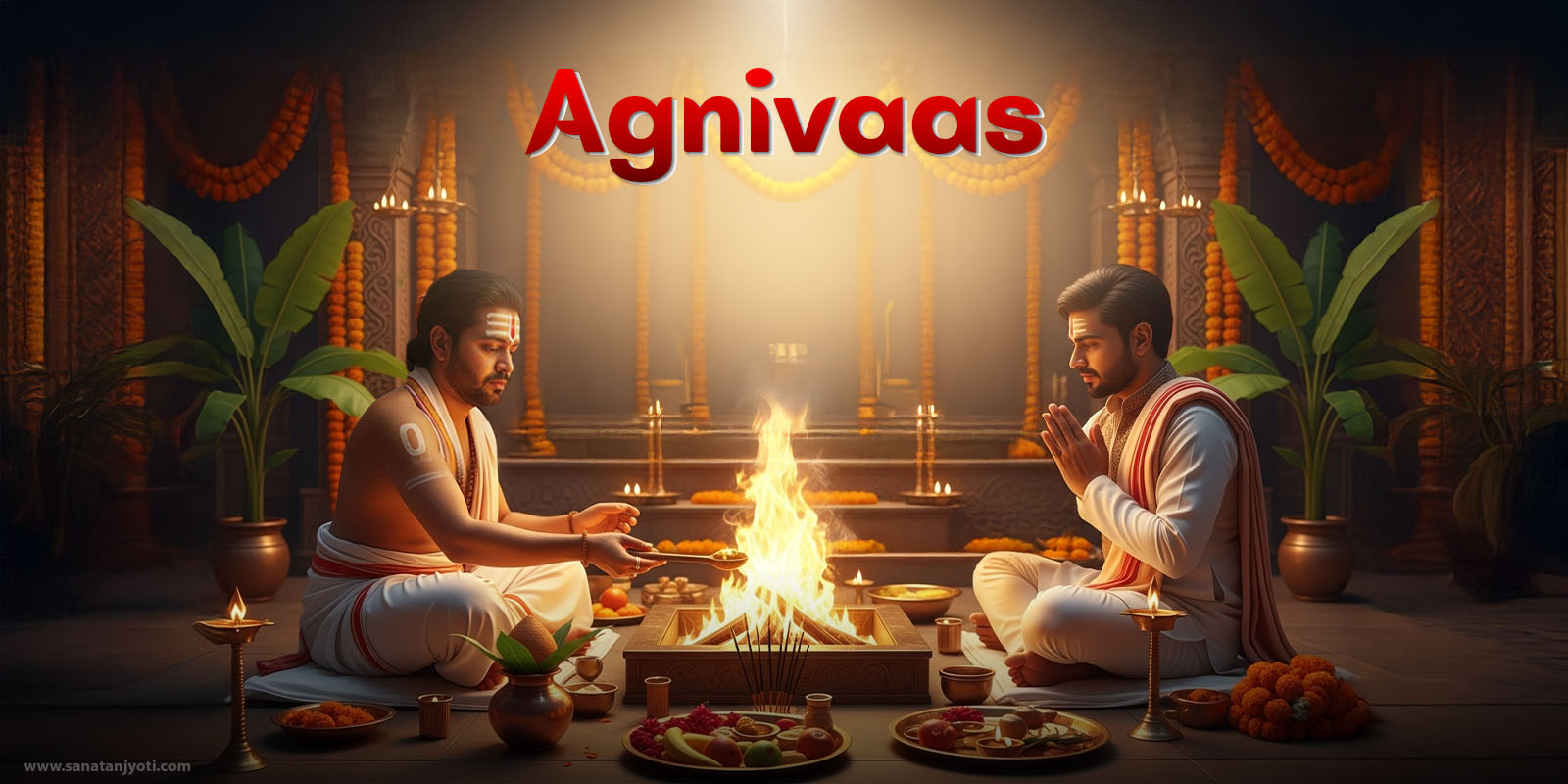
In Sanatan Dharma, Agni is considered one of the five elements and is worshipped as a deity. Agni Dev holds a special place in all important rituals of our life, such as marriage and Yajna.
But do you know that before starting a Havan, it is very important to know where Agni Dev is residing at that particular time? This placement of Agni is called Agnivaas. Based on the location of Agni’s residence, it is decided how successful and fruitful your Havan will be. Let us understand this ancient and important rule in simple words. For invoking the presence of Agni Dev and attaining the complete benefits of the Yajna,consulting an expert Acharya for the precise calculation of Agnivas is highly beneficial.
What is Agnivaas and its importance?
The direct meaning of Agnivaas is the place of residence of Agni. According to religious beliefs, Agni Dev resides in different places (or lokas) depending on the day and time. Before performing a Havan, we must know whether Agni is in an auspicious place or an inauspicious place.
• Auspicious Agnivaas (Prithvi Loka):
When Agni Dev resides in the earthly realm, it is considered the most auspicious time for performing a Havan. Any Havan performed during this period is highly successful and fruitful. It brings happiness, prosperity, good health, and fulfills all your desires.
• Inauspicious Agnivaas (Aakash Loka or Paataal Loka):
When Agni Dev resides in the sky or in the netherworld, it is considered inauspicious for performing a Havan. At such times, the Havan does not bring good results, but rather may cause difficulties, obstacles, losses, or failures.
Therefore, to ensure the success of your Havan and to receive its complete benefits, it is very important to calculate the correct Agnivaas.
How to Calculate Agnivaas?
To calculate Agnivaas, you will need two things: Tithi number and Day number. With the help of a religiousPanchang, you can easily determine these numbers.
Day numbers are as follows:
Sunday = 1, Monday = 2, Tuesday = 3, Wednesday = 4, Thursday = 5, Friday = 6, Saturday = 7
The calculation of Agnivaas depends on the Tithi and the Paksha (Krishna or Shukla). People often choose timing based onShubh Choghadiya, but the calcul ation of Agnivas is different and more important.
1. In Shukla Paksha (From Amavasya to Purnima)
If you want to perform a Havan on any Tithi of Shukla Paksha, then follow this method:
- Note down the number of the Tithi on which you are performing the Havan.
- Add the Day number of that date.
- Then add 1 more.
- Now divide the total number by 4.
Example: Suppose today is the 5th Tithi of Shukla Paksha (5) and the day is Tuesday (3).
Calculation:
(5 + 3 + 1) = 9 Now divide 9 by 4 → 9 ÷ 4 = 2, remainder = 1. This means that Agni is residing in the Aakash Loka (Sky realm).
2. In Krishna Paksha (From Purnima to Amavasya)
If you want to perform a Havan on any Tithi of Krishna Paksha, then follow this method:
- Note down the number of the Tithi on which you are performing the Havan.
- Add the Day number of that date.
- Now divide the total number by 4.
Example:
Suppose today is the 8th Tithi (Ashtami) of Krishna Paksha (8), and the day is Saturday (7).
Calculation:
(8 + 7) = 15 Now divide 15 by 4 → 15 ÷ 4 = 3, remainder = 3. This means Agni is residing in the Prithvi Loka (Earthly realm).
Result of Agnivaas According to Remainder
After dividing, the number that remains (0, 1, 2, or 3) shows the position of Agni (fire element) and tells whether the time is favorable or unfavorable for performing a havan (fire ritual).
Very Auspicious (Highly Favorable)
• Remainder 0 or 3 — Agni in Prithvi Lok (Earth realm)
This is considered the best position for performing a havan. It brings happiness, prosperity, and positive results.
Inauspicious (Unfavorable)
• Remainder 1 — Agni in Akash Lok (Sky realm)
Performing a havan at this time can bring obstacles, delays, and difficulties.
• Remainder 2 — Agni in Patal Lok (Netherworld)
This time can cause financial loss and other negative outcomes.
Note:
• Remainder 0 and 3 mean that Agni is in the Earth realm, which is the most auspicious and beneficial for havan.
• Remainder 1 and 2 are considered inauspicious, so it is better to avoid havan at these times.
When is it not necessary to check Agnivaas?
For certain special types of Havans and religious rituals, it is not necessary to check Agnivaas, as these rituals are considered auspicious in themselves. Such works include:
• Nitya Havan: Daily Havans performed regularly.
• Sanskaras: Ceremonies like Upanayan (sacred thread ceremony) and marriage, etc.
• Peace and Prosperity Rituals: Activities performed to eliminate illness or to bring peace and prosperity into life. If you are performing a Havan for a specific purpose, it is essential to follow the completeWorship procedureproperly.
Therefore, performing important rituals like Havan only after calculating Agnivas and selecting the properauspicious timeensures you receive complete benefits and that your worship is successful. In case of any doubt, you should consult knowledgeable Acharyas for properMuhurat guidance.