
Sanatan Logo
Ganesh Logo
Kanaka Dhara Stotram

What is Kanak Dhara Stotram recitation?

The Kanakadhara Stotram is a powerful hymn dedicated to Goddess Lakshmi, the goddess of wealth. The word "Kanak" means gold, and "Dhara" means flow or shower. So, Kanakadhara Stotram means “a hymn that brings a shower of gold.”

It was composed by the great saint Adi Shankaracharya to please Goddess Lakshmi. This stotram is very dear to the Goddess and is believed to remove poverty and attract wealth and prosperity.

By regularly chanting the Kanakadhara Stotram, a person can receive the blessings of Goddess Lakshmi, get rid of financial difficulties, and experience overall well-being. It is also known as a Debt-Relief and Auspicious Hymn, and those who sincerely recite it are believed to gain wealth and freedom from all kinds of troubles.

Origin of Kanakadhara Stotram recitation

The Kanakadhara Stotram was first chanted by the great spiritual teacher Adi Shankaracharya. It is said that Goddess Lakshmi was so pleased by his prayer that she showered wealth in the courtyard of a poor Brahmin woman. Here's the sacred and inspiring story behind it:

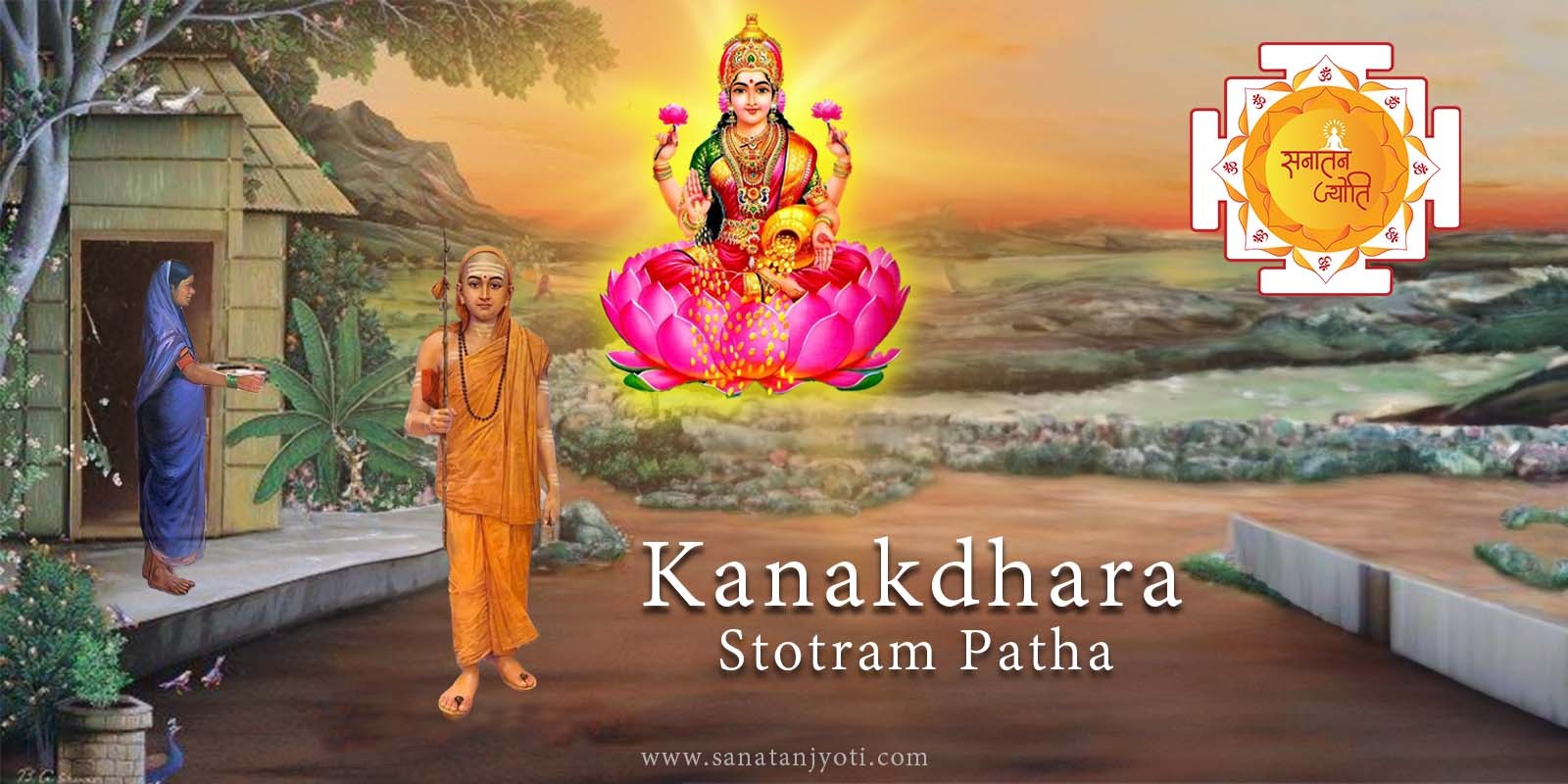
Once, Adi Shankaracharya went to a Brahmin household to ask for alms (bhiksha). The Brahmin was very poor but deeply honest and religious. When the Brahmin’s wife saw the saint standing at their door—looking wise and radiant—she was filled with respect but also confusion, because she had nothing to offer him.

After searching her small home carefully, she found a single amla (gooseberry) fruit. With humility and devotion, she brought it to the young ascetic Shankaracharya and offered it to him with great hesitation and reverence, feeling sorry that she couldn’t give more.

Acharya Shankaracharya understood the poor condition of the Brahmin woman. But seeing her selfless spirit of giving, he was deeply moved and impressed. Her difficult situation filled his heart with sorrow, and he felt great compassion for her.

He decided in his heart that he would pray to Goddess Lakshmi, the goddess of wealth, and try to please her—so that she would bless the kind Brahmin woman and free her from her poverty. Acharya Shankaracharya was determined to help her through his devotion and powerful prayer.

So, Acharya Shankaracharya began to lovingly praise Goddess Lakshmi, the consort of Lord Narayana and the divine ruler of wealth and prosperity. Touched by his heartfelt devotion, Goddess Mahalakshmi appeared before him in her radiant, divine form that enchants all three worlds.

With a gentle and sweet voice, she asked, “O great sage Shankaracharya, why have you remembered me today?”

Acharya first offered his respects to the Goddess and then, with deep sorrow, described the miserable condition of the poor Brahmin woman. He humbly prayed to Goddess Lakshmi, saying,

“O Mother, please have mercy on this poor Brahmin family and bless them with your grace.”

Hearing Acharya Shankaracharya’s heartfelt prayer, Goddess Lakshmi gently replied,

“O great sage, it is not written in that Brahmin’s destiny to receive wealth in this lifetime.”

But Acharya humbly and compassionately pleaded again, saying,

“Mother, it is true that this Brahmin may not have done any good deeds or charity in his past life to deserve wealth now. However, in this life, he gave a single amla (gooseberry) to a poor monk like me with a pure and selfless heart. That one act of kindness is a great virtue.”

Acharya then lovingly and respectfully requested Goddess Lakshmi once more to show her mercy.

Seeing the depth of Acharya’s compassion and devotion, Goddess Lakshmi could not deny his request. Moved by his plea, she blessed the poor Brahmin woman — and showered gold into her home.

From that day, the Brahmin's poverty ended, and he and his family became prosperous. Because of this divine event — the rain of gold — the hymn composed by Shankaracharya came to be known as “Kanakadhara Stotram”,

where “Kanak” means gold, and “Dhara” means a flow or shower.

Kanaka Dhara Stotram

Kanakdhara Stotram pleases Goddess Lakshmi, removes poverty, brings sudden wealth, and blesses life with peace, prosperity, and abundance.

Price : INR 2100/-

By continuing with the payment, you accept and agree to our Anushthan Policy.

singleSVG

5+ Years Experience

50+ Types of Puja

groupSVG

50+ Expert

Send us a message now for contact!WhatsApp+91 9219765437
Frequently Asked Questions
What is the Good time of the day of Anusthan? +
Generally, the most auspicious times for performing rituals and ceremonies are the Abhijit Muhurat, Brahma Muhurat, sunrise, and sunset. However, if you are conducting a ritual for a specific purpose, it is crucial to select an auspicious Muhurat for its commencement.
The determination of an auspicious Muhurat is based on astrological factors such as Tithi, Vaar, Nakshatra, Yoga, and Karana.
Starting the ritual during an auspicious Muhurat not only enhances its effectiveness but also multiplies the benefits of your spiritual practice and divine blessings.
What is the Place to perform the Anushthan? +
One should choose a place for the ritual (Anushthan) that is pure, calm, and sacred. This place could be your home's prayer room, a temple, or any location where the atmosphere is filled with spiritual peace and positive energy. If the ritual involves a fire offering (Havan) or any specific procedure, it is advisable to choose an open and well-ventilated space. Additionally, the selection of the place should align with the nature of the ritual. For example, daily prayers are typically performed in the home's prayer room, while larger rituals are more suitable for a temple or an open space.
The sacredness and organization of the place not only ensure the success of the ritual but also transform it into a positive and spiritual experience.
Who can perform the Anushthan? +
A ritual (Anushthan) cannot be performed by an ordinary person; it can only be conducted by someone who has received Guru Diksha. In rituals performed for special purposes, the correct pronunciation of Vedic mantras is extremely important. Since ordinary people are not proficient in the accurate pronunciation of Vedic mantras, it is beneficial and effective to conduct the ritual with the assistance of an experienced Acharya. This is also stated in the scriptures.
Does one himself benefit by doing Jap-Anusthan for others? +
Yes, performing Japa (chanting) and rituals for others also brings spiritual benefits to oneself. By doing so, a person's energy is purified, the balance of the mind is enhanced, and positivity is generated. It serves as a means of both spiritual welfare and self-well-being.
What does the Anushthan involve? +
Generally, the materials used in any ritual (Anushthan) include a lamp (deepak), incense sticks (agarbatti), flowers, sandalwood, offerings (naivedya), and ritual materials for the fire offering (Havan), if included. In addition, the intent and devotion of the person performing the ritual (the one performing the ritual for the welfare of the soul, family, or society) are considered the most important.
After the ritual, the distribution of prasad is a necessary step, symbolizing the divine blessings among all devotees. However, it is important to note that many rituals are performed to achieve specific purposes, such as peace, success, health, or to gain the grace of particular deities. In such cases, the materials used may vary according to the purpose. For example, some rituals may involve the use of specific fruits, herbs, or garments.
Thus, the materials and process of each ritual are determined in accordance with the purpose and tradition of that ritual.
What do if my Anushthan is interrupted? +
If for any reason your ritual (Anushthan) gets interrupted, take it seriously and try to resume the ritual with purity. Follow these steps if an obstacle occurs:
  • Restoring Purity: Cleanse the ritual space by sprinkling Ganga water or any sacred water. Take a bath yourself, and return to the ritual with both mental and physical purity.
  • Seeking Forgiveness: Ask for forgiveness from your chosen deity or Ishta and humbly pray to them to forgive any unintentional mistakes or obstacles that occurred. This shows your humility and devotion.
  • Consulting an Experienced Acharya: For properly restarting the ritual and resolving any faults, seek guidance from an experienced Acharya or priest. They can provide you with the right solutions or mantras.
  • Reaffirming the Sankalpa (Vow): If you made a vow (Sankalpa) at the start of the ritual, make sure to fulfill it. Not completing your Sankalpa could bring inauspicious results.
  • Maintain Patience and Faith: Complete the ritual with patience and devotion, despite the obstacles. This demonstrates your faith and dedication.
Purity, rules, and discipline are extremely important in a ritual. It not only boosts your morale but also reflects your loyalty to the deity you worship. Don’t panic when an obstacle arises; instead, accept it as a positive experience and complete the ritual with full devotion.
How much time it will takes any anushthan? +
The time for a ritual (Anushthan) can vary depending on its nature, purpose, and complexity. Simple prayers or brief religious rituals are typically completed within a few hours. On the other hand, special rituals, such as Yajnas, can last for several months due to their procedures, mantra chanting, fire offerings (Havan), and other religious processes. These rituals include mantra chanting, Havan, and various other religious activities.
Are you providing Anushthan samagari(Hawan Samidha)? +
Sanatan Jyoti provides all the materials required for the ritual (Anushthan) for its devotees and ensures that the materials are completely pure.
If you do not have the time to perform the ritual or are concerned about the arrangements, Sanatan Jyoti takes on this responsibility with full dedication and according to the proper procedures. Whether it is the ritual materials, arranging qualified astrologers and priests, or any other necessary preparations, Sanatan Jyoti handles every aspect, allowing you to complete your religious duties without any worries.
What are the number of ‘Ahutis’ prescribed for various types of Anusthans? +
The offerings (Ahutis) for a ritual (Anushthan) can vary depending on its nature, purpose, and complexity. In simple prayers or rituals, a few offerings are sufficient, while for special purposes, such as during rituals and Yajnas, more offerings are made. Each offering has its own specific purpose, which enhances the effectiveness and the spiritual merit (Punya) of the ritual.
Will I benefit from a ritual performed away from home? +
Yes, absolutely! Even if your ritual is performed away from home or at another location, you will still receive its full benefits. Performing the ritual at places where chanting of mantras, Havan, and other religious activities are regularly conducted is often more effective. In such sacred places, the divine energy remains active and awakened, which enhances the spiritual impact of the ritual.
Whether your ritual is hundreds or thousands of kilometers away from your home, you will receive the full result, as the ritual is carried out with full adherence to the procedures, keeping your name, family lineage (Gotra), and purpose in mind. Your faith and devotion make this process even more powerful.
How to contact Sanatan Jyoti for a ritual (Anushthan)? +
Contacting Sanatan Jyoti for ritual-related services is very easy. You can visit our official website www.sanatanjyoti.com to get all the necessary information about rituals and book your ritual.
Additionally, you can connect with us via email, chat, or call. Our team is always ready to assist you, ensuring that your religious rituals are carried out smoothly and that you receive their full spiritual benefits.
Where can Vedic rituals be performed to overcome life’s challenges?+
At Sanatan Jyoti, expert priests conduct specific rituals for every challenge—be it peace for planets, debt relief, business growth, health, or marriage. Every ritual is performed with proper mantras and scriptural methods. The aim is not just solutions but also peace, prosperity, and positive energy in life.
Where can I find experts for Vedic rituals focused on personal growth?+
At Sanatan Jyoti, qualified priests perform rituals for personality growth, success, and mental peace. They not only chant mantras with accuracy but also follow every step as per scriptures. Each ritual is customized to your horoscope and goals, bringing visible positive changes in life.

Contact Us

'Sanatan Jyoti' is dedicated to the welfare of humans and all living beings. To connect with us or for more information, please email us or fill out the form – your message will be responded to promptly.

Emailcare@gauritechtrade.com
mobile+91 9219765437
company addressGauritechtrade Consulting Private Limited
Plot No. 117, Ramganga Housing Society, Tikra Naramau Kanpur Nagar, Bagdaudhi Kachhar, Bithoor, Kanpur Nagar, Uttar Pradesh, 209217
Connect with Us
Youtube
Facebook
Instagram
Astrologer
Talk to us